
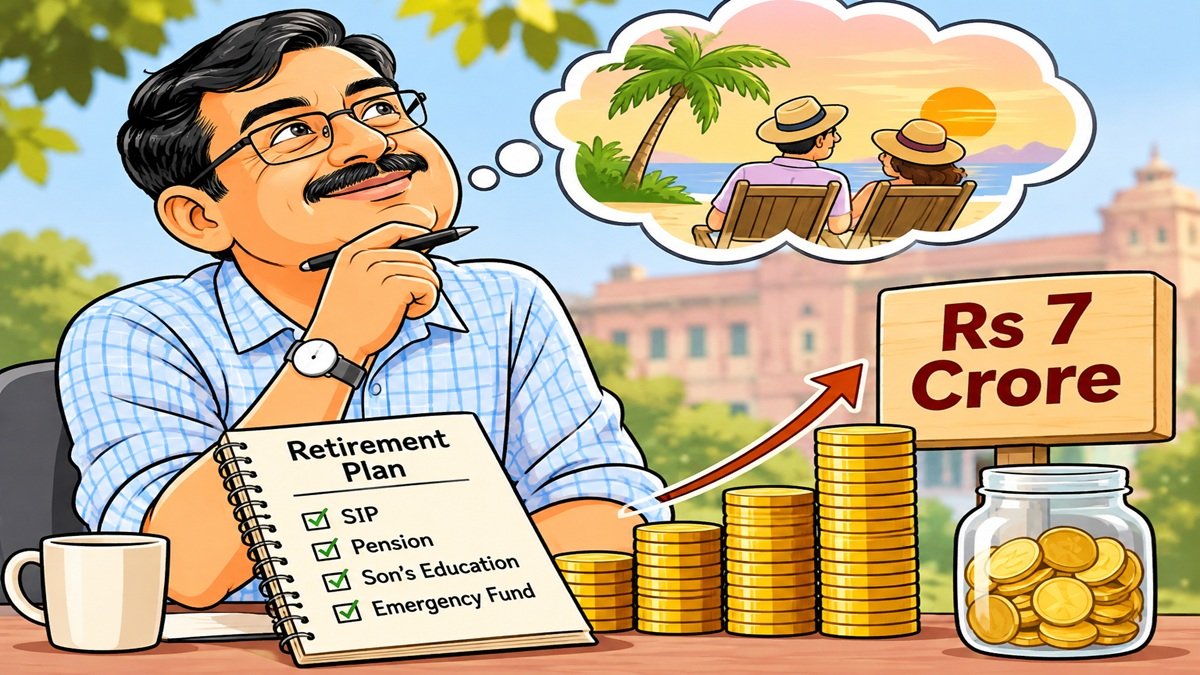
When I first looked at Rajiv Solanki’s investment journey, one number stood out. At 43, he has already built a mutual fund corpus of around Rs 32 lakh through systematic investment plans. He started with Rs 10,000 a month about a decade ago and has gradually increased his SIP to Rs 26,000.
His next milestone is much bigger. He wants to build a retirement corpus of Rs 7 crore by the time he turns 60.
On the face of it, this looks like a familiar story of disciplined investing. A salaried individual starts small, increases investments as his income grows and allows compounding to do its job.
But when I started examining his numbers more closely, I realised that there was much more to his financial journey than just SIPs and expected returns.
Rajiv, 43, works as a Senior Divisional Accountant in the Rajasthan Public Works Department in Jaipur. His monthly salary is around Rs 1.55 lakh. His wife is a homemaker, and they have a 14-year-old son. He also has responsibilities towards his parents.
He owns a flat in Jaipur and pays an EMI of around Rs 18,000. His monthly household expenses, including the home loan EMI, are approximately Rs 82,000. After meeting these expenses, he is left with around Rs 55,000.
His SIP has increased from Rs 10,000 to Rs 26,000 over ten years, largely through annual increases of around 10%. He has invested approximately Rs 19 lakh, and the portfolio is now worth around Rs 32 lakh.
His journey made me revisit some basic but important questions about wealth creation. How much should one invest? How realistic are long-term return expectations? Is a large retirement corpus always necessary? And are we accounting for all our sources of retirement income?
Here are 6 lessons I learnt while examining his financial plan.
1. Increasing your SIP gradually can make wealth creation easier
One thing I liked about Rajiv’s investment journey was that he did not start with an unusually large SIP.
He began with Rs 10,000 a month and increased it as his income grew. His current SIP stands at Rs 26,000.
This is a practical approach for salaried individuals who may not have enough surplus income at the beginning of their careers.
For someone starting with a modest salary, committing a large amount towards investments can become difficult. Household expenses, rent, home loans and family responsibilities can leave little room for savings.
A gradual increase in SIPs can make the process more manageable.
However, there is an important distinction between increasing an SIP occasionally and making it a regular habit.
In Rajiv’s case, the 10% annual increase has helped him take his monthly investment from Rs 10,000 to Rs 26,000. This is a habit worth building, particularly when salary increments come in.
My takeaway is simple. Do not wait until you can afford a very large SIP. Start with an amount you can sustain and increase it as your income rises.
But remember that the increase should be linked to your actual cash flow. A 10% annual step-up should not become a financial burden when expenses or family responsibilities rise.
2. Do not build your retirement plan around optimistic returns
Rajiv’s existing portfolio of Rs 32 lakh has generated an estimated annualised return of around 11.5%, based on his investment history.
That is a reasonable outcome for a long-term equity-oriented investment portfolio.
However, he expects his investments to generate 13-14% returns over the next 17 years.
This is where I felt his plan needed a reality check.
Equity mutual funds can generate attractive returns over long periods, but there is no guarantee that the market will deliver a particular return every year or even over the entire investment period.
A retirement plan should not depend on the assumption that markets will consistently perform at the upper end of one’s expectations.
I ran the numbers assuming that Rajiv continues his existing Rs 26,000 monthly SIP, increases it by 10% every year and keeps his existing Rs 32 lakh invested.
The estimated corpus at age 60 looks like this:
| Assumed annual return | Estimated corpus |
|---|---|
| 11% | Rs 4.7 crore |
| 12% | Rs 5.2 crore |
| 13% | Rs 5.8 crore |
| 14% | Rs 6.5 crore |
Source: Author’s calculations based on investor data and assumed returns.
Even at 14%, he falls short of his Rs 7 crore target by around Rs 50 lakh.
To reach the target with his current investment trajectory, he would need returns of approximately 14.6% annually for the next 17 years.
That is a demanding assumption.
One alternative is to increase his starting SIP to around Rs 41,500 a month and continue the 10% annual step-up. At an assumed 12% return, this could take his corpus close to Rs 7 crore.
But this also means increasing his monthly investment by around Rs 15,500.
The larger lesson for investors is that there are two ways to improve the probability of reaching a financial goal: increase contributions or give investments more time. Depending entirely on higher returns is not a sound strategy.
3. A big retirement corpus is not necessarily the right retirement target
This was probably the most important lesson from Rajiv’s case.
When someone says they want Rs 5 crore, Rs 7 crore or Rs 10 crore by retirement, the immediate question is whether their investments can generate that amount.
But I realised that the more important question is whether they actually need that much money from their investments.
Rajiv works in the Rajasthan government and may be covered under the Old Pension Scheme.
Rajasthan brought back the Old Pension Scheme in 2022 for employees appointed on or after January 1, 2004. Under the scheme, eligible employees generally receive a pension linked to their last drawn basic pay, along with dearness relief.
Rajiv has been in government service for around 20 years. His exact eligibility and pension entitlements need to be verified from his service records.
If he is covered, his retirement calculations could look very different.
A regular pension can provide an important source of income after retirement. This means his mutual fund portfolio may not have to fund all his monthly expenses.
Instead, his investments could be used for his son’s higher education, medical expenses, travel, major purchases and other financial goals.
This is a distinction many investors overlook.
A private-sector employee without a guaranteed pension may need a larger retirement corpus to generate regular income. A government employee with pension benefits may have a different requirement.
The retirement target should reflect the income sources available after retirement, not just an arbitrary large number.
4. Do not let your child’s education disrupt your retirement investments
Rajiv’s son is currently 14. This means higher education expenses will begin becoming a reality in about four years.
That is an important financial milestone.
His current investment plan assumes that he will increase his SIP by 10% every year for the next 17 years. But what happens when college fees, hostel expenses and other education-related costs start rising?
Will he still be able to maintain the same SIP increase?
This is where financial planning needs to go beyond a single investment target.
Parents often focus on retirement because it involves a large amount of money and a long investment horizon. But children’s education is a nearer financial goal and can require substantial funding.
If the education goal is not planned separately, parents may eventually have to reduce their retirement investments or withdraw from their long-term portfolio.
That can disturb the power of compounding.
My takeaway is that retirement and children’s education should have separate financial plans.
The education corpus should be built according to the expected year of admission and the likely cost of the course. The retirement portfolio should ideally remain untouched.
Investors should also review the asset allocation of each goal as the deadline approaches. Money required in four years should not be exposed to the same level of market risk as money meant for retirement after 17 years.
5. Do not confuse the money left in your bank account with investible surplus
Rajiv earns around Rs 1.55 lakh a month and says he is left with approximately Rs 55,000 after household expenses.
His current SIP is Rs 26,000.
This leaves some room for additional investments, but I would not automatically treat the entire remaining amount as available for a higher SIP.
He has responsibilities towards his parents, a son whose education expenses will rise and an outstanding home loan.
There could also be medical expenses, unexpected family requirements and other irregular costs.
This is why calculating monthly expenses alone is not enough. Investors should also account for annual expenses, emergency requirements and upcoming financial commitments.
Before increasing his SIP to Rs 41,500, Rajiv should check whether he has an adequate emergency fund and sufficient health and life insurance.
An emergency fund is particularly important for a family with one earning member. It can help prevent long-term investments from being disturbed when an unexpected expense arises.
A financial plan should be sustainable even when life does not go according to schedule.
6. Review your financial plan whenever your life circumstances change
One thing that stood out to me was how much Rajiv’s financial responsibilities have changed over the years.
He started investing around ten years ago. At that time, his son was younger, his salary was lower and his retirement was further away.
Today, he earns more, has built a sizeable mutual fund portfolio and is closer to important financial milestones.
But his responsibilities have also increased.
This is why a financial plan should not remain static.
An investor who starts with a 20-year retirement horizon cannot simply continue with the same assumptions when only 10 years are left.
Salary increases, home loans, children’s education, healthcare requirements, changes in pension eligibility and market performance should all be factored into periodic reviews.
There is another aspect worth remembering. A target of Rs 7 crore after 17 years will not have the same purchasing power as Rs 7 crore today.
At an illustrative inflation rate of 6%, Rs 7 crore received after 17 years would be worth approximately Rs 2.6 crore in today’s money.
This does not mean the target is inadequate or excessive. It means investors should first decide whether their financial goal is expressed in today’s purchasing power or as a future nominal amount.
That distinction can change retirement calculations significantly.
The bigger lesson: Retirement planning is not just about building a corpus
Rajiv’s financial journey reinforced something I have come across repeatedly while examining personal finance case studies.
People often focus on the final number. They want to become crorepatis, build a Rs 5 crore portfolio or retire with Rs 10 crore.
But the number alone does not tell us whether someone is financially prepared for retirement.
What matters is how much money they will need, what income they can expect after retirement, what liabilities they will carry and whether they can meet their financial goals without putting excessive pressure on their present lifestyle.
Rajiv has already done several things right. He started investing early, increased his SIP as his income grew and stayed invested through different market conditions.
The next step is not necessarily to chase higher returns or stretch his monthly investments.
It is to get his retirement calculations right, verify his pension eligibility and create a separate plan for his son’s education.
For me, that is the biggest takeaway from his story.
Wealth creation is important, but knowing how much wealth you actually need is equally important.
Disclaimer:
The corpus projections and return estimates mentioned in this article are illustrative and based on assumed rates of return. Mutual fund investments are subject to market risks, and actual returns may vary. The pension benefits discussed are subject to the employee’s eligibility and applicable government rules. Investors should assess their financial goals, risk appetite and investment horizon before making investment decisions.
Every financial journey has a turning point. What’s yours?
Financial Express is launching a new series highlighting real experiences with money, investments, and the taxman. Did a sudden tax rule catch you off guard? Did a piece of financial advice change your life? Your story could provide invaluable, practical lessons for thousands of fellow taxpayers. Share your experience with us. We respect your privacy: no stories will be featured without a direct conversation and your full consent. Thank you.