
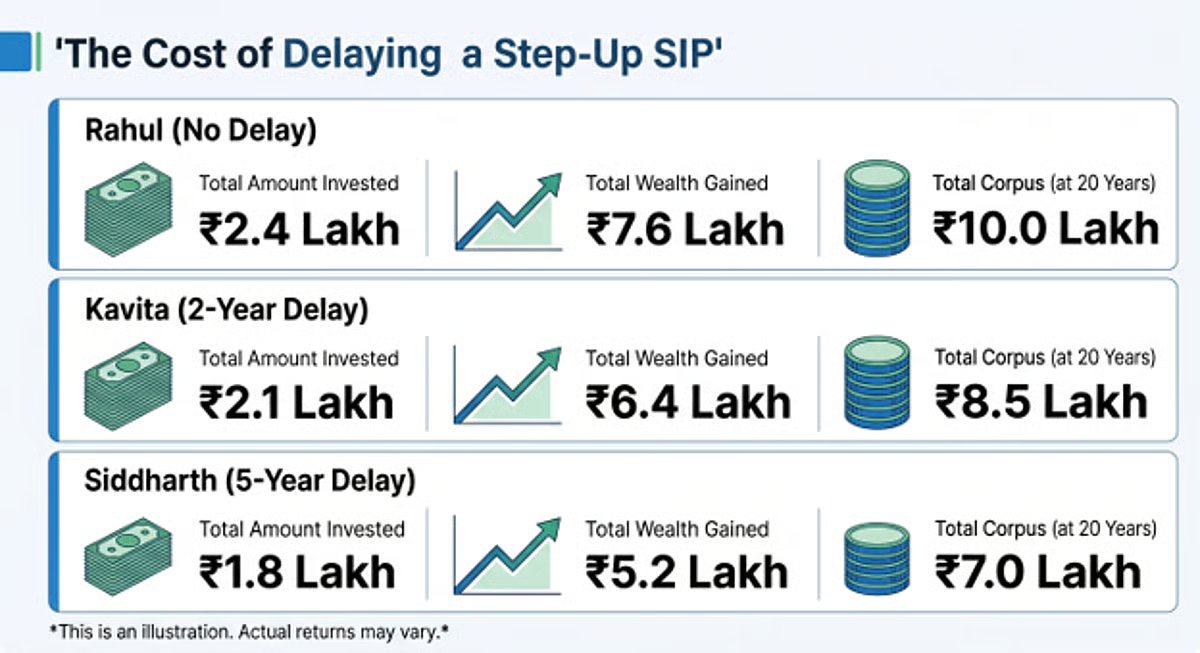
A Step-Up SIP allows investors to increase their SIP contribution periodically as their income and financial capacity grow. Starting the increase earlier can give the additional investments more time to participate in market-linked growth. Delaying the step-up may therefore reduce the potential corpus, even when the total investment period remains unchanged.
What Is a Step-Up SIP?
A Step-Up SIP is a facility that enables an investor to increase the amount invested through a Systematic Investment Plan at predefined intervals. The increase may be structured as a fixed amount or a specified percentage of the existing SIP contribution.
It allows investors to progressively increase their investments over time in line with changes in income, cash flows or financial goals, while continuing with a systematic investment approach.
How Does Delaying a Step-Up SIP Affect the Corpus?
When an investor postpones increasing their SIP, they continue investing the existing SIP amount for a longer period. The additional amount that could have been invested through a higher SIP therefore enters the portfolio at a later stage. For example, an investor may be investing ₹10,000 every month and later decide to increase the SIP to ₹12,000. If the investor postpones this increase for two years, the SIP continues at ₹10,000 during that period. The additional ₹2,000 per month starts getting invested only after the investor increases the SIP.
The Timing of Higher Contributions Matters
The impact of delaying the increase is not limited to the additional amount invested later. The timing of those additional investments also matters. An amount invested earlier has a longer period to potentially grow and compound, subject to market performance. As a result, continuing with the lower SIP for longer and increasing it at a later stage can lead to a different long term corpus compared with increasing the SIP earlier. The difference will depend on the amount of the increase, the length of the delay, the remaining SIP investment period and the returns generated during the respective periods.
Factors to Consider When Reviewing a Delayed Step-Up SIP
Whether an investor should increase the SIP after a period of delay depends on their current financial circumstances. Changes in the future financial requirement and investment capacity can both be relevant when reviewing the SIP amount.
Inflation and the Future Investment Requirement
Inflation reduces the purchasing power of money over time. As the cost of goods and services increases, the amount required to meet a financial objective in the future may also be higher than it is today. If an investor has continued with the same SIP amount for longer than initially considered, it may be useful to reassess whether the contribution remains appropriate for the intended financial requirement and investment horizon. The impact of inflation on the future requirement can form part of this review.
Income Growth and Investment Capacity
An increase in salary or other regular income may improve an investor’s capacity to allocate more towards investments. However, the amount available for investment also depends on expenses, debt obligations, lifestyle costs and other financial commitments.
If the investor’s financial capacity has improved, increasing the SIP may be considered as part of a broader review of the investment plan. The increase does not necessarily
need to follow the same proportion as the rise in income.
How a Step-Up SIP can help avoid delayed increases
A Step-Up SIP provides a structured way to increase the SIP contribution at predefined intervals. Instead of continuing with the same SIP amount and making a separate decision to increase it later, an investor can choose the step-up facility while setting up the SIP, subject to the terms offered by the scheme. For example, an investor with a monthly SIP of ₹10,000 may choose to increase the contribution by ₹2,000 at a predefined frequency. The SIP amount would then increase according to the selected schedule. This can help investors incorporate higher contributions into their investment plan as their financial capacity changes over time. It also reduces the need to remember to make a separate increase at each interval. The decision to opt for a Step-Up SIP and the amount of increase should be based on the investor’s income, expenses, financial commitments, investment horizon and objective. A Step-Up SIP is a facility that can help structure increasing contributions; it does not determine the appropriate investment amount for an investor.
What Should Investors Do After Delaying a Step-Up SIP?
If an investor has continued with the existing SIP for longer than intended, the next step is to review the contribution based on the current financial position rather than simply trying to make up for the period of delay. The investor can consider the current SIP amount, income, regular expenses, financial commitments, investment horizon and the amount required for the intended objective. Based on this assessment, they may decide to introduce a Step-Up SIP for future increases. There is no fixed additional amount that an investor needs to invest merely because a Step-Up was delayed. The appropriate contribution depends on individual circumstances and the investment objective. Using a Step-Up SIP Calculator can help investors estimate the potential corpus under different step-up amounts and frequencies before deciding on a contribution level.
What matters is that the SIP is periodically reviewed so that the investment amount continues to reflect the investor’s financial capacity and requirements.
Conclusion
A Step-Up SIP can provide a structured way to increase investments over time. When an investor postpones an increase and continues with the existing SIP, the additional amount is invested later and has a shorter period to potentially grow. This can result in a different long-term corpus compared with increasing the SIP earlier, depending on the investment period and market linked returns. Inflation, changes in income and evolving financial requirements can also influence whether the existing SIP remains appropriate. Regularly reviewing the contribution and using a Step-Up SIP where suitable can help investors keep their investment plan aligned with their changing financial circumstances.
Disclaimers
Investors may consult their Financial Advisors and/or Tax advisors before making any investment decision.
These materials are not intended for distribution to or use by any person in any jurisdiction where such distribution would be contrary to local law or regulation. The distribution of this document in certain jurisdictions may be restricted or totally prohibited and accordingly, persons who come into possession of this document are required to inform themselves about, and to observe, any such restrictions.
MUTUAL FUND INVESTMENTS ARE SUBJECT TO MARKET RISKS, READ ALL SCHEME RELATED DOCUMENTS CAREFULLY.
Disclaimer: This article is published in association with KotakMF and not created by TNM Editorial.