
When the House and Senate education committees unanimously agreed upon per-pupil funding for the next two school years, it was merely a recommendation, which is something lawmakers don’t generally vote on.
The respective education committees spend months outside of the Legislative session working on their proposal on how to fund public and charter schools — and they approved a plan Monday during their joint meeting.
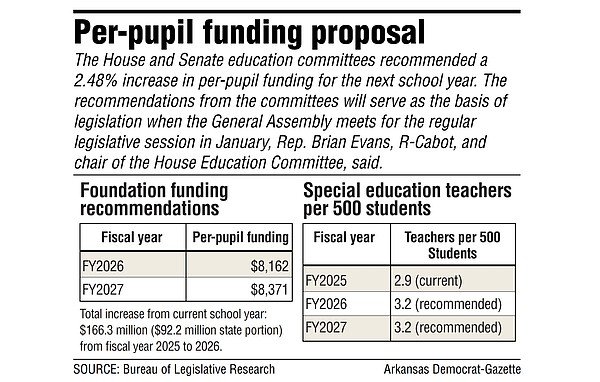
The committees signed off on a recommendation of $8,162 in per-pupil funding for the 2026 school year and $8,371 in funding for the 2027 school year. The per-pupil funding is derived from a matrix, or funding formula, where legislators make suggestions on how much funding schools need for teachers, operations and maintenance and transportation, among other items.
The per-pupil funding that lawmakers recommended is a 2.48% increase from the current school year. It’s the end of a process where legislators work to establish a formula to fund public education for the next two school years, known as the adequacy process.
The recommendation is the culmination of what lawmakers call the adequacy process, a 10-month long study of the state of public education in Arkansas that ends with the House and Senate education committees coming up with a plan to fund schools, which is then sent to the governor, speaker of the House and Senate president pro-tempore for review.
The plan that lawmakers agreed to on Monday will be written into a bill which will be filed during the upcoming legislative session, which begins in January, Rep. Brian Evans, R-Cabot, chair of the House Education Committee said. But even after the adequacy recommendations become law, it’s up to each public school or charter school district on how it spends the foundation funding.
“How they spend it after it’s approved is up to them,” said Sen. Jane English, R-North Little Rock, chair of the Senate Education Committee.
While the current per-pupil funding is $7,771, lawmakers are also planning to increase the per-pupil amount for the current school year during the session to $7,809 to account for rising premiums for health insurance for teachers, said Rep. Keith Brooks, R-Ferndale, vice chair of the House Education Committee.
Some of the largest line item increases lawmakers have recommended in the matrix are earmarked for special education, pay for classified workers and to offset increased costs for operations and maintenance.
“I think they took a lot of those concerns with inflation, with classified salaries with health insurance costs potentially rising and took a lot of those things into account,” said Mike Hernandez, executive director of the Arkansas Association of Educational Administrators.
The matrix calls for increasing the number of special education teachers from 2.9 per 500 students to 3.2 for the 2026 and 2027 school years. The matrix also suggests increasing the number of guidance counselors from 2.5 to 3 per 500 students.
“I don’t know if special-ed funding will get to where it needs to be,” said Dennis Copeland, director of the Arkansas Rural Education Association. “Any extra monies you get at this point is good. If it could have been more, that would have been great.”
The matrix also funds a raise for nonteacher school staff, referred to as classified employees, which includes bus drivers, custodians, security and support staff.
The education committees recommended an additional $6 per-pupil for salary enhancements for classified staff, which accounts to $50 per-pupil for the 2026 school year according to the matrix lawmakers approved and which was prepared by the Bureau of Legislative Research. How much classified personnel will be paid will be up to each individual school district.
During the 2023 legislative session, the General Assembly approved a $2 dollar-per-hour raise for classified staff, but Evans admitted that many workers didn’t receive the raise.
“This makes a much larger significant impact,” Evans said of the most recent proposal for raises for classified workers.
The matrix also calls for teachers, principals and secretaries to receive a 2.48% cost-of-living adjustment from the previous year.
Public schools also receive dollars in addition to the foundation funding, referred to as categorical and supplemental funds. Categorical programs are meant to address students with specific needs, such as Alternative Learning Environments, English Language Learners and Enhanced Student Achievement for students who qualify for federal free and reduced lunch according to a summary from the Bureau of Legislative Research.
Like the foundation funding, categorical programs are funded on a per-pupil basis. As part of their recommendations, the House and Senate education committees are calling for a 2.48% increase in funding for all of the state’s categorical programs with the exception of professional development, which is being cut from $41 per-pupil to $0.
Supplemental funds are dollars to help provide fairness for school districts that may have higher cost burdens than others, according to Bureau of Legislative Research. The supplemental funds include additional support for transportation, special education and teacher salaries.
Lawmakers are recommending supplemental remain steady, spending $108 million, slightly more than the $107.5 million for the current school year.
Under the LEARNS Act, vouchers, referred to as Education Freedom Accounts, are worth 90% of per-pupil funding. The Education Freedom Account is being phased in over three years, with the program becoming open to all students for the 2025-2026 school year.
April Reisma, president of the Arkansas Education Association, an affiliate of the National Education Association, one of the largest teachers’ unions in the nation, said she is concerned that despite the increase in foundation funding for schools, universal vouchers may lead to a decrease in enrollment at public schools and, thus, fewer state dollars.
Reisma lobbied against the LEARNS Act and also was part of a constitutional amendment campaign to require private schools that accept state dollars to follow the same accreditation and academic standards as public schools.
“We are always welcome to increased spending on education, but we always want to make sure that our public tax dollars only go towards public schools and we are concerned about the increased spending going towards the educational savings accounts,” Reisma said. “We are encouraged about how they want it to go toward raises for our education support professionals and I hope that they do so.”
Funding for items in the LEARNS Act, such as teacher raises and merit bonuses, high-impact tutoring and literacy coaches are funded separately and are not included in the state’s funding matrix.
The genesis of the adequacy process was a series of Arkansas Supreme Court rulings that found the state had not complied with the Arkansas Constitution’s requirement to properly fund public schools.
Public education in Arkansas is funded through of mix of state, local and federal funds, with state dollars making up the majority. In 2023, the foundation funding made up 51% of the dollars of the funding for public schools in Arkansas, according to the Bureau of Legislative research, with the next largest portions coming from other state and local sources (24%), federal funds (19%), categorical funding (4%) and supplemental funding (2%).
The funding matrix lawmakers just approved is a $166.3 million increase in the foundation funding from the 2024 school year to the 2025 school year, with $92.2 coming from the state.
The matrix does not include a total for how much the state will spend on public schools. Instead, the number will be based on the state’s total enrollment multiplied by the per-pupil funding. For the 2023 school year, the state gave public schools $3.7 billion for foundation funding, sourced from both state and local governments according to the Bureau of Legislative Research.