
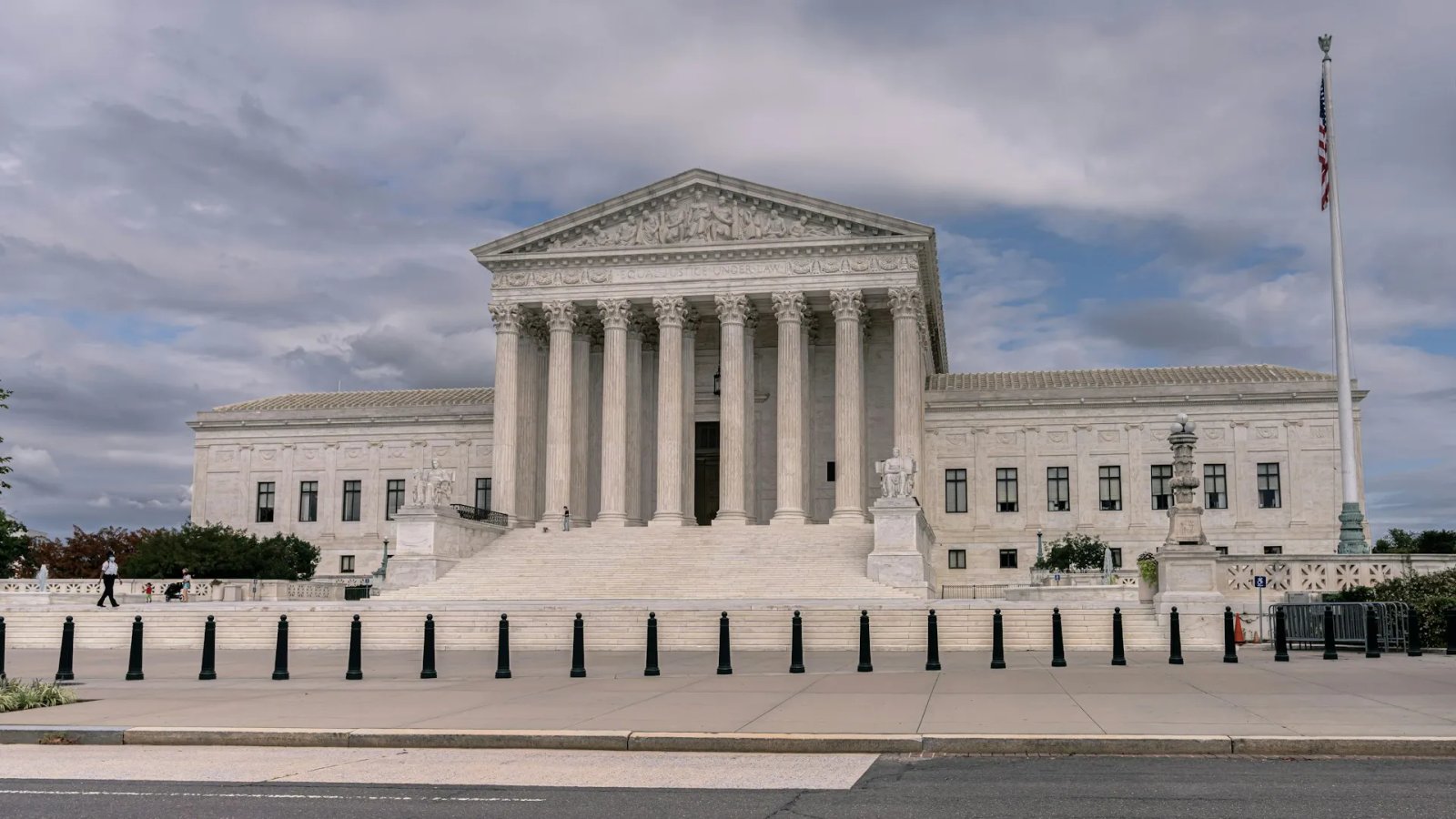
Lawyers for groups challenging the Trump administration’s efforts to freeze billions of dollars in foreign-aid funding on Friday afternoon urged the Supreme Court to leave in place a ruling by a federal judge in Washington, D.C., that requires the government to commit to spending $4 billion in funds by Sept. 30. President Donald Trump asked Congress in late August to claw back the funds – a maneuver known as a “pocket rescission” – and has told the justices that his administration may not commit the money as U.S. District Judge Amir Ali has ordered.
Lawyers for the challengers countered on Friday that “[a]ny emergency is of the government’s own making, as it has been under an obligation to spend the appropriated funds for specified purposes since at least March 2024.”
Chief Justice John Roberts on Tuesday issued a temporary order, known as an administrative stay, that put Ali’s order on hold to give the court time to consider the government’s request.
Friday afternoon’s filing was the latest chapter in a long-running dispute that began soon after Trump’s inauguration for his second term. In an executive order issued on Jan. 20, Trump contended that the U.S. “foreign aid industry and bureaucracy are not aligned with American interests and in many cases [are] antithetical to American values.” “It is the policy of [the] United States that no further United States foreign assistance shall be disbursed in a manner that is not fully aligned with the foreign policy of the President of the United States,” Trump proclaimed.
A few days later, the State Department announced that to implement Trump’s order, Secretary of State Marco Rubio had frozen all foreign-aid funding through the State Department and the U.S. Agency for International Development while the administration conducted “a review of all foreign assistance programs to ensure they are efficient and consistent with U.S. foreign policy under the America First agenda.”
Several nonprofits that had received foreign-assistance funds, or whose members had received such funds, filed a lawsuit in Washington to challenge the funding freeze. On Feb. 25, Ali issued an order that instructed the State Department and USAID to pay contractors and grant recipients within 36 hours for work that had already been done.
The Trump administration came to the Supreme Court on Feb. 26, asking the justices to intervene. By a vote of 5-4, with Roberts and Justice Amy Coney Barrett joining the court’s three Democratic appointees, the court turned down the government’s request to lift Ali’s order, although the deadline for compliance had already passed. The majority’s brief, unsigned opinion directed Ali to “clarify what obligations the Government must fulfill to ensure compliance with the temporary restraining order” that Ali entered in the case, paying attention to how feasible it is for the government to comply with those timelines.
Ali’s next order in the case came on March 6, when he ruled that the Trump administration’s freeze of funds that had been earmarked for foreign aid likely violated both the Constitution and federal law. He instructed the Trump administration to “make available for obligation the full amount of funds that Congress” had allocated. The Trump administration once again asked the Supreme Court to block Ali’s order, but it eventually withdrew that request after actions by a federal appeals court left it moot – that is, no longer a live controversy.
The Trump administration’s most recent attempt to seek emergency relief came on Monday, after Ali ordered the Trump administration to commit to spending $4 billion in funds by Sept. 30, the end of the federal government’s fiscal year. Ali wrote that although the government may “have significant discretion in how to spend the funds at issue,” it does not “have any discretion as to whether to spend the funds” at all.
In his filing asking the justices to step in, U.S. Solicitor General D. John Sauer argued that Ali’s order “raises a grave and urgent threat to the separation of powers.” Relying on a federal law, the Impoundment Control Act, he explained, the Trump administration had proposed that Congress claw back these $4 billion in funds. Under that law, the funds can be frozen for up to 45 days to give Congress time to consider the president’s request. (When a request, like this one, is made with less than 45 days before the end of the fiscal year, it is known as a pocket rescission.) While that proposal is pending, Sauer said, the Trump administration is unable to comply with Ali’s order and commit the money.
In a brief order on Tuesday, Roberts put Ali’s order on hold for now to the extent that it requires the executive branch to commit to spending $4 billion in funding.
The government’s theory, the challengers wrote, rests on the idea that “once Congress was ‘considering’ the special message” from the president proposing the rescission, “USAID and the State Department no longer had a duty to obligate the relevant funds.” But that premise is “incorrect,” the challengers insisted, because although the House of Representatives received the president’s proposal on Aug. 28, several days before Ali’s Sept. 3 order, the proposal did not arrive at the Senate until Sept. 8 – notwithstanding the ICA’s requirement that a rescission proposal “be transmitted and delivered to the two chambers ‘on the same day.’” Therefore, the challengers contended, the 45-day period “did not even arguably begin until September 9, and, actually, has not been triggered at all.”
In any event, the challengers continued, “the upshot of the government’s theory is that Congress’s signature law meant to control impoundments actually provided the President vast new powers to impound funds, and made it virtually impossible to challenge impoundments in court.” But Congress, the challengers suggested, “would not have enacted such a self-defeating statute.”
Posted in Emergency appeals and applications, Featured