
In a market where mutual fund rankings change faster than investor sentiment, one scheme has quietly climbed to the top — the Bank of India Small Cap Fund.
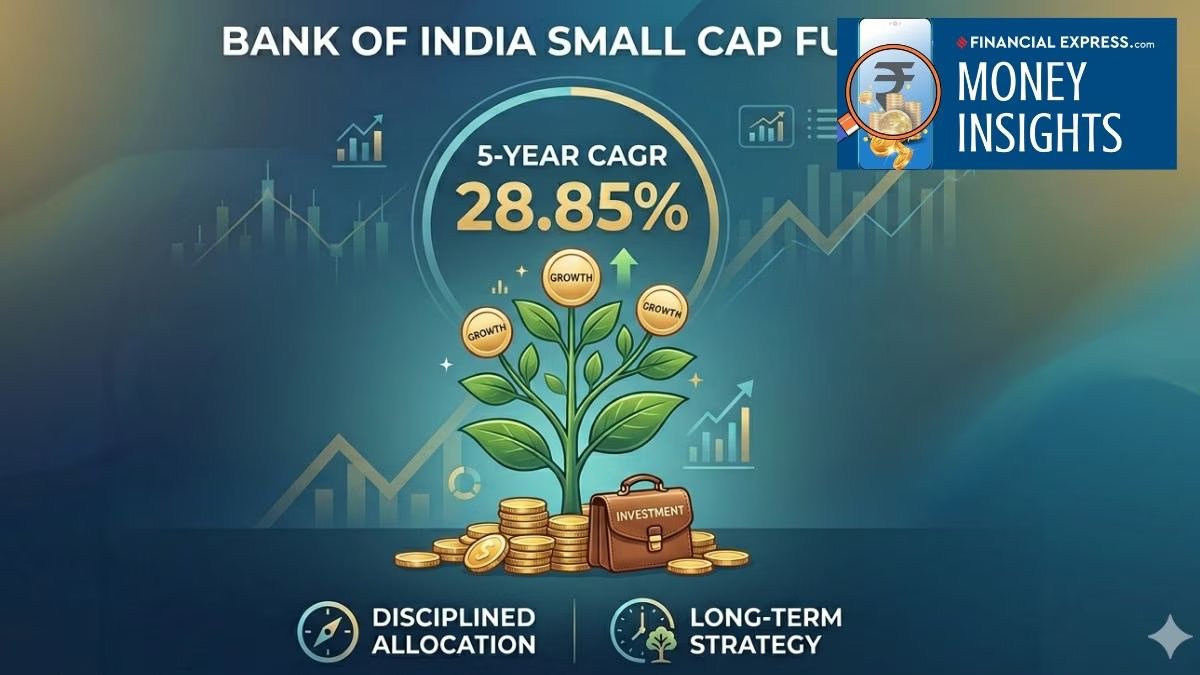
The Bank of India Small Cap Fund has climbed the performance charts with a strong 5-year CAGR of 28.85%, outpacing its benchmark, the Nifty Smallcap 250 TRI, at 27.10%, as well as the broader category average.
This consistent outperformance is now drawing investor interest but also raising the classic question: is it still the right time to enter?
| Scheme Name | 1 Year | 2 Years | 3 Years | 4 Years | 5 Years |
| Bank of India Small Cap Fund | 0.80 | 16.87 | 22.47 | 18.17 | 28.85 |
| Category Average | 3.00 | 15.63 | 21.77 | 17.70 | 27.43 |
| Nifty Smallcap 250 TRI | -0.09 | 16.26 | 23.02 | 16.87 | 27.10 |
Data as on April 29, 2026
(Source: ACE MF)
But before you jump in, pause for a moment. In investing, the biggest returns often come not from chasing winners but from avoiding mistakes.
The Performance That’s Driving Buzz
There’s no denying that the fund’s numbers look attractive.
Over the past five years, it has delivered strong compounded returns, outperforming many peers in the small-cap category. Consistency across different time frames has further strengthened its position in performance rankings.
What makes this even more interesting is that such outperformance hasn’t come from a one-off rally. The fund has managed to stay competitive across market phases including recovery periods and bullish cycles.
Naturally, this raises a tempting question for investors: If a fund has already proven itself, why not invest in it now?
Why Top Rankings Could be Misleading
The answer lies in understanding how mutual fund performance works.
Most investors look at trailing returns like 1-year, 3-year, or 5-year numbers and assume that a top-ranked fund will continue delivering similar results. But markets don’t work in straight lines.
Performance leadership in mutual funds is often cyclical. A fund that tops the chart today may underperform tomorrow due to:
- Changing market conditions
- Sector rotation
- Valuation corrections
- Portfolio saturation
This phenomenon is especially visible in the small-cap segment, where returns may swing sharply depending on liquidity and sentiment.
Understanding the Small Cap Reality
Before evaluating any funds in this category, it’s important to revisit what small-cap investing means.
Small-cap companies are typically:
- Early in their growth cycle
- Less researched
- More volatile
- Highly sensitive to economic changes
This creates a double-edged sword.
On one hand, these companies could grow rapidly and generate outsized returns. On the other, they may fall just as quickly during market corrections.
For investors, this means one thing — returns come with higher risk, and patience is non-negotiable.
What Could be Working in Its Favor?
While we avoid blindly praising performance, it’s still useful to understand what might be driving the fund’s success.
1. Active Stock Selection
Small-cap funds depend heavily on fund manager expertise. Identifying emerging businesses early and exiting at the right time could make a significant difference.
2. Sector Positioning
Outperformance in recent years has been driven by sectors like capital goods, manufacturing, and niche consumption themes. Funds that captured these trends early have benefited.
3. Market Tailwinds
The broader rally in mid and small-cap stocks post-pandemic has lifted many portfolios. Some funds simply executed better within this favourable environment.
However, here’s the catch: These tailwinds don’t last forever.
The Risk Investors Often Ignore
When a fund tops performance charts, it usually attracts large inflows. While that may sound positive, it creates a hidden challenge.
As assets under management (AUM) increase:
- It becomes harder to deploy capital efficiently in small-cap stocks
- Liquidity constraints start to matter
- Return potential may gradually decline
Additionally, small-cap valuations in recent years have expanded significantly. This means the margin of safety is lower than before.
So even a strong fund may struggle to replicate past returns in a more expensive market.
Should You Invest Now?
The real question is not whether the fund is good but whether it’s right for you at this moment.
Here are three practical considerations:
1. Your Existing Allocation
If you already have exposure to small-cap funds, adding more just because one fund is performing well may increase risk unnecessarily.
2. Your Time Horizon
Small-cap investments require at least a 5–7 year horizon. Short-term investors may not be able to handle volatility.
3. Your Risk Appetite
Can you stay invested if your portfolio drops 25–30% in a market correction?
If the answer is no, aggressive small-cap exposure may not be suitable.
A Smarter Approach to Investing in Winners
Instead of chasing returns, consider a more disciplined strategy:
Diversify Across Categories
Balance your portfolio with large-cap, flexi-cap, and value-oriented funds. Small caps should only be a part of your allocation not the entire strategy.
Prefer Gradual Investing
Systematic Investment Plans (SIPs) could help manage volatility and reduce timing risk, especially in overheated markets.
Focus on Process, Not Just Performance
Look beyond returns. Evaluate the following:
- Portfolio quality
- Risk metrics
- Consistency across market cycles
Ultimately, a good fund is one that fits your portfolio — not just one that tops a list.
The Bigger Lesson for Investors
The rise of funds like the Bank of India Small Cap Fund highlights an important truth about investing.
Markets will always create new winners. Every year, there will be a fund that stands out. But successful investors don’t chase these winners blindly.
They focus on:
- Asset allocation
- Long-term discipline
- Risk management
Wealth is not built by picking the best-performing fund of the past — but by staying invested in the right mix of funds over time.
Final Thoughts
The Bank of India Small Cap Fund has undoubtedly delivered strong returns and earned its place among top performers.
It may continue to do well if supported by the right strategy and market conditions.
But investing is not about reacting to past performance.
It’s about making decisions that align with your goals, your risk profile, and your time horizon.
So instead of asking, ‘Should I invest in this top fund?’, ask yourself… ‘Does this fund fit into my long-term plan?’
That one question can make all the difference.
Happy investing.
Disclaimer: This article is for information purposes only. It is not a stock recommendation and should not be treated as such. Learn more about our recommendation services here…
The website managers, its employee(s), and contributors/writers/authors of articles have or may have an outstanding buy or sell position or holding in the securities, options on securities or other related investments of issuers and/or companies discussed therein. The content of the articles and the interpretation of data are solely the personal views of the contributors/ writers/authors. Investors must make their own investment decisions based on their specific objectives, resources and only after consulting such independent advisors as may be necessary