
The COP30 climate summit in Belém will put adaptation to a warming world front and centre, with the aim of moving negotiations from technical debate to deciding how to measure adaptation progress and accelerating action on the ground, according to Alice Amorim, Brazil’s COP30 programme director.
At the mid-year UN talks in Bonn, countries reached a compromise on work to select a set of 100 indicators this year for the Global Goal on Adaptation (GGA), which is part of the Paris Agreement.
But a key sticking point has been how to track funding for vulnerable communities to become more resilient to climate shifts – which affect everything from agriculture to water and infrastructure – in a way that can help ensure that developed countries are providing adequate support to developing nations.
IEA says some oil and gas projects must shut early to meet 1.5C limit
A meeting of technical experts in late August narrowed down the list of GGA indicators to 113, but was unable to agree on how to monitor finance for adaptation, according to a summary released this week.
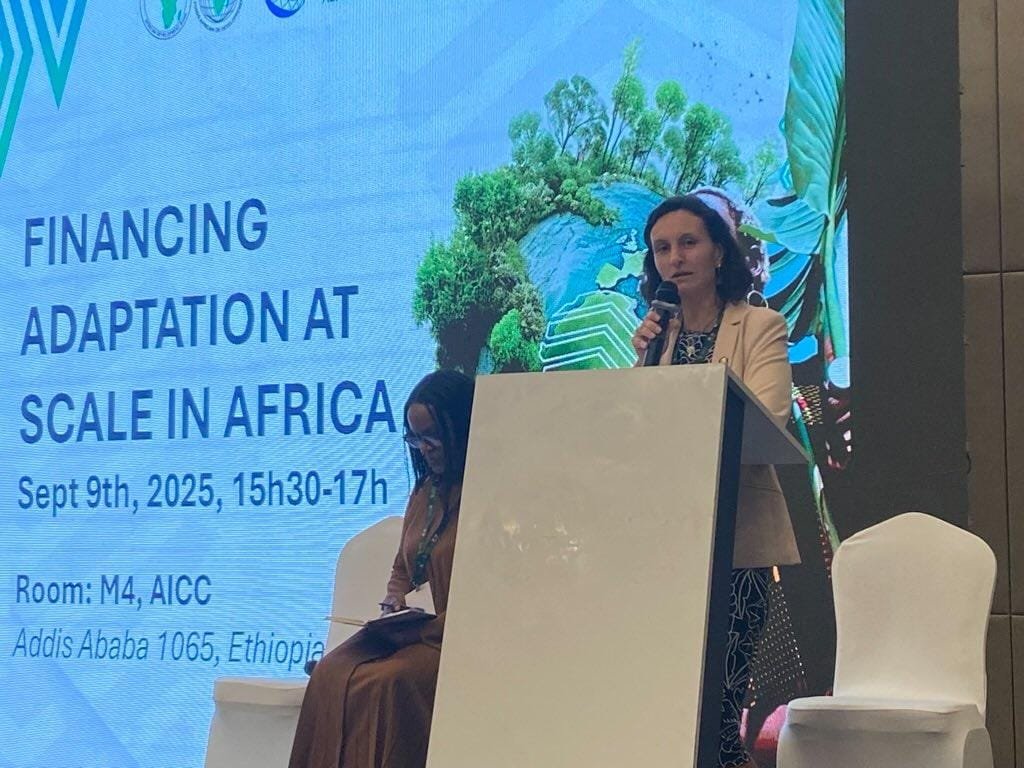
With the negotiations set to continue at COP30, Amorim told this month’s Africa Climate Summit in Addis Ababa that she hopes countries will finally agree on the indicators in Belém, adding that the Brazil conference – being described as an “implementation COP” – must go further to shape a system that can quickly turn those decisions into real-world results.
“This is a moment where we don’t need to wait anymore for all parties to agree on what needs to happen to make adaptation finance flow to Africa, to Latin America, to the small island states and so on. It’s about acting upon it, it’s about moving from commitments to practice,” Amorim said.
She added that there should be no more delay in investing in adaptation and resilience-building because resources are needed urgently to build climate-safe infrastructure and implement national adaptation plans.
COP30 will not launch “shiny new initiatives”, she added, but will bring existing solutions “to understand what is already happening on the ground that needs to be leveraged and what are the gaps that financial sector players and policy makers need to address”.
An existing goal to double adaptation finance to around $40 billion a year by 2025 – agreed at COP26 – expires this year, and experts say it has helped drive more money into adaptation.
The Least Developed Countries group has called for a new goal of tripling finance from 2022 levels by 2030 to close to $100 billion a year. But even that would not close the gap which the UN estimates to be $160 billion-$340 billion a year by 2030.
Addis summit gets behind adaptation
Brazil’s Amorim told the Africa climate summit in Ethiopia last week that the need for adaptation “is clear and tangible” on the continent. What is missing, however, are the conditions to drive it in a much wider and faster way, she added.
Adapting to climate change by shoring up defences against negative impacts such as extreme heat, floods and food insecurity remains a priority for African countries. Leaders at the summit made it clear in their final declaration – yet to be published – that the continent needs scaled-up, grant-based and concessional finance for adaptation, whose delivery should avoid loading countries with more debt.
Since 2017, most adaptation finance flows to the continent have come as loans, with little private sector investment, raising fears over rising debt burdens on the continent. While Africa needs about $70 billion annually for adaptation, it received only $14.8 billion in 2023, according to an analysis by the Global Center on Adaptation (GCA) and Climate Policy Initiative (CPI) released during the summit.
The analysis showed that since most adaptation finance comes from international public sources such as donor governments and multilateral development banks, cuts in bilateral aid mean capital flows to sub-Saharan Africa are projected to decline in 2025.
“Public health emergency”: Report shows fossil fuel impacts on every stage of life
Reacting to the report’s findings, Macky Sall, former president of Senegal and chair of the GCA, said the aid cuts from major donor countries would be “unprecedented – and unacceptable – precisely when resilience spending must rise”.
To enable African countries to build resilient infrastructure without piling on unsustainable debt, Sall called on developed-country partners “to reverse planned reductions, ring-fence adaptation within aid budgets, and expand guarantees and local-currency facilities”.
Tadeous Chifamba, permanent secretary of environment, climate and wildlife in Zimbabwe, said COP30 should focus attention on increasing adaptation finance flows to Africa, drive a restructuring of the global financial architecture and ensure developed countries, which are responsible for historical emissions, play their part in mobilising funds for adaptation.
“It has become a moral obligation on their part to ensure that there is fairness, justice and that they assume responsibility just as we are doing as the first-line defenders,” Chifamba told an event on the sidelines of the Addis summit.
Mobilising African money too
While African leaders need developed countries to help deliver finance for adaptation, they made it clear at the summit that the continent is not asking for charity, but is championing local solutions and will also mobilise resources from African financial institutions to respond to climate shocks.
At the summit, the second phase of the Africa-led Adaptation Acceleration Program (AAAP)- a joint initiative of the African Development Bank and the GCA – was launched with a goal to mobilise $50 billion by 2030 to climate-proof Africa and build resilience in different sectors including agriculture, infrastructure, food systems and urban areas, as well as creating jobs.
This is a boost to the program’s initial target of $25 billion and will be achieved through a convergence of private-sector leadership, innovation and resilient economic growth, according to the GCA.
COP observers invited to reveal who is bank-rolling their participation at climate talks
Bernadette Arakwiye, Rwanda’s environment minister, told the summit that Africa needs to shift from a position of deficit to opportunity, and start leveraging its assets by unlocking domestic capital. “Africa’s financial institutions hold trillions in assets and yet only a fraction is flowing to climate resilience – we need to change this,” she added.
Investing for resilient growth
Unlocking private finance would scale up adaptation investments to equip countries to quickly respond to climate shocks, Arakwiye emphasised, adding that private capital can move the continent away from small and fragmented initiatives to large-scale bankable projects.
The Baku-to-Belém Roadmap for boosting climate finance to $1.3 trillion a year by 2035, to be presented at COP30, will go some way in showing how more funds can be raised for adaptation, including through multilateral development banks, private investment and country platforms for investment, Melanie Robinson, global climate director at the World Resources Institute (WRI), told journalists this week.
Comment: How COP30 could deliver an ambitious outcome on global finance flows
Citing WRI’s research, she noted that every dollar invested in adaptation can generate more than ten times its value in economic, social and environmental benefits.
In addition to finance, policy and regulatory changes such as insurance systems, land zoning and business incentives are also needed to support adaptation on the ground, she said.
“COP30 will be an opportunity to focus more on adaptation and resilience – and this is about investing, not just to save lives, although that’s very important, but actually to drive resilient growth and enable communities and businesses to thrive in a changing climate,” she added.