
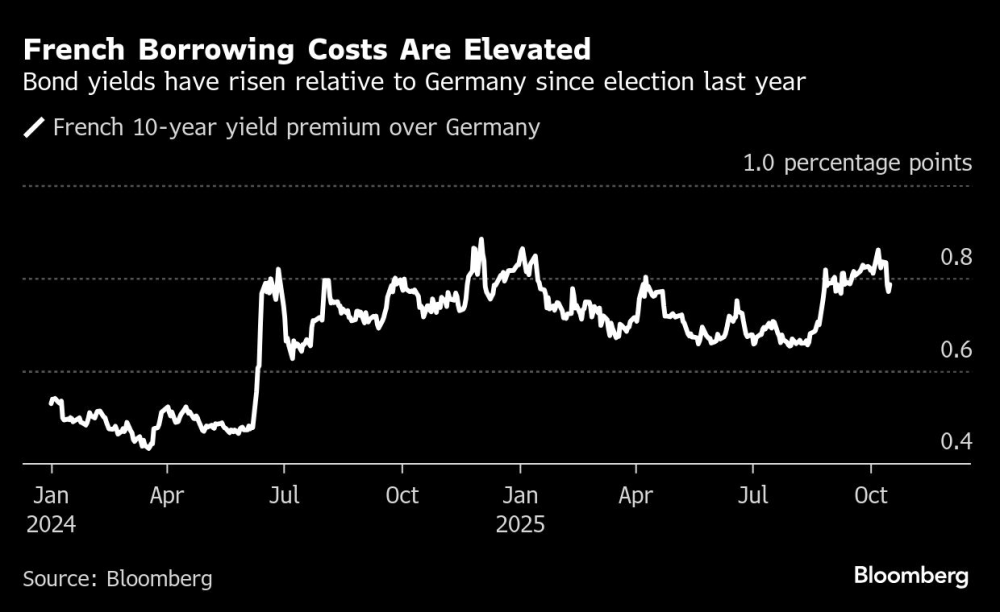
The latest crisis has laid bare the nation’s precarious fiscal and political situation, which is likely to factor into crunch decisions from Moody’s Ratings and S&P Global Ratings over the next six weeks. If either downgrade, bond funds with ultra-strict investment criteria are likely to be compelled to offload their French sovereign debt holdings.
BlackRock Inc, Vanguard Group Inc and Legal & General Group Plc are among firms managing products that have objectives to hold securities that are scored double-A and above on average by major rating providers, according to documents reviewed by Bloomberg.
The risk is that French bonds could soon fail to fulfill that standard. Fitch Ratings has already cut France’s creditworthiness rating below that level, and investors are worried S&P and Moody’s — which both assign the nation the lowest possible double-A score — may take the same step at upcoming reviews.
The yield premium investors demand to hold French debt “could increase further if the average sovereign credit rating falls,” said Claudia Panseri, Chief Investment Officer for France at UBS Global Wealth Management. She warned of “potential forced selling by rating-constrained investors.”
France is Europe’s largest government debt issuer, with close to €3tn ($3.5tn) in securities outstanding. That means it makes up a sizable chunk of European bond allocations, raising the stakes for fund managers with strict rules.
While the vast majority of funds will continue to be able to invest in French government bonds after a downgrade, the risk of outflows is already the subject of market speculation. That leaves a question mark hanging over this week’s rally in bonds.
The securities jumped after Prime Minister Sebastien Lecornu appear to stave off the risk of new elections, partly by suspending a pension law that raises the retirement age. That move was crucial to securing the promise of Socialist Party backing in no-confidence votes that he otherwise risked losing.
While the concession helped boost markets this week, it complicates the nation’s path to fiscal consolidation — a key concern of credit agencies. Indeed, Moody’s warned last year that a reversal of the pension reform may be “credit negative.” Moody’s is scheduled to update its assessment on October 24 followed by S&P on November 28.
S&P already has a negative outlook on the nation and the timing of its review — the final working day of November — could complicate matters if the firm decides to downgrade France. That’s because the next month-end rebalancing, when indexes and the funds which track them shuffle their holdings, would be around the year-end period, where liquidity is traditionally thin.
Nearly 80% of Societe Generale SA clients surveyed last week expect a downgrade by at least one of the two firms before year-end. That’s a potential problem for the most risk-averse asset owners — such as foreign public institutions like central bank reserve managers, as well as some pension funds — who seek out highly-rated assets.
“If France were to suffer additional rating downgrades, this would lead to lower demand for OATs from foreign central banks,” said a Unicredit team led by Tullia Bucco.
France’s woes partly reflect a broader deterioration in sovereign credit ratings, limiting the relative supply of top-rated assets globally. In May, the US lost its final triple-A score from the major credit-rating firms. Yet France’s decline has been notable because it coincides with upward rating trajectories for neighbors such as Italy and Spain.
French bond yields currently trade at around the same levels as Italy’s, even though they are higher rated, suggesting further downgrades are at least somewhat priced in. And even if France loses its double-AA status, it will still remain firmly in investment-grade territory, a more common threshold when it comes to bond-fund criteria.
But in Europe’s bond markets, products with AA minimum credit-rating criteria grew in popularity during the region’s sovereign debt crisis as global investors sought to avoid distressed issuers.
Vanguard, the world’s second-largest asset manager, has a €675mn passive fund which targets European government long-dated bonds with a credit rating of AA- and higher. It had a 37% allocation to France as of the end of September. A Vanguard spokesperson didn’t respond to requests for comment.
London-based Legal & General, which manages over £1.1tn in assets, runs a similar €221mn Eurozone AAA-AA Government Bond product. An L&G spokesperson said only two of its sixteen-euro government strategies would be materially impacted by potential French downgrades, with those strategies designed to cater to specific client needs.
Meanwhile, an exchange-traded fund from New York-based VanEck offering exposure to short-dated highly-rated government bonds has a 30% allocation to France. It tracks a Markit iBoxx benchmark from S&P Global’s index business.
“We are aware of the current developments and continue to monitor the situation closely,” said Moritz Henkel, Product Manager at VanEck. “We are in contact with the index provider to stay informed and are reviewing potential market developments around timing and liquidity.”
BlackRock’s iShares Global AAA-AA Govt Bond exchange-traded fund has a 10% allocation to France because it tracks an index which limits the allocation to any one AA issuer at that level. Lower-rated sovereigns are excluded altogether. The benchmark is compiled by Bloomberg Index Services Ltd, part of Bloomberg LP, the parent of Bloomberg News.
A BlackRock spokesperson declined to comment. The published objectives for the BlackRock, Vanguard and VanEck funds include language saying they seek to track the underlying index as far as possible and practicable — a common caveat among passive funds.
There are also actively-managed products such as UBS Group AG’s “high-grade” range, which includes a €947mn fund targeting euro-denominated long-dated debt and a €615mn strategy for shorter maturities. Their descriptions say they invest “primarily” in bonds rated double- or triple-A rated, and reference Bloomberg indexes with AA- minimum criteria.
Because they’re actively managed, they are not beholden to changes in their underlying benchmark in the same way. That gives fund managers more discretion as to how they manage any potential French ejection from indexes.