

The island nation of Mauritius, set in the Indian Ocean just east of Madagascar, is gaining attention not only as a tourist and expat paradise. With its white sandy beaches, strong legal, financial, and political systems, and cultural blend of African, Indian, and Creole heritages, Mauritius offers an appealing lifestyle that goes well beyond vacation living. Government schemes have opened doors for foreign buyers looking for property investments, as well as those interested in making Mauritius their new permanent home.
This 2025 edition guide will take you through the basic steps and important things to consider when buying property in Mauritius as a foreign first-time buyer.
11 Things to Know Before Buying a Property in Mauritius
- Can Foreigners Buy Property in Mauritius
- Best Cities and Regions to Invest
- Median Asking Prices
- Rental Yields and Rents
- Market Performance (Past and Present)
- Landlord and Tenant Laws
- Property Related Taxes
- Buying (and Selling) Costs
- Short-Term Rental Regulations
- Mortgage and Financing Options
- How to Buy Property in Mauritius: Step-by-Step
1) Can Foreigners Buy Property in Mauritius?
Yes, foreigners can purchase several types of property in Mauritius.
While Mauritian citizens can purchase property freely across the island, foreign investors can only buy property following specific property schemes approved by the Economic Development Board (EDB). Pathways that provide permanent residency extend not only to the property owner, but also to spouses/common-law partners, dependent children under age 24, and dependent parents.
- Property Development Schemes (PDS) are located in gated communities and include townhomes, apartments, and villas. Property investments of at least USD $375,000 can grant permanent residency.
- Ground + 2 (G+2) Schemes allow foreigners to purchase apartments in developments that have two or more floors above ground. A minimum investment of approximately $130,000 USD is required and must be approved by the government. G+2 schemes do not permit permanent residency, but can be used as vacation homes or investment property.
- Smart City Scheme properties are in urban areas that mix residential, commercial, and leisure spaces. An investment of approximately $375,000 USD or more can grant permanent residency.
Additional schemes are available for large-scale developments (Integrated Resource Scheme or IRS) or for hotel developers to sell rooms or villas to foreigners (Invest Hotel Scheme or IHS).
2) Best Regions and Cities to Invest
Mauritius offers an exceptional range of real estate investment opportunities, from bustling urban areas and resort-style coastal developments to tranquil inland communities surrounded by nature.
Port Louis
As the capital and financial hub of Mauritius, Port Louis remains the country’s economic heartbeat. The city attracts both local and international businesses, creating consistent demand for commercial and residential properties. Redevelopment projects along the waterfront and in business districts have enhanced the city’s modern appeal, while nearby areas like Moka and Pailles offer well-planned residential options. With ongoing investment in infrastructure and business incentives, Port Louis continues to be a solid choice for investors seeking stable returns and long-term growth.
Grand Baie
Located on the northern coast, Grand Baie is the island’s premier lifestyle and tourism destination. Known for its upscale resorts, marinas, and shopping centers, the area draws high-net-worth individuals and expatriates looking for beachfront living. Luxury villas and integrated resort schemes (IRS) developments are particularly popular among foreign buyers, offering both rental income potential and access to residency benefits. Grand Baie’s vibrant social scene, combined with its scenic coastline, positions it as one of the most sought-after markets in Mauritius.
Tamarin and Black River
On the west coast, Tamarin and the surrounding Black River district offer a blend of luxury, leisure, and natural beauty. This region has become a hotspot for real estate investment, especially among those seeking high-end villas and ocean-view apartments. With international schools, golf courses, and a growing number of eco-friendly developments, the area appeals to both families and retirees. The combination of relaxed coastal living and strong property value appreciation makes it a key area for investors.
Moka
Nestled in the island’s central plateau, Moka represents a model for sustainable urban development in Mauritius. Its master-planned communities combine residential, educational, and commercial spaces, attracting young professionals and families. The city’s strategic location—close to major highways and business centers—has made it one of the fastest-growing regions on the island. As Moka continues to evolve into a modern, self-sufficient city, its real estate market shows promising potential for steady long-term returns.
3) Median Asking Prices
Foreign investors must spend a minimum of approximately $125,000 USD to qualify for the G+2 apartment scheme, and investments of at least $375,000 are required for permanent residency.
As of July 2025, one-bedroom prices for Mauritius were as follows:
- Mauritius (all locations) – $239,000
4) Rental Yields and Rents
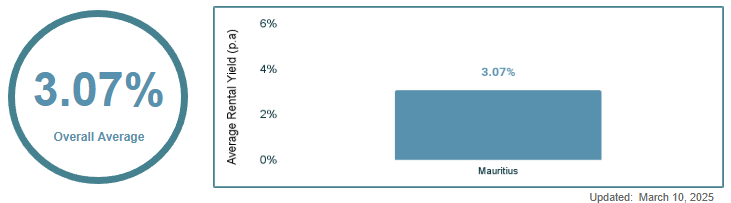
Rental yields in Mauritius are considered poor, averaging 3.07% across the island. While yields vary by city and the number of bedrooms, data shows that yields consistently fall in the 2.5% and 3.85% range across the board.
5) Market Performance (Past and Present)
The property market in Mauritius has consistently shown long-term growth. Since the 2010s, Mauritius has developed an expanding tourism and expat industry, positioning the island as a safe, high-quality destination.
Real estate in Mauritius has become a key economic driver over the past 10 or so years, and government programs – known as schemes – have provided several attractive options for foreign property investors from around the globe. Some of the schemes also offer investors the ability to become permanent residents.
While rental yields are currently low, the overall market appears resilient thanks to strong demand, limited supply, and growing foreign confidence in the island’s long-term possibilities.
Mauritius house price annual change:
Data Source: Statistics Mauritius.
6) Landlord and Tenant Laws
Landlord and tenant laws in Mauritius are judged by Global Property Guide to be slightly Pro-Tenant. While both parties have protections, the laws emphasize tenant rights, especially in reference to rental agreements. Although rents can be freely negotiated, rent increases are limited, security deposits must be returned within one month of the lease’s end (assuming there are no unpaid bills), and evictions must follow specific legal steps and can be challenged by tenants
7) Property Related Taxes
Property is not taxed in Mauritius, but rental income is. In July 2025, the tax scale was changed from 11 tax brackets to just three, and income taxes range from 0% to 20% depending on the amount of earnings.
Corporate income is taxed at a flat rate of 15%.
Mauritius has no capital gains taxes when reselling property.
8) Buying (and Selling) Costs
For those looking to purchase property in Mauritius, acting quickly may be advantageous, as higher registration and land transfer duties are set to increase from 5% to 10% starting July 2026.
Here’s a full breakdown:
| Transaction Costs | ||
| Who Pays? | ||
| Property Transfer Tax (Registration fee) Transfer tax (Land Transfer Tax) |
5.00% 5.00% |
buyer seller |
| Legal Fees | 1.00% – 2.00% | buyer |
| Notary Fees | 0.50% – 2.00% | buyer |
| Real Estate Agent Fee | 2.00% 2.00% |
buyer seller |
| Costs Paid by Buyer | 8.50% – 11.00% | |
| Costs Paid by Seller | 7.00% | |
| ROUNDTRIP TRANSACTION COSTS | 15.50% – 18.00% | |
| Source: Global Property Guide, PWC | ||
9) Short-Term Rental Regulations
Currently, Mauritius requires that owners of short-term rentals (i.e., those available for rent less than 12 months) must register their properties with the Tourism Authority and have a valid Tourist Enterprise License.
While Mauritius does not have many specific short-term rental regulations at this time, laws are subject to change.
10) Mortgage and Financing Options
Foreign investors can obtain Mauritius-based mortgage loans, but should expect to pay higher down payments (generally 30% to 40%) and higher interest rates than citizens. Loan terms generally range up to 25 years.
As of December 2024, non-citizens must pay at least 85% of the property’s purchase price in Mauritian rupees (MUR), meaning only 15% can be paid in foreign currency.
11) How to Buy Property in Mauritius: Step-by-Step
- Research and Find Property: Research the various parts of the island and the types of property that are available to foreigners under the Mauritian government schemes. Online listings can be found on sites such as Property Cloud, Property Finder, and Green Acres Mauritius. A professional Mauritian real estate agent will know more about the various areas and neighborhoods and the regulations for purchasing property. An agent may also have access to listings not available online.
- Research Pricing, Yields, and Legal Restrictions: Non-citizens may only purchase residences that fall under approved government property schemes. Foreign buyers who invest USD 375,000 or more in qualifying developments are eligible for residency rights while they own the property. Although rental yields in Mauritius tend to be modest, the island continues to attract tourists, retirees, and expatriates, offering long-term potential for capital appreciation. Short-term rental regulations remain relatively flexible, and government incentives continue to support foreign investment.
- Research Long-Term Policy Changes: Recent reforms will be tightening incentives and increasing transaction duties from 5% to 10% for foreign investors starting mid-2026. Foreigners can only purchase properties that fall under the government’s approved schemes. A local real estate agent or attorney can help ensure that a property qualifies.
- Research Local Taxation and Landlord Laws: There are no annual property taxes in Mauritius, but income is taxed based on a sliding scale at 0% to 20% based on profit. Corporations are taxed at a flat 15%. Landlord and tenant laws lean pro-tenant, particularly when it comes to rental agreements and eviction processes.
- Hire a Real Estate Attorney: While a notary is required for buying property in Mauritius, a real estate attorney can help buyers navigate the purchasing process and protect their interest. A Mauritius-based real estate attorney should understand the local laws for foreign investors and can identify potential risks, negotiate terms, and sign paperwork as the buyer’s representative if the buyer cannot be present.
- Hire a Real Estate Attorney: While a notary is required for buying property in Mauritius, a real estate attorney can help buyers navigate the purchasing process and protect their interest. A Mauritius-based real estate attorney should understand the local laws for foreign investors and can identify potential risks, negotiate terms, and sign paperwork as the buyer’s representative if the buyer cannot be present.
- Apply for Financing: Foreign buyers needing to borrow money from a Mauritius bank will need to apply after the promise of sale is signed and present it to the lender as proof of intent to buy. The bank may conduct its own valuation of the property and legal review.
- Conduct Due Diligence: A notary will be appointed to perform due diligence prior to the sale being completed. The notary will verify the title’s ownership and land registry, check for liens, ensure proper zoning, and verify other important details related to the property.
- Submit Buyer’s File to EDB: While conducting due diligence, the notary will also submit the buyer’s file – which includes the promise of sale, the buyer’s passport, financing information, and other important information – to the Economic Development Board (EDB), which oversees foreign property purchases under government-approved schemes. The EDB must approve the file before the sale can be completed.
- Sign the Final Paperwork: The contract’s completion occurs at the notary’s office where the buyer and seller – or their legal representatives – sign the deed of sale. At this time, any balances, transfer taxes, and notary fees will also need to be paid.
- Register the Deed: The notary has 15 days from the time the final paperwork is signed to register the deed with the Registrar-General without facing penalties. Once this step is completed, the buyer’s ownership is official.
Timeline: Expect 2-4 months from offer to official registration.
Need Help?
Buying property in a foreign country can feel overwhelming, but we’re here to help.
At Global Property Guide, we offer:
- Data-backed insights on property prices, rental yields, and taxes
- Country-specific legal and tax guidance through our partner network
- Pre-screened investment properties, including income-generating Airbnb units
- 1-on-1 consultations with real estate experts focused on international buyers
- Step-by-step buyer support, from due diligence to closing
Whether you’re looking for your first investment in Mauritius or expanding your international portfolio, we can help you make smart, secure decisions.
Contact our team or book a free consultation to get started.