

Rakuten Group’s corporate bonds for individual investors are on sale starting today, October 19. The interest rate is 4.37% per annum. Following last month’s SoftBank Group bond at 4.75%, another corporate bond in the 4% range has emerged.
Many people must have felt that “if it’s in the 4% range, it’s much better than a savings account.” However, you cannot judge a corporate bond’s interest rate by the face value alone. The remainder after subtracting the yield of government bonds contains everything about the company’s situation.
In this article, I have lined up the 4.37% Rakuten bond alongside government bonds, SoftBank bonds, and SIM benefits. I have also calculated the take-home amount if you purchase 1 million yen worth. I personally intend to buy them. In the final chapter, I also write about why I am buying them and for whom they are not suitable.
*About this article
-
I am not an employee of a securities company or a financial product intermediary. This article is for informational purposes only and does not provide advice on purchasing individual issues.
-
The figures are as of October 19, 2026. The government bond yield used for comparison with the Rakuten bond is the figure from October 15.
-
Taxes are calculated at 20.315%. The take-home amount is an estimate after withholding tax.
1. The difference from government bonds is about 2.0%, which is the “true interest rate” of the Rakuten bond
First, let’s establish the fixed conditions. The Rakuten Group 26th Unsecured Corporate Bond has a term of 5 years and 6 months, with an interest rate of 4.37% per annum (3.482% after tax). The application period is from October 19 to 28, and it will be redeemed on April 28, 2032. The rating is A- from JCR.
The interest rate for the Rakuten bond was decided on October 16. Therefore, just like the SoftBank bond in [16], I will use the figures from the day before the decision date. On October 15, the new 5-year bond was 2.309%, and the new 10-year bond was 2.914%.
There is no government bond for exactly 5 years and 6 months. The difference between 5 and 10 years is 0.605%. Half a year is one-tenth of that, which is 0.0605%. Adding 0.0605% to 2.309% results in approximately 2.37%.
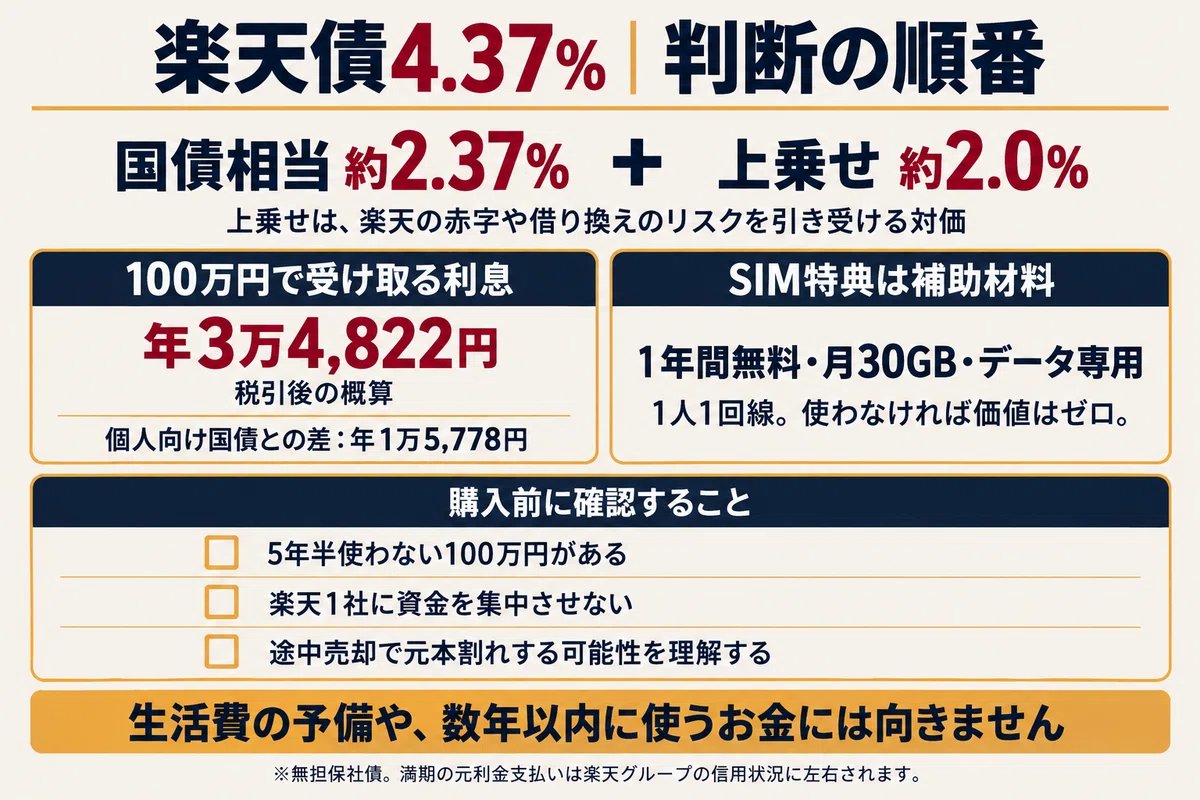
Subtracting 2.37% from 4.37% leaves about 2.0%. The 2.37% portion is the interest rate for lending money to the government for 5 and a half years. The remaining approximately 2.0% is the premium for lending to Rakuten instead of the government.
The October offering of individual government bonds (fixed 5-year) was 2.39%. Even compared to this, the difference is still about 2.0%. For 1 million yen, this calculates to a premium of 20,000 yen per year before tax.
Up to this point, it is simple subtraction. Next, we will look at whether this 2.0% is high or low.
2. The fact that it was decided 0.23% lower than the upper limit of the provisional conditions is because buyers gathered
Rakuten had previously indicated an interest rate range of 3.80% to 4.60%. This is called the provisional condition. Securities companies gathered estimates of investor orders, and it was decided at 4.37% on October 16.
This interest rate was finalized in the supplementary issuance registration document on October 16. It is 0.23% lower than the upper limit. The more orders that are gathered, the more the issuer can lower the interest rate. In other words, 4.37% is the figure resulting from sufficient buyers gathering.
The issuance amount is also large. This offering totals 400 billion yen, of which 360 billion yen is for individuals. The 27th bond for institutional investors was limited to 40 billion yen. It is an offering financed almost 90% by individual money.
The previous 25th bond was a 3-year bond issued in August 2025 with an interest rate of 2.336%. This time, they were able to extend the term by two and a half years and increase the scale.
By the way, the SoftBank bond was also decided at 4.75% against a provisional condition of 4.30% to 4.90%. It was 0.15% below the upper limit. Lining the two up allows for an even more interesting comparison.
③ Compared to SoftBank bonds, Rakuten bonds cannot be called cheap
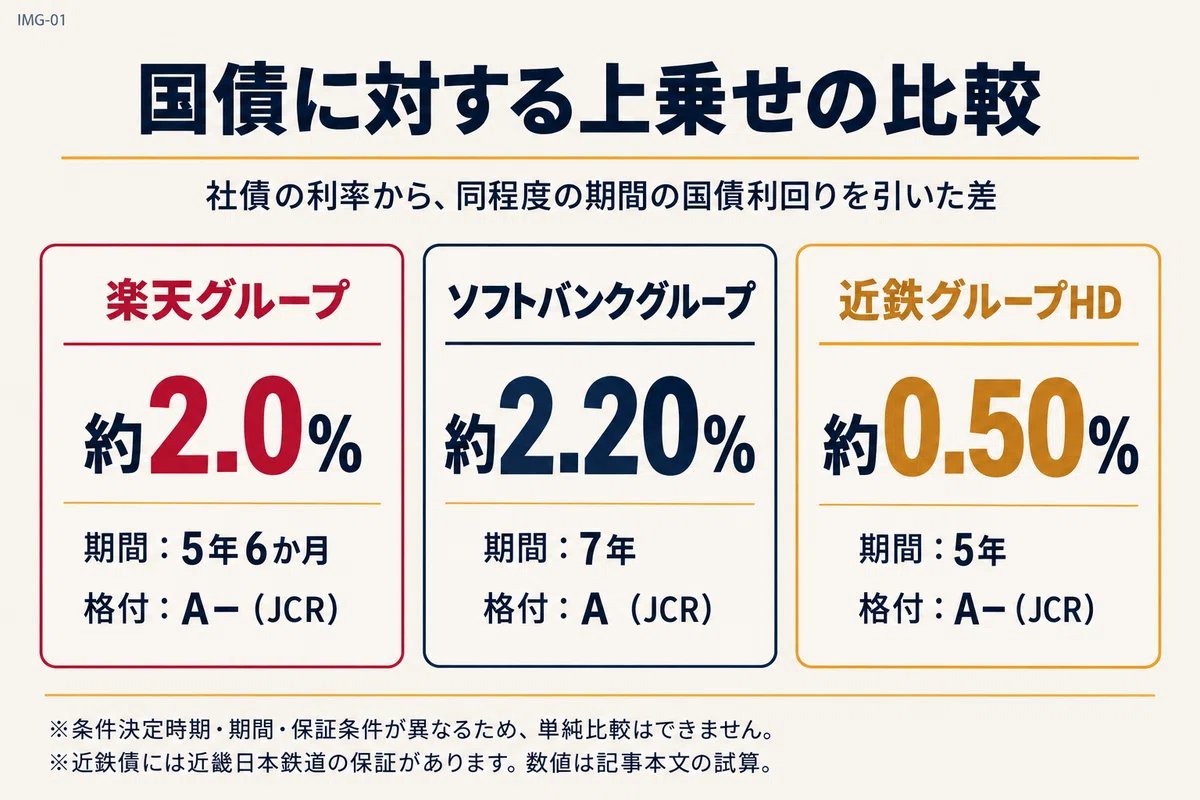
I calculated SoftBank bonds in [16]. The day before the terms were set, September 3rd, the 7-year government bond yield was 2.547%. Subtracting that from 4.75%, the premium is about 2.20%.
The premium for Rakuten bonds was about 2.0%. Lining them up, it looks like this:
-
① SoftBank bond: 7 years, JCR A, premium approx. 2.20%
-
Rakuten bond: 5 years 6 months, JCR A-, premium approx. 2.0%
Normally, the longer the term of a corporate bond, the larger the premium. Since the Rakuten bond is a year and a half shorter than the SoftBank bond, it is not strange that the premium itself is smaller.
However, Rakuten’s credit rating is one notch lower. The lower the rating, the larger the premium should be. The reduction due to the shorter term and the increase due to the lower rating cancel each other out, leaving a difference of only about 0.20%.
Rakuten bonds cannot be called cheaper than SoftBank bonds. They look about the same, or perhaps even slightly more expensive. I have already purchased SoftBank bonds, so this was honestly a bit surprising.
For the same JCR A- rating, Kintetsu Group Holdings’ 5-year bond was set at 2.521% on July 9th. The average yield for the 5-year government bond auction on the same day was 2.020%. Subtracting that, the premium is about 0.50%.
There is a difference of about 1.5% in the premium compared to Rakuten’s 2.0%. However, Kintetsu bonds are guaranteed by Kintetsu Railway, and their R&I rating is BBB+. Since the conditions are different, this difference does not directly represent a difference in creditworthiness.
Even so, with the same A- symbol, the premiums differ by a factor of four. Rakuten is seen as being on the “heavier side of A-“. The size of the premium reflects the market’s true sentiment better than the rating symbol.
So, how much of a difference does it make in take-home pay? In the next chapter, I will calculate it for 1 million yen.
④ If you buy 1 million yen worth, your take-home pay will be 15,800 yen more per year than government bonds
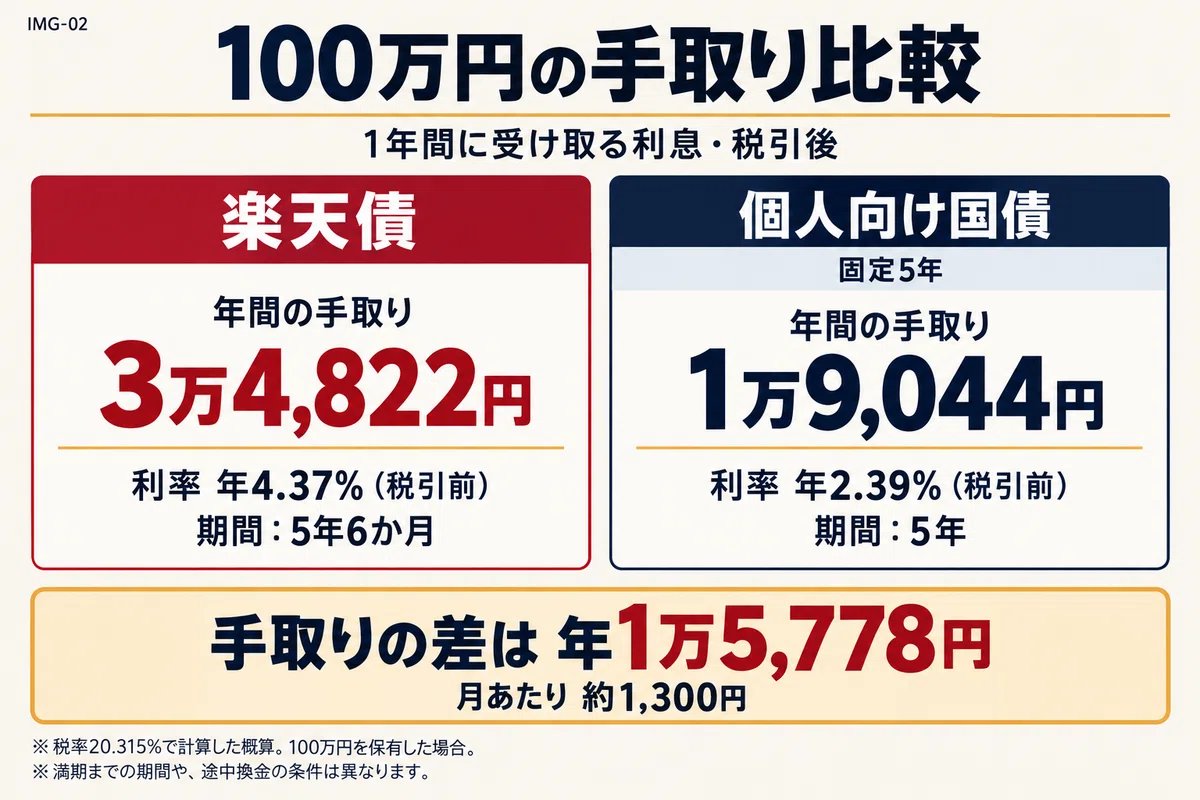
Calculating for a 1 million yen purchase, the interest on the Rakuten bond is 43,700 yen per year before tax. After deducting 20.315% in taxes, the take-home pay is 34,822 yen per year.
For individual government bonds with a fixed 5-year term (2.39%), the interest is 23,900 yen per year before tax. The take-home pay is 19,044 yen per year. The difference is 15,778 yen per year, or about 1,300 yen per month. Think of it as the difference of about one lunch per month.
Interest payments are made twice a year, on April 29th and October 29th. The first payment will be on April 29, 2027, and you will receive a total of 11 payments by maturity. The final payment is for a period one day short of six months. Since interest accrues from the day after the payment date, the first payment might also be one day shorter. Each will just be about 120 yen less per 1 million yen.
If held until maturity, the interest on the Rakuten bond is about 240,000 yen before tax, and about 190,000 yen after tax. For the 5-year fixed individual government bond, the take-home pay over 5 years was about 95,000 yen. It is not a strict comparison because the periods differ by six months, but it is roughly double the difference.
There is one other major difference. Rakuten bonds can be bought in 1 million yen units, while individual government bonds can be bought in 10,000 yen units. For those who want to cash out only a portion along the way, government bonds are much easier to handle.
When and where interest is deposited is something I wrote about in detail in [18] using individual government bonds as an example. The mechanism is almost the same for corporate bonds.
That is all for the difference in interest. However, Rakuten bonds come with a bonus separate from the interest.
5. The SIM benefit is worth 0.7% per year for 1 million yen, and 0.07% per year for 10 million yen.
Individuals who purchase Rakuten bonds will receive a SIM that allows them to use the Rakuten Mobile network for free for one year. Data usage is limited to 30GB per month. The information is scheduled to be sent by the securities company where the purchase was made around February 2027.
There are a few points to note. It is a data-only SIM that cannot be used for voice calls. You must apply yourself and complete identity verification through the benefit website mentioned in the notification to receive it. Those under 18 and corporations are not eligible.
In the previous 25th bond issuance, the benefit was an eSIM with unlimited data. This time, it has been changed to 30GB per month.
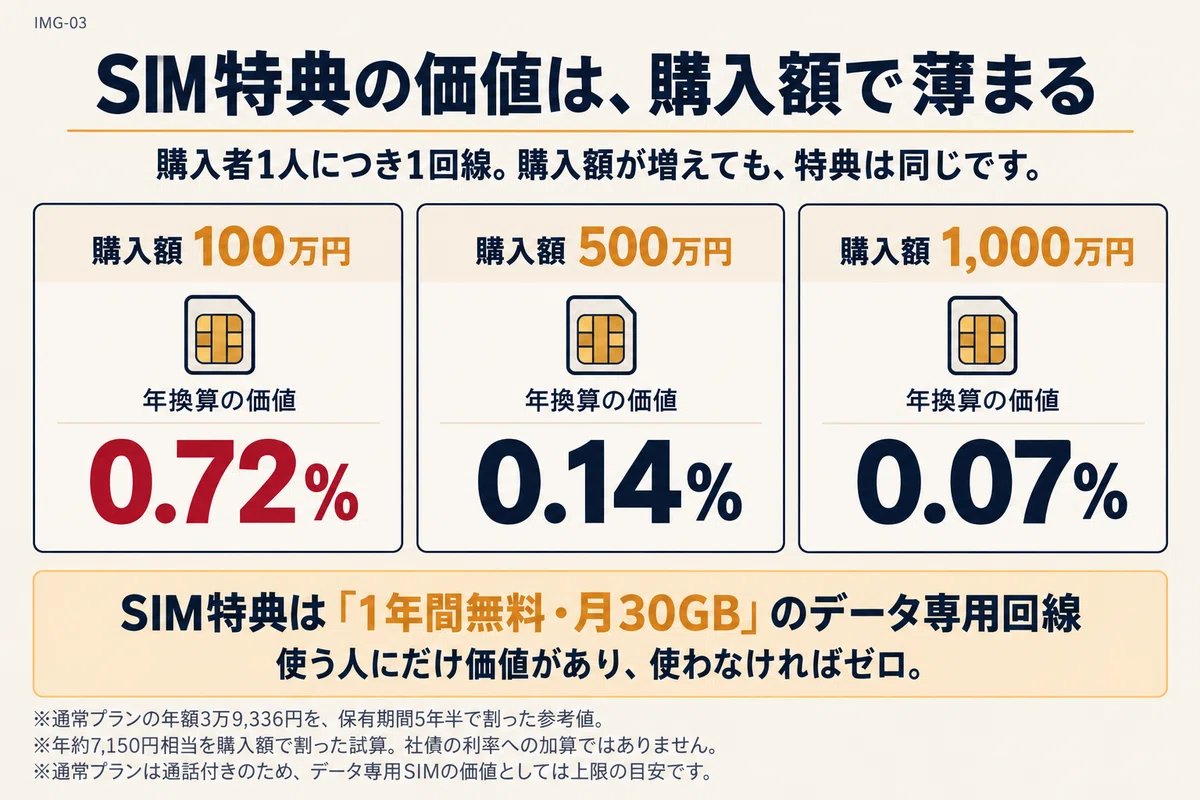
Let’s convert this into a monetary value. The standard Rakuten Mobile plan costs 3,278 yen (tax included) per month once you exceed 20GB. Over 12 months, this amounts to 39,336 yen. However, since this is a rate that includes voice calls, it serves as an upper-limit estimate for the value of a data-only plan.
Dividing 39,336 yen by 5.5 years gives approximately 7,150 yen per year. For an investment of 1 million yen, this is a premium of about 0.72% per year. Honestly, this is quite significant.
However, the benefit is limited to one line per purchaser. Even if you buy 10 million yen worth, you receive the same single SIM. In this case, it only amounts to 0.07% per year.
In other words, the SIM benefit is more effective for those buying in smaller amounts. And it only has value for those who actually use it. If you don’t use it, it’s worth zero.
Now that we have added up the interest rate and the benefits, I will discuss the most important point at the end. What is the 2.0% premium actually compensating for?
6. The 2.0% premium is the price of Rakuten Mobile’s deficit and refinancing.
The intended use of the funds raised this time is disclosed in the shelf registration supplement. The net proceeds are approximately 354.6 billion yen. Of that, 265.6 billion yen will be used to redeem US dollar-denominated corporate bonds maturing in February 2027.
10 billion yen will be used for the redemption of the 9th unsecured corporate bonds. The remainder will be used to replenish cash on hand, which decreased due to preparations for the reorganization of the fintech business.
The terms for these dollar-denominated bonds were set in January 2024. The issuance amount was 1.8 billion dollars, and the interest rate was 11.25% per year. Even with the effective interest rate after conversion to yen, it was 7.21% per year.
From Rakuten’s perspective, this is a matter of refinancing 7.21% debt with 4.37% debt. Since they are replacing money borrowed for three years at that time with 5.5-year yen-denominated corporate bonds, the repayment deadline is also extended. The structure is such that Rakuten’s interest payments are lightened by individuals lending at 4.37%. In other words, the cycle of paying off corporate bonds with new corporate bonds continues.
Let’s also look at the financial results. The final loss (attributable to owners of the parent) for the fiscal year ending December 2025 was 177.9 billion yen. The first half of 2026 also saw a loss of 10.9 billion yen.
However, looking only at the April-June quarter, there was a profit of 7.7 billion yen attributable to the parent company. This is the first profit in six years since the April-June quarter of 2020. The mobile segment, including Rakuten Mobile, posted an operating loss (Non-GAAP) of 33.1 billion yen during the same period. This is a reduction of 4.1 billion yen from the previous year.
What about the credit rating? On September 26, 2025, JCR revised Rakuten’s rating outlook from “Negative” back to “Stable.” The rating itself remains at A-.
Improvements are being made. Even so, it is still in the red.
Finally, let’s confirm the protections as a corporate bond. These bonds are unsecured. They include a “negative pledge clause,” meaning that collateral cannot be provided exclusively to other corporate bonds. However, bank loans are excluded from this promise.
You can sell them before maturity, but in that case, it will be at the market price. If interest rates have risen or Rakuten’s valuation has fallen, there is a possibility that the value will drop below 1 million yen. The 2.0% premium is the compensation for bearing these risks for 5.5 years.
⑦ I will buy it—it is suitable for those who have ‘1 million yen that will not be used for 5 and a half years’
After calculating this far, I intend to buy the Rakuten bond.
The reason is that I have money from selling investment trusts.
There is one thing to note. I bought SoftBank bonds through SBI Securities, but this Rakuten bond is not handled by SBI Securities. The underwriting securities companies are the six firms: Daiwa, Rakuten, Mizuho, Mitsubishi UFJ Morgan Stanley, SMBC Nikko, and Nomura.
The application period is until October 28, but the deadline time varies by securities company. Rakuten Securities is until 14:30 on the 28th, and Nomura Securities online is until 19:00 on the 27th. If they sell out, it ends at that point.
You can judge whether it is suitable for you based on the following four points.
-
You have 1 million yen that you do not plan to use for 5 and a half years
-
You will not put the majority of your available funds into Rakuten alone
-
You intend to hold until maturity rather than selling midway
-
You have plans to actually use the SIM (those who do not should judge based solely on the interest rate)
Conversely, it is not suitable as a place to keep emergency living expenses or money you will use within a few years. It is also not eligible for NISA. For such money, individual government bonds are sufficient. The individual government bonds for the October offering are summarized in [21].
It is a waste to decide based solely on the 4.37% figure. If you look at the content of the 2.0% spread after subtracting the government bond yield before deciding, you can avoid ending up in a situation after 5 and a half years where you think, ‘This is not what I expected.’
The article that read SoftBank bonds by spread rather than rating is [12], the postscript after the conditions were finalized is [16].The yardstick for this comparison was created there.
Sources
[Issuance Conditions/Use of Funds]
-
Rakuten Group, Inc. 26th Unsecured Bond Issuance Guide (Nomura Securities)
-
Rakuten Group, Inc. New Yen-Denominated Bond Guide (SMBC Nikko Securities)
-
Rakuten Group, Inc. 26th Unsecured Bond (New Issue) (Rakuten Securities)
-
Rakuten Group, Inc. Amended Shelf Registration Statement (Submitted October 16, 2026, EDINET)
[Performance & Credit Ratings]
[Compared Bonds & Government Bond Yields]
[Monetary Conversion of SIM Benefits]