
Close Menu
Fund Focus News
    Facebook X (Twitter) Instagram
    Trending
    • Kopernik Global All-Cap Equity Fund’s Q1 2026 Investor Letter
    • Sectoral mutual funds lose sheen — Inflows & folio additions plunge as investors seek diversification – Mutual Funds News
    • These multi-cap mutual funds have delivered up to 21% five-year returns
    • Best ELSS funds in 2026: Motilal Oswal, SBI, or Quant — who topped 3- and 5-year return charts? – Mutual Funds News
    • Should investors bet on metal funds in 2026 amid geopolitical crisis, rising commodity cycles?
    • PPFAS to HSBC, Kotak: 62% equity mutual funds outperform Nifty 50 in brutal Q4 selloff – Check top performers
    • Premium Bonds provider NS&I sending letters to 37,500 households from this week
    • Sectoral mutual funds lose sheen – Mutual Funds News
    Facebook X (Twitter) Instagram
    Fund Focus News
    • Home
    • Bonds
    • ETFs
    • Funds
    • Investments
    • Mutual Funds
    • Property Investments
    • SIP
    Fund Focus News
    Home»Bonds»China says ‘please stop buying our bonds’
    Bonds

    China says ‘please stop buying our bonds’

    August 20, 2024


    China is experiencing a bull market, but Beijing doesn’t seem to like it.

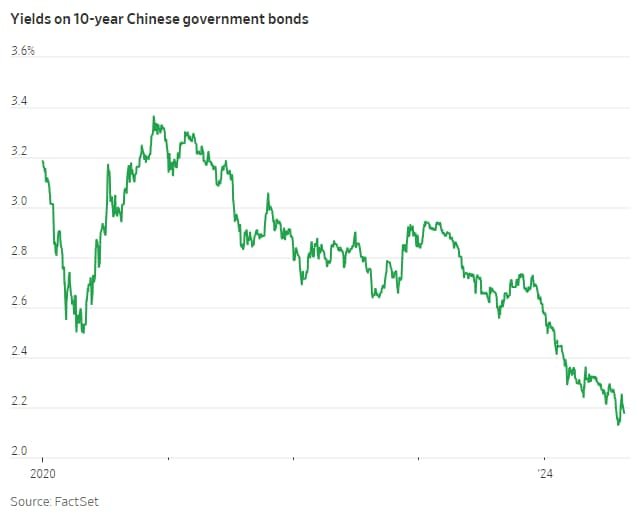
    While stock and housing markets languish in China, one asset has stood out—Chinese government bonds. Yields on 10-year government bonds have dropped to around 2.18% from around 2.6% a year earlier. In most countries—especially those experiencing an alarming slowdown like China—that would be welcome. Yet the authorities have gone to extraordinary lengths to try to stem the rally in bonds they issue.

    It is starting to work. China’s government bond yields have indeed picked up in the past week or so as state-backed banks appear to have turned into heavy sellers. Also helping to reverse the rally, China’s central bank said last month that it signed agreements with brokers to borrow “hundreds of billions” of yuan in government bonds. (100 billion yuan is equivalent to $14 billion). Regulators have also stepped up scrutiny on banks that have been active in the bond market.
    Graphic: WSJ

    View Full Image

    Graphic: WSJ

    While it is common for central banks around the globe to meddle in their bond markets, it is rarer for them to intervene to push yields up. China’s central bank just cut its short-term rates last month. Beijing’s heavy handed efforts to push bond yields in the opposite direction are another worrying sign about its economy.

    The official explanation is that banks could end up with huge losses if the bond rally takes a sharp turn, citing Silicon Valley Bank as an example. That bank faced a devastating run last year as depositors were spooked by unrealized losses it had on its balance sheet from U.S. Treasury bonds bought before the Federal Reserve began raising interest rates.

    There were indeed signs of a speculative frenzy in Chinese government bonds. Trading volume had surged and some price action was getting irrational: One 30-year government bond issued in May traded up 25% on the first day—not a swing one would expect to see in a boring government bond market.

    But there also are very strong fundamental reasons why investors are flocking to the low-yielding but basically risk-free assets. First, China’s economy remains mired in weakness, being dragged down by the implosion of its housing market. Instead of worrying about inflation, an issue in the U.S. and Western Europe, downward pressure in prices is the problem instead. China’s core consumer-price index, which excludes food and energy, rose only 0.4% year on year in July, down from 0.6% in June.

    And there is a lack of promising investment options. China’s CSI 300 index, which tracks the biggest stocks listed in Shanghai and Shenzhen, is down 3% this year after three consecutive years of losses. The property market, which used to be the most popular form of investment for Chinese households, remains in doldrums. New home prices in 70 major cities dropped 5.3% in July from a year earlier.

    What Beijing might be most worried about isn’t low bond yields but what they say about China’s economy—that instead of lending money out, banks are happier to let it sit in government bonds with ever-lower yields. In a country that can stamp out unpleasant news such as economic pessimism in the news media and the internet, bond yields are a sign of trouble that can’t be censored.

    Nudging from the government could indeed work, at least in the short term, in a financial system that is tightly-controlled by the government. But for bond yields to go sustainably higher, Beijing needs to go beyond treating the symptoms and deal with what is clouding the economy—fixing the housing market, boosting consumption and restoring investment confidence.

    That will be a lot harder.

    Write to Jacky Wong at jacky.wong@wsj.com


    Source link

    Share. Facebook Twitter Pinterest LinkedIn Tumblr Telegram Email

    Related Posts

    Premium Bonds provider NS&I sending letters to 37,500 households from this week

    May 28, 2026

    Banco Santander and NatWest sell record AT1 bonds with 10-year calls, locking in cheap capital

    May 28, 2026

    Corporate bond sales cross the Sh100 billion mark for first time

    May 27, 2026
    Leave A Reply Cancel Reply

    Top Posts

    The Shifting Landscape of Art Investment and the Rise of Accessibility: The London Art Exchange

    September 11, 2023

    Charlie Cobham: The Art Broker Extraordinaire Maximizing Returns for High Net Worth Clients

    February 12, 2024

    Montana Board of Investments plans $150m annual real estate deployment | News

    May 27, 2026

    The Unyielding Resilience of the Art Market: A Historical and Contemporary Perspective

    November 19, 2023
    Don't Miss
    Mutual Funds

    Kopernik Global All-Cap Equity Fund’s Q1 2026 Investor Letter

    May 29, 2026

    When Jeff Bezos said that one breakthrough technology would shape Amazon’s destiny, even Wall Street’s…

    Sectoral mutual funds lose sheen — Inflows & folio additions plunge as investors seek diversification – Mutual Funds News

    May 29, 2026

    These multi-cap mutual funds have delivered up to 21% five-year returns

    May 29, 2026

    Best ELSS funds in 2026: Motilal Oswal, SBI, or Quant — who topped 3- and 5-year return charts? – Mutual Funds News

    May 28, 2026
    Stay In Touch
    • Facebook
    • Twitter
    • Pinterest
    • Instagram
    • YouTube
    • Vimeo
    EDITOR'S PICK

    Discover coyyn for smarter crypto investments

    March 10, 2025

    Never a bad time to buy: How adaptability drives long-term property investment success

    July 25, 2025

    9 Best Investments According to Pros

    July 24, 2025
    Our Picks

    Kopernik Global All-Cap Equity Fund’s Q1 2026 Investor Letter

    May 29, 2026

    Sectoral mutual funds lose sheen — Inflows & folio additions plunge as investors seek diversification – Mutual Funds News

    May 29, 2026

    These multi-cap mutual funds have delivered up to 21% five-year returns

    May 29, 2026
    Most Popular

    🔥Juve target Chukwuemeka, Inter raise funds, Elmas bid in play 🤑

    August 20, 2025

    💵 Libra responds after Flamengo takes legal action and ‘freezes’ funds

    September 26, 2025

    ₹9000 monthly SIP can help you retire at 45 with ₹2 lakh monthly pension

    May 5, 2026
    © 2026 Fund Focus News
    • Get In Touch
    • Privacy Policy
    • Terms and Conditions

    Type above and press Enter to search. Press Esc to cancel.