I Bonds Pay 5.51%. Here’s What Dividend Investors Should Know
Quick Read
Johnson & Johnson (NYSE:JNJ) yields about 2%, well below the new 6% I bond rate, but it has raised its dividend 64 straight years.
That 6% I bond rate covers only the first six months, then resets with inflation, and cashing out within five years forfeits three months of interest.
I bond interest escapes state tax and can be deferred until redemption, while J&J dividends are taxed yearly, though usually at lower qualified rates.
Building a portfolio and living off one are two completely different skills, and almost nobody teaches the second. This problem is what The Definitive Guide to Retirement Income helps, and it is free today. Read more here. (Sponsor)
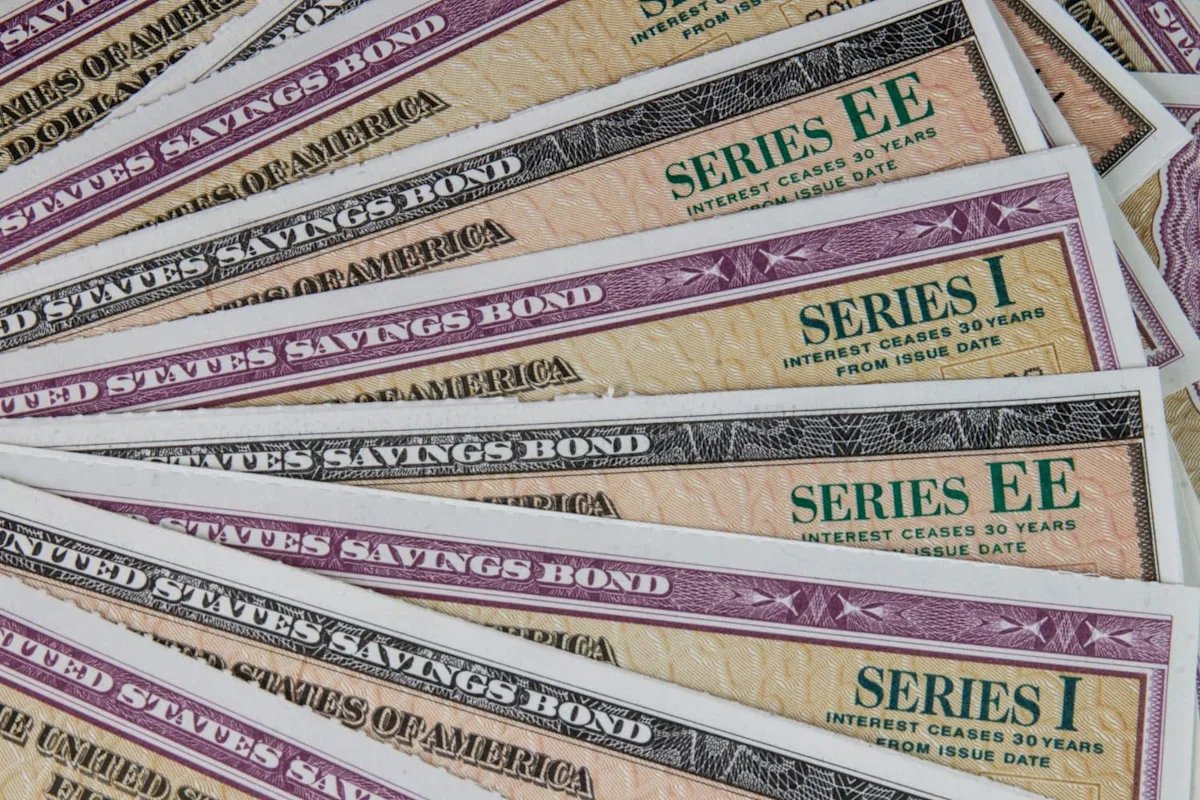
Series I savings bonds issued from November 1, 2026, through April 2027 pay a composite rate of 5.51%. That rate combines a fixed rate of 1.4% with a semiannual inflation rate of 2.04%, and it took effect on November 1, 2026. For comparison, Johnson & Johnson (NYSE:JNJ) yields about 1.88% as of November 13, 2026. That figure uses its $5.36 annualized forward dividend and a share price of $284.92 in early trading. Both figures measure yield only, and each has risks the other avoids.
Jonathan Weiss / Shutterstock.com
How I Bonds Work and Why the 5.51% Rate Can Change
An I bond is a savings bond you buy straight from the U.S. Treasury. Its rate has two parts. The fixed rate, 1.4% for this issue window, stays with the bond for its whole life. The inflation rate resets every 6 months, so the composite rate resets with it.
Treasury says simply that “The rate can go up. The rate can go down.” The 5.51% rate applies only to the first six-month earning period. After that, the bond earns whatever the next inflation reading adds to the fixed rate.
——
Now Available: The Definitive Guide to Retirement Income
Many successful investors eventually reach the same moment. The saving is done, the portfolio is built, and the question quietly changes from how much can I grow this to how much can I take out? Get that second question wrong and decades of good investing can come apart in a handful of years.
That is exactly what The Definitive Guide to Retirement Income helps answer. It covers what your retirement could actually cost, which income sources are worth using, and the withdrawal math that decides whether the money lasts. It is free today from Fisher Investments. Read More Here ›
——
The 2.04% inflation figure covers six months. Annually, it comes to about 4.08%, and most of the headline rate comes from that component. Interest is earned monthly and compounded semiannually. You receive nothing until you cash the bond. Each bond earns interest for 30 years, and electronic I bonds pay out automatically at maturity.
Getting out early has limits:
Minimum holding period: You can cash an I bond only after 12 months. Money placed here stays inaccessible for that first year.
Early redemption penalty: If you cash in before 5 years, you give up the last 3 months of interest.
Purchase cap: Treasury limits how much each person can buy every calendar year, which keeps I bonds a supplement to a retirement income plan rather than its core.
Where to buy: I bonds are only available electronically through a TreasuryDirect account. TreasuryDirect.gov is “the one and only place to electronically buy and redeem U.S. Savings Bonds,”. So a brokerage account can’t have them.
The U.S. government backs the bond, which means your principal and credited interest don’t depend on any company’s earnings. That backing has limits. It doesn’t protect against a falling inflation component. It doesn’t promise the official inflation index will match what you personally spend on healthcare or housing.
And it doesn’t remove reinvestment risk. When the rate resets lower, or the bond comes due, you have to find a new home for the money at whatever rates are on offer then. I bonds don’t trade on a market, so they have no price swings, and the trade-off is the one-year lockup and the interest penalty.
Dividend Safety Comes First in the Johnson & Johnson Comparison
A dividend is a board decision. A company can cut it, and no government stands behind it. I bond interest carries no such risk. So the first question about J&J’s payout is whether it’s safe, and only then whether it’s big enough.
J&J has a strong safety record. In April, the board raised the quarterly dividend 3.1% to $1.34 per share. That made 64 consecutive years of increases, putting it in the small club of Dividend Kings we ranked by valuation in a free report. The company generated $19.7 billion in free cash flow in fiscal 2025. It is also one of only two U.S.-based companies with a AAA credit rating. Management raised 2026 guidance to adjusted EPS of $11.60 to $11.75 and revenue of $100.8 billion to $101.4 billion.
Trailing GAAP EPS of $6.59 is far below the adjusted figures. The dividend looks less well covered on a GAAP basis than headline guidance suggests. STELARA sales fell 55.2% in the second quarter as biosimilars took share. Litigation charges and patent expirations are still on the risk list. The company also plans to separate its Orthopedics business, and that will change the earnings base the dividend depends on.
The other side is growth, which I bonds can’t offer, because an I bond only tracks inflation, plus its fixed rate. A dividend can grow faster than inflation. J&J’s quarterly payment was $0.95 in 2019 and is $1.34 now. Recent raises haven’t always kept up, though. The latest 3.1% increase is below the about 4.08% annualized inflation pace built into the new I bond rate. Dividend growth can beat inflation, but nothing guarantees it will.
Price is the other risk. J&J shares are up 39.89% year to date through November 13, 2026, which helps explain the low yield. Over the past 52 weeks, the stock has traded between $189.28 and $286.08. A retiree who has to sell shares in a downturn takes that loss, while an I bond holder, after the first year, never faces a market price.
Tax Treatment Often Decides Which Income Wins
I bonds: Interest is subject to federal income tax but exempt from state and local income tax. Interest is payable when you redeem the bonds, and the gain over your purchase price counts as taxable interest. Cash-method taxpayers can generally defer reporting it. Until they cash the bond or it comes due, the federal bill can wait for a lower-income year. If the money pays for qualified higher education, the interest may be excluded entirely under 26 U.S.C. § 135. That exclusion has income limits and other conditions. When the interest is taxed federally, it is taxed as ordinary income.
J&J dividends: Dividends from domestic corporations usually count as qualified dividend income, which is taxed as net capital gain under 26 U.S.C. § 1(h)(11). That rate is generally below the rate on ordinary income. You do have to meet a holding period: more than 60 days within 121 days around the ex-dividend date. Dividends are taxed in the year you receive them, so you can’t delay them, and in states with an income tax, they are also taxed at the state level.
In a high-tax state, the I bond’s state exemption and federal deferral count for a lot. For someone in a low federal bracket with no state income tax, the lower qualified dividend rate can narrow the gap.
Who Each Option Suits
I bonds suit retirees who want government-backed protection against inflation and can leave money alone for at least a year. They also fit savers in high-tax states and anyone who would rather delay the tax bill than pay it every quarter. Johnson & Johnson suits income investors with a long horizon. They can ride out price swings and want a payout that has grown for 64 consecutive years. In return, they give up a guarantee and accept a starting yield well below the current I bond rate. The next things to watch are the I bond rate reset on May 1 and J&J’s dividend declaration in April.
Released: The Definitive Guide to Retirement Income
(Sponsor) Most people spend their entire working lives focusing on one thing: growing a pile of money. Then they retire and discover the skill they actually need is close to the opposite. Turning that pile into steady income, year after year, through good markets and bad, without ever running out.
It may be the least discussed and most consequential transition in personal finance, and plenty of otherwise careful investors walk into it with no real plan. That is exactly what The Definitive Guide to Retirement Income helps answer. It is a free guide from Fisher Investments covering what your retirement will really cost, where the cash flow should come from, and how much you can safely withdraw each year. Learn more here. Learn More Here ›