

Close Menu
Fund Focus News
    Facebook X (Twitter) Instagram
    Trending
    • ETF assets are surging. Here’s how they differ from mutual funds
    • AMFI Data Decoded: Equity Mutual Fund Inflows Fall To One-Year Low, Gold ETF Record 1st Outflow in 13 Months
    • Infra funds steal the show: 5 schemes among top 10 SIP performers over the last decade – Money News
    • Direxion to Split Nine ETFs
    • Mutual Fund SIP: How to build more than Rs 5,00,00,000 corpus with Rs 10,000 monthly investment? Calculation explained
    • SIP investment still robust despite 40% sharp plunge in equity fund inflows: AMFI – Mutual Funds News
    • Equity mutual fund inflows fall to 1 year low in May; SIP contributions stay above ₹30,900 crore
    • Investors press for higher interest rates to lend to government in bonds market
    Facebook X (Twitter) Instagram
    Fund Focus News
    • Home
    • Bonds
    • ETFs
    • Funds
    • Investments
    • Mutual Funds
    • Property Investments
    • SIP
    Fund Focus News
    Home»Bonds»Investors spy a tipping point for bonds after geopolitics shreds old playbooks
    Bonds

    Investors spy a tipping point for bonds after geopolitics shreds old playbooks

    June 8, 2026


    • Bonds could resume safe-haven function if Iran conflict escalates again
    • Any other crisis disrupting supply chains would also support bonds
    • Investors view bond yields as attractive around current levels versus stocks
    MILAN, June 9 (Reuters) – Bonds have failed to shield investors during the Iran war. Now, some fund managers say that may be about to change, with debt poised to reclaim its safe-haven role if inflation starts ​hitting growth.

    World equities, which dropped in the first few weeks of the war, are back near record highs, fuelled by enthusiasm over AI and corporate earnings, while ‌sovereign bonds have been hit hard by fears of a protracted rise in inflation, which has driven government borrowing costs to multi-year and even record highs in some cases.

    Sign up here.

    That has not deterred investors from buying bonds. Lipper data shows that since the war broke out, a net $12 billion has flowed into developed-market government bond funds, accounting for all of the inflows this year.

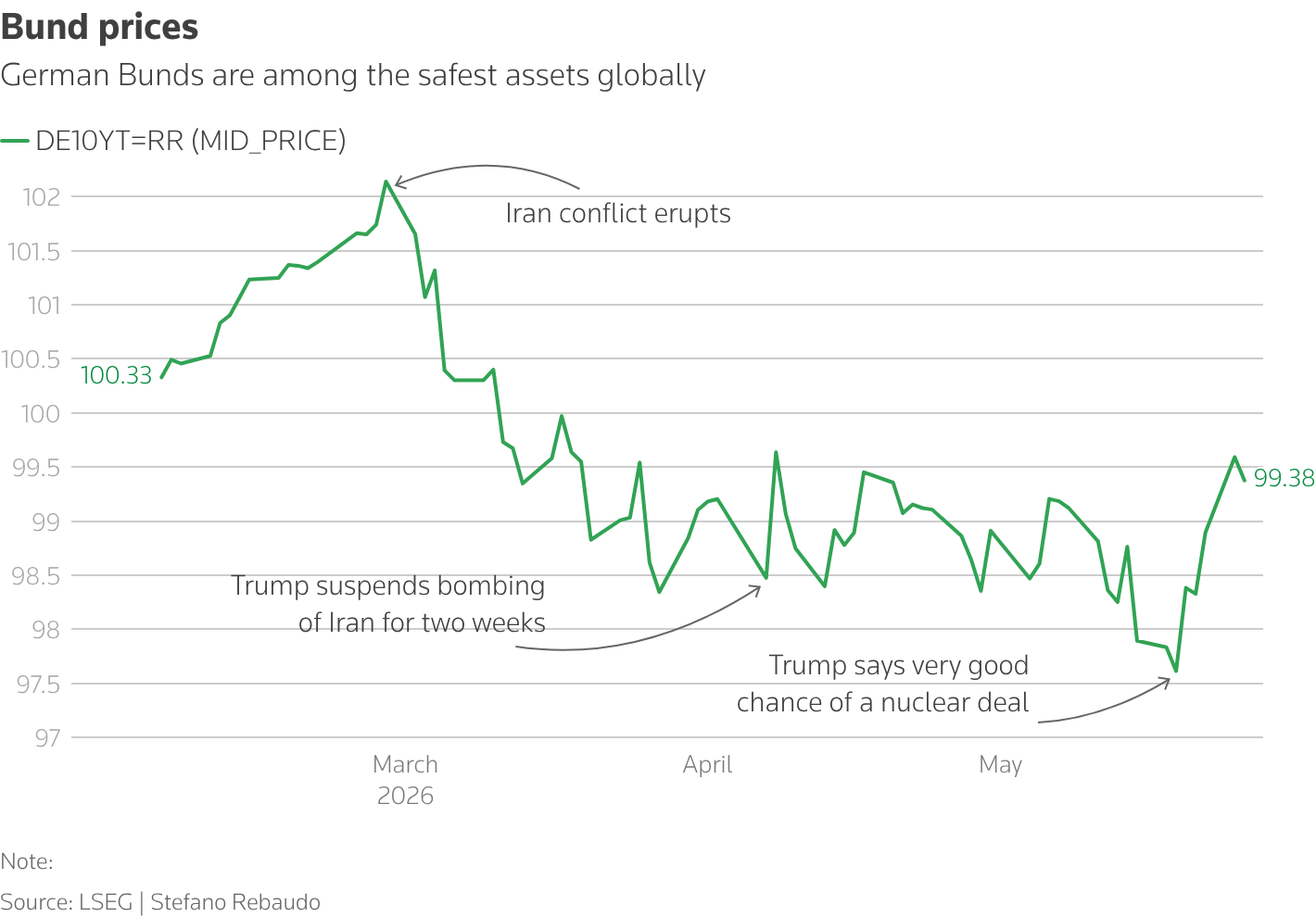
    However, the pressure on debt markets means that since late February, safe-haven 10-year Treasuries have ​delivered negative returns of 1.5%, which, annualised, is a negative return of 5.4%.

    German 10-year Bunds have returned a negative 2.4%, or negative 8.7% on an annualised basis, compared with returns ​of 9% for the S&P 500 since the start of the war – or 39% on an annualised basis – according to LSEG data.

    The most recent ⁠survey of global fund managers from Bank of America showed investors are the most underweight in bonds since June 2022 and covering a short position in fixed income right now would qualify as ​a contrarian trade.

    Even with this most recent wobble in AI and tech stocks, equities are expensive and, with the arrival of another set of high-flying megacaps, such as SpaceX or OpenAI, they could become ​even more so, while the rise in bond yields means fixed income is cheaper than it has been in years.

    Stocks from Seoul, to Frankfurt and New York are around record highs and valuations higher than they have been in months or even years.
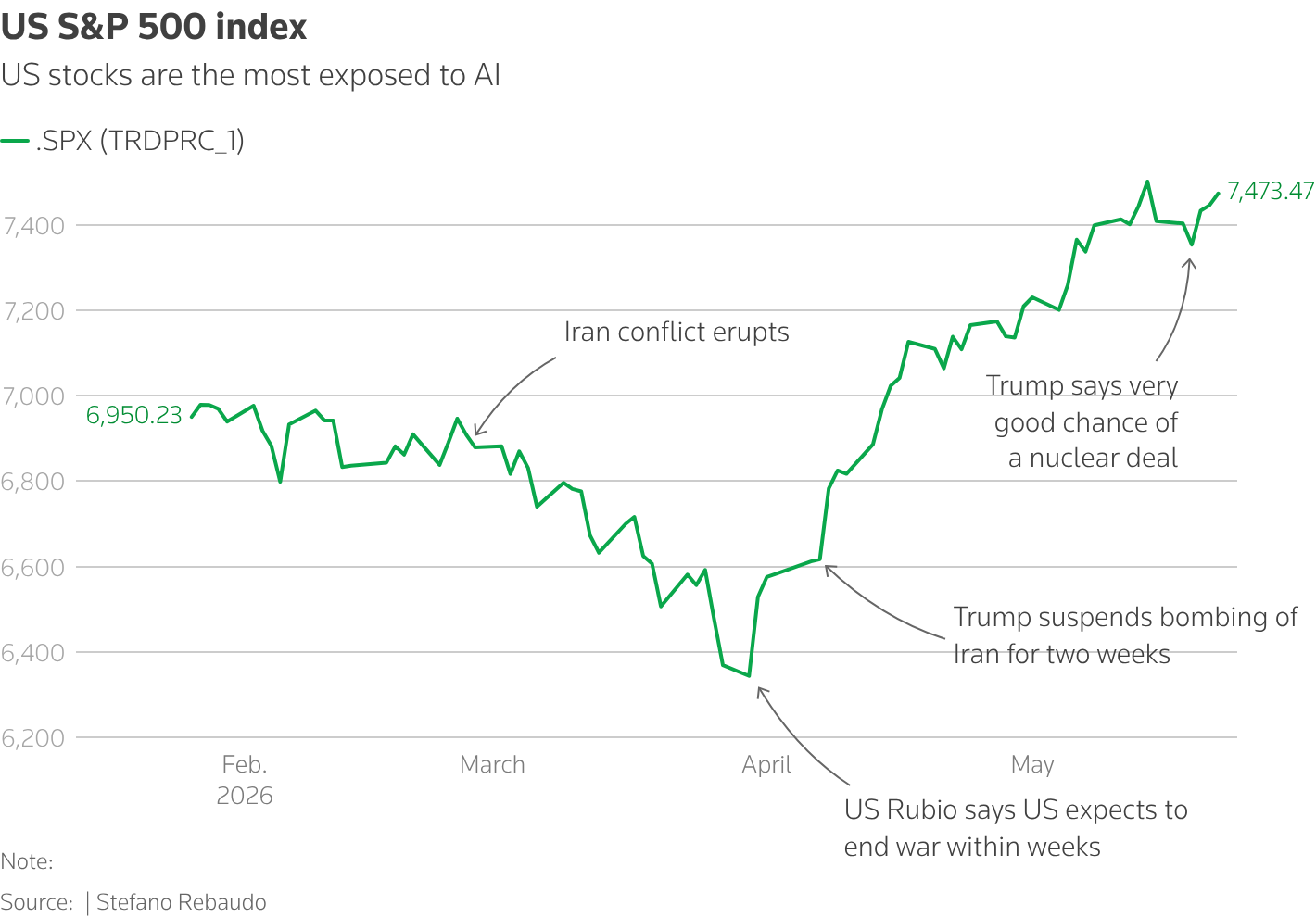
    US stocks hit fresh all-time highs despite the war
    US stocks hit fresh all-time highs despite the war
    Germany’s 10-year Bunds serve as the euro area benchmark
    Germany’s 10-year Bunds serve as the euro area benchmark

    “If you look around the globe, fixed income markets look very attractive; and this is also true in jurisdictions that have historically not been overly attractive like Europe and Japan,” said Konstantin Veit, a ​portfolio manager at PIMCO, the world’s largest bond investor.

    “It’s hard to make the case that equities look very compelling,” he added.

    Meanwhile, Bund yields are around 15-year highs of 3.1%, while 10-year Japanese debt, ​at 2.6%, hasn’t yielded this much in nearly 30 years.

    If the Strait of Hormuz — the major choke-point for global oil flows that has been effectively shuttered during the conflict — reopens, current bets on rate rises could ‌unravel, which would ⁠help bonds. Similarly, if it remains closed long enough to threaten global growth, bonds could benefit.

    “Inflation is already appearing in global data, with a risk of second-round effects via supply chains and input costs. Growth risks appear less fully priced though, which means that bond yields could fall back once inflation fears have peaked,” HSBC Private Bank strategists said in their mid-year outlook at the end of May.

    THE DYNAMIC FLIPS IF THINGS GET TOUGH

    A further escalation in the conflict, or a lengthy closure of the Strait of Hormuz, which handles around 20% of the world’s daily fuel needs, could push oil ​well above $100, heightening concerns about the negative economic ​impact of an energy shock.

    “While the diversification ⁠on bonds has been disappointing so far, we do think that it will improve and materialise when it really matters,” Andrew Sheets, global head of fixed income research at Morgan Stanley, said.

    “Were the price of oil to spike to our commodity team’s bear case to $130-$150 a barrel, we think yields ​would start to fall as markets will turn more concerned of the effect of all of this on growth,” he added.

    BONDS WILL KEEP ​HAVEN STATUS IN SUPPLY-CHAIN SHOCKS

    Oil ⁠isn’t the only risk. If rising risks around Taiwan or renewed U.S.-China tensions led to disruption in flows of critical inputs such as rare earth materials, or semiconductors, that could go straight to the heart of corporate profitability and hurt stocks.

    “If you have a geopolitical event that will impact the production of semiconductors, that’s going to impact massively financial markets,” with the tech sector on the front line, said Yoram Lustig, head ⁠of global investment ​solutions, EMEA at T. Rowe Price.

    The rate outlook is key as well. The Federal Reserve looks more likely to ​lean in favour of rate hikes, which the bond market has already factored in, but the stock market may not.

    “Should an aggressive Fed hiking cycle materialise, then I think that would be an environment where risk assets, including equities, would not ​do particularly well,” PIMCO’s Veit said, adding that this is not his firm’s base case for the U.S. rate outlook.

    Reporting by Stefano Rebaudo; Editing by Amanda Cooper and Andrew Heavens

    Our Standards: The Thomson Reuters Trust Principles., opens new tab

    Purchase Licensing Rights


    Source link

    Share. Facebook Twitter Pinterest LinkedIn Tumblr Telegram Email

    Related Posts

    Investors press for higher interest rates to lend to government in bonds market

    June 10, 2026

    Romania cuts coupons on retail government bonds, but adds 10-year maturity for local currency

    June 10, 2026

    NS&I explains reason for Premium Bonds £1 rule

    June 8, 2026
    Leave A Reply Cancel Reply

    Top Posts

    The Shifting Landscape of Art Investment and the Rise of Accessibility: The London Art Exchange

    September 11, 2023

    Charlie Cobham: The Art Broker Extraordinaire Maximizing Returns for High Net Worth Clients

    February 12, 2024

    The Unyielding Resilience of the Art Market: A Historical and Contemporary Perspective

    November 19, 2023

    The Evolution of Art and Art Investments: A Historical Perspective on Fruitful Returns and Wealth Management

    August 21, 2023
    Don't Miss
    Mutual Funds

    ETF assets are surging. Here’s how they differ from mutual funds

    June 10, 2026

    Investors have a growing list of exchange-traded funds (ETFs) and mutual funds that they can…

    AMFI Data Decoded: Equity Mutual Fund Inflows Fall To One-Year Low, Gold ETF Record 1st Outflow in 13 Months

    June 10, 2026

    Infra funds steal the show: 5 schemes among top 10 SIP performers over the last decade – Money News

    June 10, 2026

    Direxion to Split Nine ETFs

    June 10, 2026
    Stay In Touch
    • Facebook
    • Twitter
    • Pinterest
    • Instagram
    • YouTube
    • Vimeo
    EDITOR'S PICK

    Leveraged ETFs: What Are They and How Do They Work?

    June 4, 2023

    Market Downturn? Why Mutual Funds Could Be Your Best Bet Right Now by Fincover®

    March 10, 2025

    Japan Property Prices: The Cost of Housing

    July 22, 2024
    Our Picks

    ETF assets are surging. Here’s how they differ from mutual funds

    June 10, 2026

    AMFI Data Decoded: Equity Mutual Fund Inflows Fall To One-Year Low, Gold ETF Record 1st Outflow in 13 Months

    June 10, 2026

    Infra funds steal the show: 5 schemes among top 10 SIP performers over the last decade – Money News

    June 10, 2026
    Most Popular

    🔥Juve target Chukwuemeka, Inter raise funds, Elmas bid in play 🤑

    August 20, 2025

    💵 Libra responds after Flamengo takes legal action and ‘freezes’ funds

    September 26, 2025

    ₹9000 monthly SIP can help you retire at 45 with ₹2 lakh monthly pension

    May 5, 2026
    © 2026 Fund Focus News
    • Get In Touch
    • Privacy Policy
    • Terms and Conditions

    Type above and press Enter to search. Press Esc to cancel.