
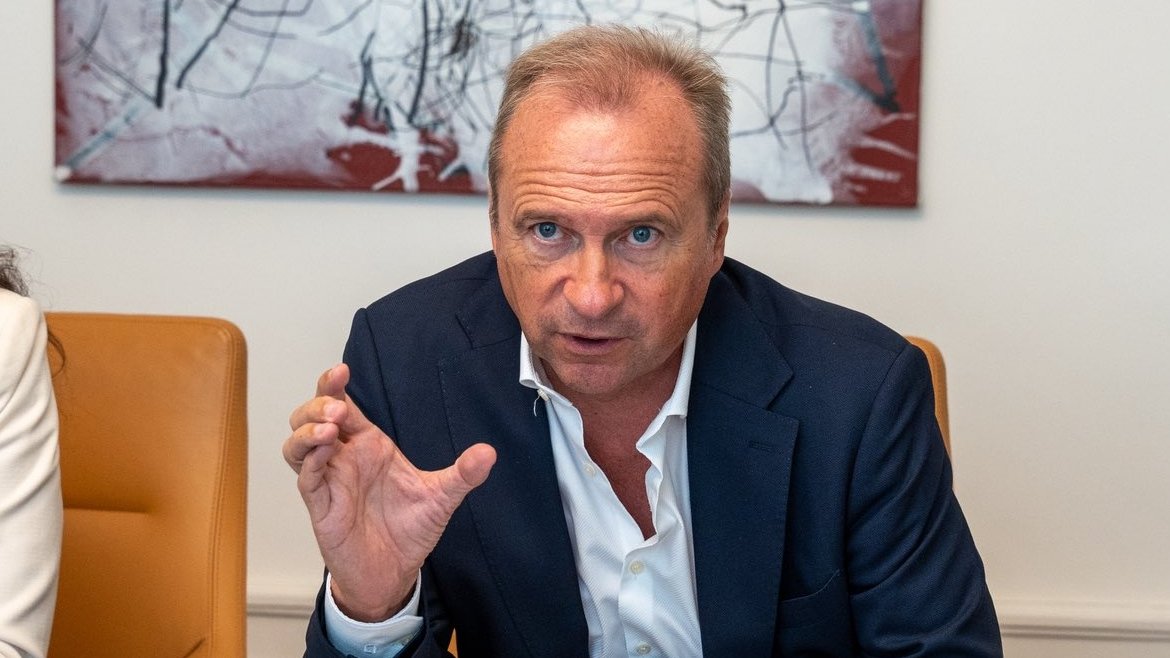
Luxembourg will not renew its approval for the sale of Israel Bonds in the European Union, the country’s finance minister has confirmed.
In an interview with broadcaster RTL, Gilles Roth said the decision had been taken solely by the CSSF, Luxembourg’s financial regulator, which he said had decided two months ago not to extend the bond programme beyond its 31 August expiry date.
Campaign groups in Luxembourg and across the EU have long called for Israel Bond sales to European investors to be stopped. As previously reported by Middle East Eye, they say the programme, which raises billions of dollars for the Israeli government, has helped fund Israel’s wars in Gaza, Lebanon and Iran.
Roth defended the CSSF against criticism, arguing that the regulator had followed European criteria throughout and that many of the accusations levelled at it were unwarranted. The discontinuation, he insisted, was a matter of regulatory compliance rather than political pressure.
That account, however, sits awkwardly within the chronology of recent events.
New MEE newsletter: Jerusalem Dispatch
Sign up to get the latest insights and analysis on
Israel-Palestine, alongside Turkey Unpacked and other MEE newsletters
A decision taken two months ago by the CSSF would place it in May, at the height of a legal and political campaign against the bonds – and campaigners who spent months being told the government had no power to act will note that the outcome matches precisely what they were demanding.
The confirmation also follows a public statement issued by Amnesty International on 21 July warning that Luxembourg and all EU member states must stop the sale of Israel bonds or risk complicity in Israel’s genocide against Palestinians in Gaza.
Unless another member state now agrees to take on the programme, the bonds can no longer be sold to investors across the EU.
What are ‘Israel Bonds’?
Israel Bonds are issued through the US-registered Development Corporation for Israel (DCI) and marketed with the slogan “Stand with Israel. Israel is at War”.
They are not ordinary bonds, like those issued by the Israeli government itself. Israel Bonds are retail bonds sold directly to ordinary members of the public, religious organisations and local government funds – often through diaspora networks and appeals to solidarity.

Since October 2023, they have raised $7.7bn for the Israeli government, according to figures published by DCI itself.
Proceeds then flow as unrestricted general financing into Israel’s treasury at a moment when military expenditure has surged from roughly 20 percent to over 30 percent of total government consumption.
Since Luxembourg’s approval last September, the bonds have been offered to the public in Austria, France, Germany, Luxembourg, and the Netherlands.
Luxembourg’s role as the EU’s regulatory home for Israel Bonds came about through a chain of political pressure elsewhere in Europe.
For years, the programme had been anchored in Ireland, with its central bank serving as the EU regulatory gateway – a role that had previously fallen to the UK before Brexit.
But sustained parliamentary and civil society pressure in Dublin – linking the bond sales to the financing of military operations in Gaza – eventually forced a change.
In September, Ireland’s Central Bank governor Gabriel Makhlouf wrote to the Oireachtas finance committee confirming the bank would not renew its approval.
The CSSF stepped in the same day, approving a fresh 12-month prospectus – without first consulting Luxembourg’s Ministry of Foreign and European Affairs.
From that moment on, the Luxembourg government insisted the matter was out of its hands.
When activists from the Stop Israel Bonds campaign protested outside the finance ministry this spring, Roth’s office issued a statement saying only that “the CSSF is the competent authority” – the same line given to journalists in February, and repeated by ministers when questioned in parliament in late May.
‘Morally and legally wrong’
Pressure on Luxembourg had been building across several fronts, and it peaked in May.
That month, Amnesty International Luxembourg and the Committee for a Just Peace in the Middle East convened a conference in the capital, bringing together legal scholars, economists, parliamentarians and international law experts to examine the country’s legal exposure over the bonds.
‘If no EU member states step in after Luxembourg, it could force Israel to default on some of its debt, and at the very least will crash the value of the bonds’
– Shir Hever, political economist
A detailed legal report released at the event concluded that Luxembourg’s approval risked violating its obligations under the Genocide Convention and the International Court of Justice’s Advisory Opinion of July 2024.
It also raised investor protection concerns, arguing that DCI’s marketing obscured material financial and legal risks.
Despite Israel being at war and running a deficit of nearly seven percent of GDP, the bonds yield less than four percent – far below the returns investors would typically demand in wartime.
Francesca Albanese, the UN special rapporteur on the occupied Palestinian territories, addressed the conference and was unsparing.
“The sale of these bonds is illegal under international law because it goes directly to funding the genocide,” she said.
“It is morally and legally wrong to sell these bonds.”
Dr Shahd Hammouri of Law for Palestine, one of the report’s authors, argued that the CSSF had possessed – and failed to exercise – the discretion to refuse.
“Luxembourg did have discretionary authority under the prospectus regulation to refuse the approval whenever there are systematic risks to public interest, peace, and the maintenance of an unlawful regime,” she said.
Irish Senator Alice-Mary Higgins, who had helped force the original transfer out of Ireland, told the conference what was at stake if Luxembourg walked away.
“There is no other placement: unless we agree to transfer it as the home state, and another country agrees to take it, Israel cannot sell its bonds within the EU,” she said.
What happens next?
EU regulations permit Israel to seek a new home for the bonds among the bloc’s 27 members.
Campaigners behind the Stop Israel Bonds initiative – coordinating pressure across Luxembourg, Ireland, and the wider EU – have been explicit that preventing a transfer to Germany or another willing host is their next objective.
Speaking to MEE after the announcement, political economist Shir Hever, who addressed the May conference, said the consequences could extend well beyond Luxembourg.
“Israel finances its wars with debt,” he said. With the Israeli economy under severe strain and skilled workers emigrating, “bonds raise money which keep the war machine marching at the cost of a growing debt”.

He credited the Luxembourg decision to pressure from the Boycott, Divestment and Sanctions movement and civil society groups, and said it could prove a turning point.
“If no EU member states step in after Luxembourg, it could force Israel to default on some of its debt, and at the very least will crash the value of the bonds,” he said.
“Anyone who was stupid enough to buy the bonds will lose some or all of their investment. It could mean a tipping point for Israel’s economy as well. A state in default cannot import weapons and ammunition,” he adds.
Amnesty has made the same argument, calling on Ireland, as the bonds’ former host state, to decline any transfer request, and on all other EU member states to refuse to accept the transfer or approve a new prospectus.
“It is a political choice to allow these bonds to be sold in Europe,” Steve Cockburn, Amnesty International’s regional director for Europe, said in the organisation’s 21 July statement.
“One of the most obvious and effective ways to end Israel’s genocide against Palestinians in the Gaza Strip is to stop financing it. By continuing to facilitate the sale of these bonds, EU member states risk complicity in Israel’s international crimes against Palestinians.”
Between 2022 and 2024, Israel’s military budget grew from 4.2 percent to 8.3 percent of GDP.
MEE has approached the CSSF and Luxembourg’s Ministry of Finance for comment on the terms and timing of the non-renewal.