
The Conversation, CC BY
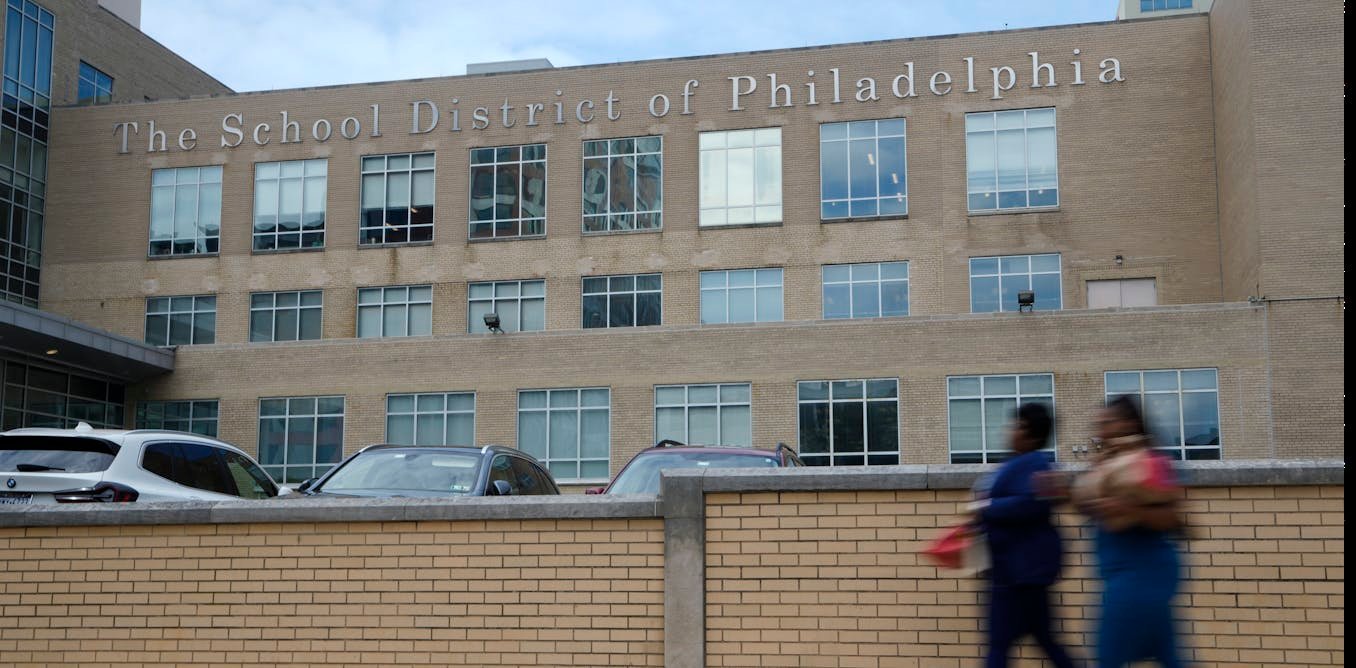
Many of Philadelphia’s schools are in terrible shape. The average public school building in the city is over 70 years old, and some are over 120 years old. The state of disrepair, including a lack of air conditioning and incidents of untreated asbestos, mold, crumbling ceilings and flooded hallways, is well documented.
I am a scholar of school finance, with an emphasis on infrastructure. My colleague Camika Royal, who’s an expert on urban education and Philadelphia schools, and I wanted to figure out why the city’s school buildings are like this.
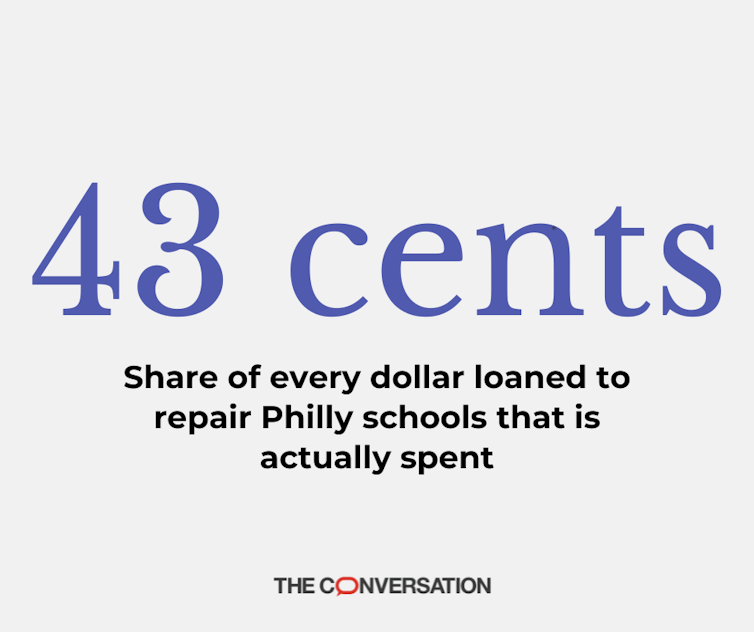
We found that one key figure explains the dire state of the city’s school buildings: Only 43 cents of every dollar loaned to the School District of Philadelphia in recent decades to maintain and repair its buildings was actually spent.
In other words, a majority of the money – the other 57 cents per dollar – meant for building and maintaining Philly schools during the nearly 30-year period we studied, from 1993 to 2021, never actually reached Philly schools.
This is not due to money going missing. Rather, it is an indicator of the overall inefficiency of how maintenance and repairs to Philly’s public school facilities are financed.
Our analysis was published in the June 2024 edition of the peer-reviewed Journal of Educational Administration and History.
Reliance on Wall Street
Pennsylvania, unlike states such as Massachusetts and Wyoming that have robust policies for financing school infrastructure, does not have a statewide program that provides sufficient revenue for school facilities.
The commonwealth’s PlanCon program, for instance, which had reimbursed districts for building costs, was defunded in the wake of the 2008 financial crisis. It hasn’t been fully restored.
While Gov. Josh Shapiro signed the Public School Facility Improvement Grant Program into law in 2024 to provide grants for school buildings statewide, the program – funded with US$100 million – is pitifully small. Philly’s school buildings alone need at least $7 billion for repairs and upgrades, according to Superintendent Tony Watlington.
To get the money it needs for its buildings and infrastructure, the School District of Philadelphia has to sell itself as an investment product on Wall Street. This is done through municipal bonds.
Municipal bonds are basically big loans for local governments’ capital projects.
Investors purchase these municipal bonds because they can make tax-free income when the school district pays them back with interest.
Financial consultants, credit raters, bond lawyers and private banks all benefit from this system as well, since they charge fees for the services helping investors front their money to school districts.
Market mayhem
The municipal bond market is subject to the erratic, competitive and unstable tendencies of Wall Street finance.
Imagine a rusty, outdated plumbing system that’s supposed to get water from a reservoir to a community. While the reservoir might have a lot of water in it, if the pipes are poorly designed and leaking, or the reservoir itself is badly maintained, much less water can get to the community than might be available. It could be that for every 100 gallons of water available, the community gets only 43 gallons.
Looking at the financial history of the school district’s relationship to the municipal bond market from 1993 to 2021, we found two main reasons for the failure of this funding model.
The first is the chaos in credit markets from 1993 to 2001.
In 1986, the Tax Reform Act regulated private banks, making it harder for them to buy and sell private activity bonds, and also taxed interest on certain bonds. This prompted many banks to pull out of that market, reducing their share of municipal debt by 15%. Credit supply went down, demand went up, and so did prices – making it more expensive for municipalities like Philadelphia to borrow.
Then, in 1987, the savings and loan crisis caused state budgets to contract nationally by 5%. This reduced Philadelphia School District revenue, making it more difficult to repay previous bonds while also necessitating further lending.
The second key reason relates to predatory investing strategies that lawmakers and the financial industry use to secure money for the district’s buildings.
After deregulating the kinds of bonds that local governments could sell in 2003, Pennsylvania took control of the Philadelphia School District’s finances. Under the leadership of former Superintendent Paul Vallas, the district used risky and predatory market instruments that ultimately led to a $330 million loss in the wake of the 2008 financial crisis.
Green New Deal for schools
An efficient policy for financing school infrastructure would yield a number closer to a dollar spent for every dollar received in loans. We conclude our paper with recommendations for policies we believe would be more efficient and just.
These include setting up a National Infrastructure Bank at the federal level that would provide appropriate loan financing for collective goods such as school infrastructure. Also, U.S. Rep. Jamaal Bowman of New York has proposed a Green New Deal for Schools that would provide more than $1 trillion in grants for social and physical infrastructure.