

Last time, I wrote about how one should hold ‘bonds’.
Bond funds discard the greatest advantage of ‘not losing principal.’
Foreign bonds carry significant currency risk.
Since the priority is not losing assets, unlike with stocks, ‘cash’ is basically sufficient.
For the portion of ‘cash’ that won’t be moved for a while, use ‘Individual Government Bonds (10-year variable)’ to gain additional returns.
‘Bonds’ should be held this simply.
Then, this kind of talk inevitably comes up.
“Aren’t there bonds with high yields even in yen? 🤗 That seems more delicious than government bonds, doesn’t it? 🤭💖”
Yes, there are.
Social lending.
Crowdfunding for real estate.
Things I don’t really understand but claim ‘guaranteed 10% annual interest.’
“Kyaa~😍 10% annual interest is just the best~💖 This is guaranteed, right⁉️”
…….
If you can’t buy it at a brokerage firm and institutional investors aren’t buying it.
Understand that at this point, it’s an out-of-the-question deal.
If it were a legitimate product, institutional investors would have incorporated it into their asset portfolios based on certain rules.
Therefore, I will not explain these at length.
So-called ‘structured bonds’ for individuals, created solely for banks to make a profit, are also out of the question. They are at a level where the Financial Services Agency has issued warnings.
In this way, ‘high-yield bonds’ are crawling with trap-like products.
Why?
That is because they can line up the words that people without investment knowledge like the most.
‘Guaranteed every year’ and ‘Same results for everyone.’
First of all, decent products themselves are limited.
Dodging that trap.
The only ‘high-yield bonds’ worth discussing as an alternative to government bonds are limited to the following.
-
Investment-grade bonds such as municipal bonds
-
Corporate bonds that are not structured bonds (e.g., SoftBank corporate bonds)
The interest rate spread over government bonds is at most around +2%.
Should this be used for asset building?
At the risk of criticism, I will write down my personal assessment.
Bonds are easy to frame with ‘attractive language’
If you assume you will hold them until maturity, the amount you will receive in a few years is fixed.
‘You are guaranteed to receive 5% annual interest, which is higher than government bonds.’
‘If you hold until maturity, your principal is guaranteed to be returned.’
At first glance, it seems ‘safe’.
However, high-yield bonds are not ‘risk-free.’
It is just that the ‘risks are hard to see.’
One day, suddenly, a major problem occurs.
Interest payments stop.
The principal is not returned as scheduled.
That is how it manifests.
‘But, doesn’t that rarely happen? 🥺💦’
Yes.
In Japan, for legitimate public corporate bonds, safety is strictly required, so there are only a handful of actual cases of bankruptcy.
However.
The problem is not the ‘frequency of occurrence.’
I do not recommend it because aiming for returns in this style itself becomes a terrible experience for an investor.
High-yield bonds are the ‘opposite of life insurance’.
Let me give you an easy-to-understand analogy.
“If you close your eyes and cross this road, I’ll give you 1,000 yen.”
Suppose you are told this.
You cross once.
You’re fine.
You cross twice.
You’re fine again.
Now, here is a question.
“Will you continue to earn this 1,000 yen every single day?”
Even if the probability is 0.01%,
the potential profit and the potential damage in the worst-case scenario do not balance out.
I think everyone considers high-yield bonds thinking, ‘I’ll just make a little extra money like pocket change.’
However, what you are actually doing is like closing your eyes and crossing the road to get 1,000 yen.
A bet where ‘there is a 0.1% chance of dying, but you get 10,000 yen’.
Actually, it is easy to make money with a bet like this.
You can definitely make a profit 10 times, or even 20 times.
You won’t be able to stop laughing.
You will think you have a talent for investing.
However.
An investor who grows up learning that this is ‘investing’ will be ruined after 10 years.
It is also easy to understand if you reverse ‘life insurance’.
Life insurance is…
The probability of it happening is less than 1%.
However, if it does happen, you will be in such financial trouble that your life could be ruined.
It is a product designed to prepare for such losses.
For that purpose, you pay a small insurance premium every month.
In other words,
You give up small, steady gains to avoid a massive loss.
This is what life insurance is.
“High-yield bonds” are the exact opposite.
You accept the possibility of a catastrophic loss in order to gain small, steady returns.
This is what “high-yield bonds” are.
Even if you have 20 million yen, it only grows by 20,000 yen a year.
At this point, I think some might have this opinion:
“Well then… wouldn’t it be fine to just buy ‘high-yield bonds’ with an amount that you could afford to lose if the worst happens…? 🥺💖✨”
If that’s the case, then it’s acceptable.
If you limit it to an amount you can afford to lose, then taking that gamble is fine.
So, specifically, what kind of return would that be?
For example.
Assets of 20 million yen.
60% in index funds.
40% in safe assets. Of that, 20% in government bonds for individuals.
Let’s assume you take half of this government bond portion—2 million yen, which is 10%—and switch it to high-yield SoftBank bonds. In this case, even in the worst-case scenario, your investment life won’t be over.
“Individual Government Bonds: Fixed 3-Year”
vs
“3-Year Maturity SoftBank Corporate Bonds”
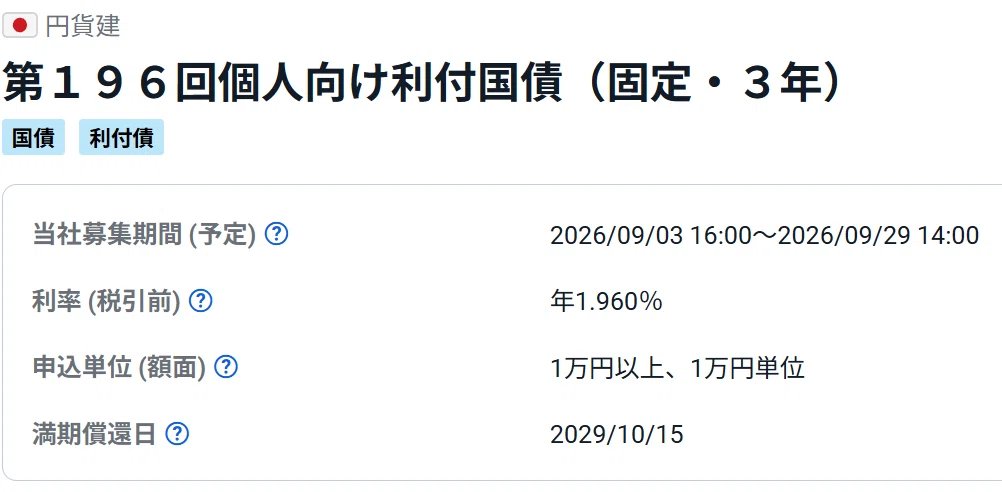

Roughly speaking, you get an additional annual yield of +1%.
The increase in profit is,
2 million yen × 1%.
That is 20,000 yen per year.
With a 20 million yen portfolio, that is only an additional return of +0.1%.
“Well… well then, what if I increase the ratio…! 🥺”
Beep!!
I told you at the beginning, didn’t I?
“Only as much as you can afford to lose entirely.”
The more correctly you buy high-yield corporate bonds, the more limited your purchase capacity becomes.
And the impact ends up being negligible.
Roughly speaking.
Even at a portfolio size of 20 million yen, it’s 20,000 yen a year.
If your stock ratio is high, or if you prioritize liquidity,
the additional return becomes even smaller.
Conversely, some people think, “Even 20,000 yen is a good deal!”
If you are someone who can construct a portfolio meticulously, it is possible to include some “high-yield bonds.”
If you are unsure,
“Do I want a +0.1% bonus on my total investment amount, even if it means carrying anxiety?”
is how you should think about it.
However, I personally do not recommend it.
An asset portfolio should be kept simple, even if it means losing a little money.
“You can eliminate one source of anxiety for a 0.1% cost? That’s a good service, I’ll pay for it.”
In my world, that is how this choice looks.
Corporate bonds are also difficult to diversify.
There is another problem.
High-yield corporate bonds are exactly what you want to diversify even more than stocks.
However, the types of high-yield corporate bonds available in yen are extremely limited.
In reality, it’s basically just SoftBank corporate bonds.
When it comes down to it, this is no different from betting everything on the investment company SoftBank.
If the stock price crashes, who knows what might happen to SoftBank.
“If things get tough, I’ll just sell them, right…!?😲”
When a real recession hits, high-yield corporate bonds will be the first thing nobody wants to buy, even before stocks. In other words, you won’t be able to sell them.
You will just have to wait for many long years until maturity while carrying that anxiety.
Is the anxiety you’re carrying worth the extra 1% annual return?
Bonds are not a place to increase your returns.
An asset portfolio should be simple enough for a child to handle.
Assets that take on risk to earn returns = Stocks.
Assets to prepare for a stock market crash = Cash.
Among cash, the portion you won’t use for a while = Government bonds.
It should have been as simple as that.
“Whoa! What is this!?😲 The yield is so high!?🥹💖✨”
Giving in to temptations like this, you end up diving into risks that could ruin your life before you know it.
Giving up small change you could have otherwise received to prepare for losses that would ruin your family.
That is what life insurance is.
Giving up small change you could have otherwise received to prepare for losses that would ruin your assets.
That is what bonds are.