
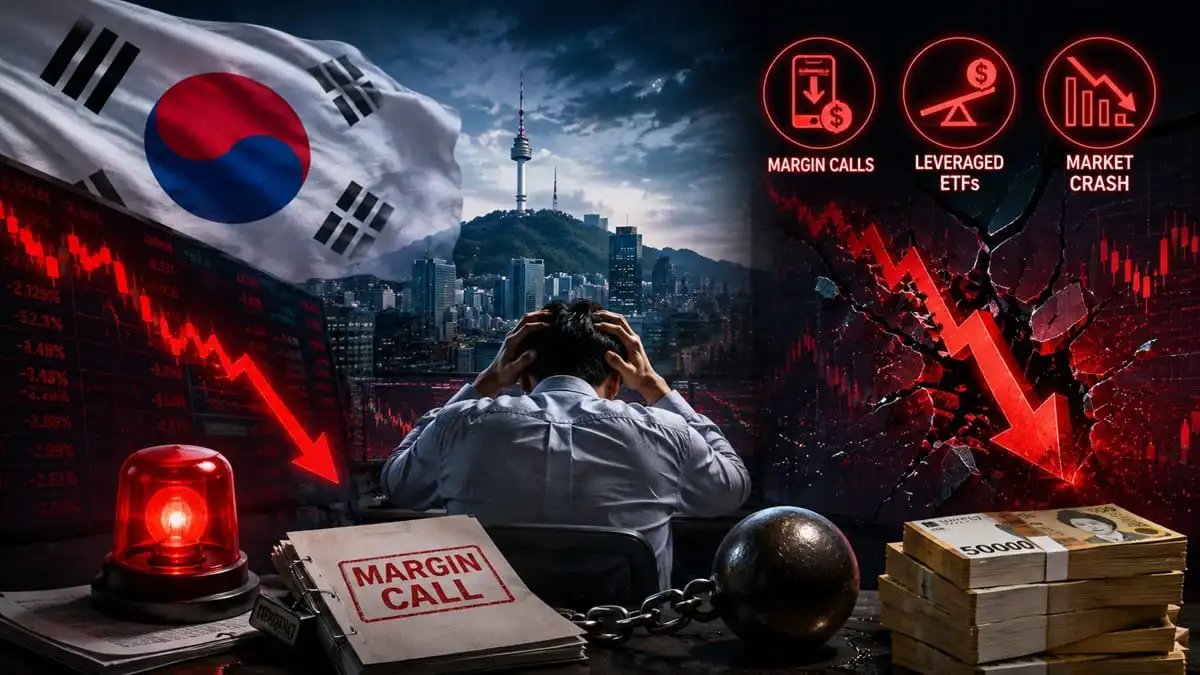
South Korea’s stock market has become one of the world’s biggest financial paradoxes. The KOSPI index, which surged on the back of the global artificial intelligence (AI) boom over the past year, has witnessed one of its sharpest corrections in recent weeks. The sell-off has been so severe that the country’s top policymakers have publicly apologised over the launch of single-stock leveraged Exchange-Traded Funds (ETFs), which are now being blamed for amplifying the market rout.
According to Goldman Sachs estimates, more than 1.2 million leveraged retail trading accounts had received margin calls by July 13, while between 320,000 and 360,000 accounts had been completely liquidated. If these estimates are accurate, around 3.4% of South Korea’s adult population received margin calls during the recent market turmoil.
A margin call occurs when investors who have borrowed money to invest are asked to deposit additional funds after the value of their investments falls. If they fail to do so, brokers can sell their holdings to recover the borrowed amount.
The situation became so critical that the South Korean government tightened regulations governing leveraged ETFs. But how did a market correction end up wiping out hundreds of thousands of retail investors?
The correction has come despite record earnings from semiconductor giant Samsung Electronics and historic profits at SK Hynix, highlighting how excessive leverage, crowded positioning and sky-high expectations can outweigh even exceptional corporate performance.
South Korean government apologises
On Wednesday, South Korea’s Finance Minister Koo Yun-cheol apologised for introducing single-stock leveraged ETFs, admitting the product was rolled out without sufficient consideration, Reuters reported. Responding to lawmakers during a parliamentary session, Koo said he was sorry for the decision. The country’s top financial regulator also issued an apology.
Financial Services Commission Chairman Lee Eog-weon acknowledged criticism that regulators had failed to adequately assess the risks posed by the products.
“As the ultimate authority responsible for the financial markets, we feel sorry that we have fallen short in properly meeting the public’s expectations,” Lee told lawmakers.
The statements came after opposition and ruling party legislators questioned regulators over the role leveraged ETFs played in accelerating the stock market’s decline.
What triggered the crash?
The sell-off has largely centred around South Korea’s semiconductor heavyweights Samsung Electronics and SK Hynix, which together account for nearly half of the KOSPI’s market capitalisation.
Retail investors had poured billions of won into leveraged ETFs linked to these companies, betting that the AI-driven semiconductor boom would continue uninterrupted. Unlike traditional ETFs, leveraged ETFs are designed to amplify both gains and losses of the underlying stock or index. As the underlying shares began to fall, leveraged investors faced margin calls and were forced to unwind their positions, creating a vicious cycle of selling.
As chip stocks declined, forced liquidation added further downward pressure on prices.
On Wednesday alone, Samsung Electronics fell by as much as 14%, while SK Hynix dropped nearly 20%, despite announcing record quarterly results.
| Stock | Price (KRW) | 1D | 1W | 1M | 1Y |
| Samsung Electronics (005930) | ₩207,000 | -0.72% | -23.33% | -38.02% | +185.12% |
| SK Hynix (000660) | ₩1,322,000 | -5.64% | -31.11% | -50.11% | +401.71% |
| KOSPI | ₩5,593.56 | -1.23% | -21.18% | -34.01% | +71.87% |
The episode highlights a common investing mistake seen during strong bull markets. When markets keep rising, many investors begin taking higher risks in the hope of earning even bigger returns. But when sentiment reverses, leverage can magnify losses just as quickly as it magnifies gains.
AI boom meets valuation reality
Ironically, the correction has unfolded even as South Korea’s semiconductor industry continues to deliver record financial performance.
According to Investing.com, SK Hynix posted what has been described as the strongest quarterly performance in Korean corporate history, reporting:
Revenue of 79.32 trillion won, up 257% year-on-year
Operating profit of 60.54 trillion won
Operating margin of 76%
Yet the company’s shares fell nearly 9% on the day the results were announced.
KOSPI’s dramatic reversal
The volatility has been extraordinary. The KOSPI remains up nearly 72% over the past year, reflecting the massive AI-driven rally. However, the benchmark has plunged 34% in just one month, making it one of the steepest declines among major global equity indices.
The report also noted that more than half of all circuit breakers ever triggered in the history of the KOSPI have occurred in the past six months, highlighting the intensity of recent market swings.
While India’s regulatory framework is different from South Korea’s, the incident offers valuable lessons for retail investors everywhere. The basic principles of investing remain the same—avoid excessive leverage, diversify your portfolio and understand the risks before chasing higher returns.
Key lessons Indian investors can learn from this incident in South Korea
- Fully understand the risks before investing with borrowed money
Using borrowed money for investing can increase profits, but losses can grow just as quickly. Even a small market correction can lead to significant losses. If you do not fully understand how leverage works and the risks involved, it is better to avoid investing with borrowed funds.
- Margin calls do not wait for the market to recover
Many investors believe that if the market falls, they can simply wait for it to recover. But if you have invested using borrowed money, you may not have that option. If the value of your investments falls below a certain level, you may be asked to deposit additional funds or securities. If you fail to do so, your broker may sell your holdings. Even if the market recovers later, those losses cannot be reversed.
- Do not invest in products you do not understand
Many investment products that promise higher returns also carry higher risks, and leveraged ETFs are one such example. They are not suitable for every investor. If you do not understand how a product works or the risks involved, it is better to stay away from it.
- Avoid putting too much money into a single sector or stock
When a particular sector or stock performs well for a long period, the temptation to invest more money in it increases. But the same sector can witness the sharpest correction when market sentiment changes. Diversifying investments across sectors and asset classes can help reduce risk and protect your portfolio during periods of volatility.
- Know your risk tolerance before chasing higher returns
Before investing, ask yourself a few simple questions. What happens if the market falls by 20% or 30%? Can I comfortably absorb such losses? Will I need this money in the next few years? Successful investors think about both returns and risks before making investment decisions.
- Higher returns usually come with higher risk
Investments that offer the potential for higher returns usually come with higher risk. If an investment can significantly increase your gains, it can also magnify your losses. Never make an investment decision by looking only at the return potential.
- Do not mistake a bull market for investment skill
When markets continue to rise, almost every investment appears successful. This can give investors a false sense of confidence. The real test comes when markets decline sharply. If your portfolio can withstand a major correction without forcing you to panic or sell, it is more likely to be built on sound investing principles.
Disclaimer: This article provides factual analysis only and should not be construed as investment advice or a recommendation to buy or sell any security. Investors should conduct their own due diligence and consult a SEBI-registered investment adviser or financial professional before making investment decisions.