

Investment management firm Vanguard is executing forward share splits on five of its equity index exchange-traded funds (ETFs) — including 6-for-1 splits on the Vanguard Growth ETF (VUG +0.07%) and the Vanguard S&P 500 Growth ETF (VOOG 0.12%).
In a press release, Vanguard cited ETF market prices, bid-ask spreads, and trading volume as reasons it is issuing splits to improve investor outcomes.
The splits will bring the Growth ETF and S&P 500 Growth ETF from triple-digit prices to around $70 per share or lower. The Growth ETF is $420.01 per share at the time of this writing, and the S&P 500 ETF is $391.94 per share.
Here are the key differences between the two ETFs, and why both are great buys now.

Image source: Getty Images.
Two historically strong ETFs
The Vanguard Growth ETF is the firm’s flagship growth fund. It has $335.9 billion in net assets at the time of this writing, which is significantly more than $21.9 billion in net assets for the S&P 500 Growth ETF. The Growth ETF has slightly outperformed the S&P 500 Growth ETF over the last decade. But most funds have outperformed the S&P 500 (^GSPC +0.11%).
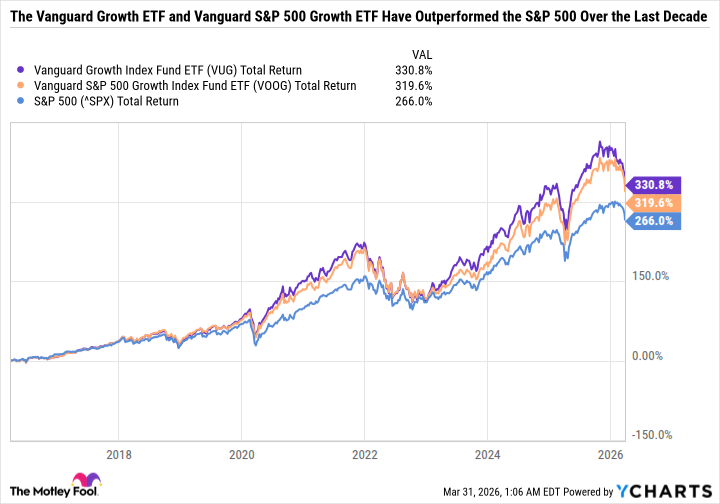
Data by YCharts.
The Vanguard Growth ETF has 151 holdings compared to 140 for the S&P 500 Growth ETF. Despite the similar historical performance and total number of holdings, the growth ETFs have noteworthy differences.
Two key differences
The biggest difference between the two funds is their allocation to Apple. The Growth ETF has a massive 12.2% weighting in Apple compared to just 6.4% for the S&P 500 Growth ETF. The lower Apple weighting allows the S&P 500 Growth ETF to allocate more to Nvidia, Microsoft, Alphabet, Broadcom, and Meta Platforms (among other names). Interestingly, the Growth ETF also has higher weightings in Amazon and Tesla.
Another key difference is that the S&P 500 Growth ETF allocates 3.1% to Berkshire Hathaway and 1.7% to JPMorgan Chase — whereas the Growth ETF doesn’t hold either of those stocks. So while the Growth ETF has just a 2% weighting in the financials sector, the S&P 500 Growth ETF is much higher at 9.7%.

Today’s Change
(0.07%) $0.33
Current Price
$441.89
Key Data Points
Day’s Range
$432.00 – $442.79
52wk Range
$316.14 – $505.38
Volume
51K
The better ETF to buy now
Both ETFs are excellent low-cost ways to get exposure to leading growth stocks. The Vanguard Growth ETF has a lower expense ratio of 0.03% compared to 0.07% for the S&P 500 Growth ETF. But even $10,000 invested in the S&P 500 Growth ETF would generate just $4 in additional annual fees compared to the Growth ETF.
Given that the expense ratios are essentially a toss-up, the decision on which fund to buy now should come down to differences in how each fund weights its top holdings.
Investors who want more exposure to Apple — and to a lesser extent, Amazon, and Tesla — should go with the Growth ETF. But investors who want less Apple and more exposure to Nvidia, other leading growth stocks, and financials should go with the S&P 500 Growth ETF.
Given Apple and Tesla are my two least favorite “Magnificent Seven” stocks, the S&P 500 Growth ETF is my preferred choice — but it all comes down to which megacap growth stocks you think are the best buys now and how each ETF complements your existing portfolio holdings.
JPMorgan Chase is an advertising partner of Motley Fool Money. Daniel Foelber has positions in Nvidia. The Motley Fool has positions in and recommends Alphabet, Amazon, Apple, Berkshire Hathaway, JPMorgan Chase, Meta Platforms, Microsoft, Nvidia, Tesla, and Vanguard Growth ETF and is short shares of Apple. The Motley Fool recommends Broadcom. The Motley Fool has a disclosure policy.