

Close Menu
Fund Focus News
    Facebook X (Twitter) Instagram
    Trending
    • The Rise of Active ETFs: Can Fund Managers Outperform Passive Investing?
    • Are low-fee ETFs really better?
    • Mutual fund investor base jumps from 1 crore to 6 crore in a decade; retail commands two-thirds of AUM
    • Wesleyan launches two new with-profits funds
    • CPP Investments Partners with EQT to Support Global Digital Infrastructure Growth
    • Best debt mutual funds by returns: Only 5 out of 520 funds delivered double-digit CAGR in the long-term – Mutual Funds News
    • Bitcoin ETFs Draw In $222M, Snapping 10-Day Losing Streak
    • Rs 10 lakh lump sum Vs Rs 10,000 SIP for 20 years – Which mutual fund investment is better? | Personal-finance
    Facebook X (Twitter) Instagram
    Fund Focus News
    • Home
    • Bonds
    • ETFs
    • Funds
    • Investments
    • Mutual Funds
    • Property Investments
    • SIP
    Fund Focus News
    Home»ETFs»What Are the Real Pros and Cons of Investing in Leveraged ETFs?
    ETFs

    What Are the Real Pros and Cons of Investing in Leveraged ETFs?

    February 15, 2026


    Many investors look at leveraged ETFs as a way to really magnify their returns. In reality, they usually do much more harm than good.

    One of the fastest-growing categories in the exchange-traded fund (ETF) marketplace is leverage. What started as a relatively small group of funds focused mostly on major indexes and sectors has grown to several hundred funds. About half have launched just since the beginning of 2025.

    In reality, leveraged products can be very dangerous if used improperly. Even when used as intended, these ETFs can expose investors to huge downside risk very quickly. As always in investing, the mantra of “know what you’re investing in” is especially appropriate here.

    In most cases, leveraged and inverse ETFs aren’t appropriate for everyday retail investors. They’re not meant for anything outside of very short holding periods. But there are situations in which they can be useful. To provide a balanced picture, let’s run down the pros and cons of investing in leveraged products.

    Yellow caution tape.

    Image source: Getty Images.

    Pro: Cheaper than doing it yourself

    If you were to attempt the strategies of these leveraged ETFs on your own, you’d need to get approved for a margin account. Trading on margin can be costly and confusing if you don’t know what you’re doing.

    By using a leveraged ETF instead, you don’t need any special approval or cash requirements up front. You simply buy and sell as you would with any other ETF. The ease of use is one of the key advantages.

    Con: Volatility is the enemy of leverage

    Volatility drag can be a real problem for leveraged ETFs. In choppy markets, big price swings often hurt returns, as the cost of daily leverage resets increases. That can actually result in negative returns for the leveraged ETF even if you get the direction correct.

    The best example of this happened during the financial crisis. The sector was swinging so violently that the returns for both the Direxion Daily Financial Bull 3x Shares ETF (FAS 0.14%) and the Direxion Daily Financial Bear 3x Shares ETF (FAZ +0.22%) were hugely negative.
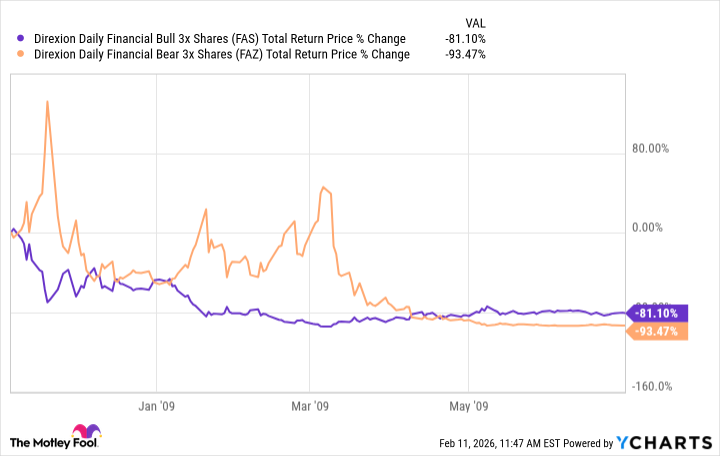
    FAS Total Return Price Chart

    FAS Total Return Price data by YCharts

    The more volatile the security, the more likely you are to experience losses at some point.

    Pro: Doesn’t require sophisticated trading knowledge

    Understanding how to layer leverage correctly and execute the trades to accomplish it can be very complex. By owning a leveraged ETF, all of that work is done for you. Traders can simply use the ETF as a tool for expressing the trade without needing to worry about the mechanics.

    Con: Decaying returns over time

    Leveraged ETFs are designed to magnify a single day’s return for a given security. Holding on to that ETF for more than a single trading day can result in much different returns over time.

    If you own a 2x leveraged ETF on a sector that moves exactly sideways, the return on that ETF will almost certainly be negative. That’s because the fund incurs costs to reestablish its leveraged position every day. Those costs will eat away at returns over time. The longer you hold the leveraged ETF, the larger the return decay.

    Overall, leveraged ETFs should be considered trading tools, not investments. They are meant to be held only for a single day, not for an indefinite period. That makes them better suited for tactical, short-term use. They’re not appropriate for a long-term buy-and-hold investing strategy.

    While they can be tempting as a way to juice returns, the downside risk is significant. Most everyday investors should just resist the temptation and avoid them altogether.


    Source link

    Share. Facebook Twitter Pinterest LinkedIn Tumblr Telegram Email

    Related Posts

    The Rise of Active ETFs: Can Fund Managers Outperform Passive Investing?

    July 3, 2026

    Are low-fee ETFs really better?

    July 3, 2026

    Bitcoin ETFs Draw In $222M, Snapping 10-Day Losing Streak

    July 3, 2026
    Leave A Reply Cancel Reply

    Top Posts

    The Shifting Landscape of Art Investment and the Rise of Accessibility: The London Art Exchange

    September 11, 2023

    Charlie Cobham: The Art Broker Extraordinaire Maximizing Returns for High Net Worth Clients

    February 12, 2024

    The Rise of Active ETFs: Can Fund Managers Outperform Passive Investing?

    July 3, 2026

    The Unyielding Resilience of the Art Market: A Historical and Contemporary Perspective

    November 19, 2023
    Don't Miss
    ETFs

    The Rise of Active ETFs: Can Fund Managers Outperform Passive Investing?

    July 3, 2026

    Key PointsHistorically, fund managers have not outperformed passive investing, but that may be changing.Higher fees…

    Are low-fee ETFs really better?

    July 3, 2026

    Mutual fund investor base jumps from 1 crore to 6 crore in a decade; retail commands two-thirds of AUM

    July 3, 2026

    Wesleyan launches two new with-profits funds

    July 3, 2026
    Stay In Touch
    • Facebook
    • Twitter
    • Pinterest
    • Instagram
    • YouTube
    • Vimeo
    EDITOR'S PICK

    First Bitcoin and now ETH ETFs: Where is the market headed next?

    July 20, 2024

    PGIM MF caps SIP in global funds

    June 4, 2026

    Barry Bonds makes honest admission about making Hall of Fame

    August 25, 2024
    Our Picks

    The Rise of Active ETFs: Can Fund Managers Outperform Passive Investing?

    July 3, 2026

    Are low-fee ETFs really better?

    July 3, 2026

    Mutual fund investor base jumps from 1 crore to 6 crore in a decade; retail commands two-thirds of AUM

    July 3, 2026
    Most Popular

    🔥Juve target Chukwuemeka, Inter raise funds, Elmas bid in play 🤑

    August 20, 2025

    💵 Libra responds after Flamengo takes legal action and ‘freezes’ funds

    September 26, 2025

    ₹9000 monthly SIP can help you retire at 45 with ₹2 lakh monthly pension

    May 5, 2026
    © 2026 Fund Focus News
    • Get In Touch
    • Privacy Policy
    • Terms and Conditions

    Type above and press Enter to search. Press Esc to cancel.