

‘Long-term investors seeking sustainable gains from resilient, fundamentally strong companies may go for these funds.’

Kindly note that this illustration was generated using ChatGPT and is intended solely for representational purposes. Any resemblance to real persons, living or dead, is purely coincidental.
Key Points
- Focus on strong companies: Quality funds invest in firms with high RoE, strong balance sheets, low debt, and consistent earnings.
- Stability with growth: These funds aim to deliver steady long-term returns with lower downside risk.
- Active vs passive choice: Active funds offer deeper research and flexibility, while passive funds provide low-cost, rule-based exposure.
- Ideal for long term: Investors should invest via SIP and stay invested for at least five years.
What is a quality fund?
A quality fund invests in companies with strong and sustainable business fundamentals and sound financials.
These funds have the potential to deliver consistent long-term growth while withstanding market volatility.
“Fund managers use quantitative filters such as return on equity (RoE), return on capital employed (ROCE), earnings consistency, low leverage, and free cash flow strength,” says D P Singh, deputy managing director and joint CEO, SBI Mutual Fund.
“On the qualitative side, they assess management quality, corporate governance, competitive advantage (moat), resilience of the business model, and industry leadership,” adds Singh.
“This investment approach is market-cap and sector-agnostic, and relies on bottom-up selection,” says Shantanu Awasthi, cofounder & CEO, Mavenark Wealth.
Portfolios also tend to have modest turnover and a long-term ownership bias.
Strong Fundamentals and Quality Stocks
Quality funds aim to combine stability with growth for long-term wealth creation, while running relatively lower risk. They offer downside protection.
“Companies with strong balance sheets tend to fall less in market declines,” says Anand K Rathi, co-founder, MIRA Money.
These funds invest in stocks with greater earnings visibility, thereby reducing uncertainty for long-term investors.
“They invest in businesses that rely less on external funding and economic cycles, which helps them navigate slowdowns and tight financial conditions,” says Rathi.
Lower portfolio churn helps reduce transaction costs over time.
“Insurance companies, which deploy long-term capital, tend to invest in quality stocks, which lends stability to them,” says Feroze Azeez, joint CEO, Anand Rathi Wealth.
Stability With Long-Term Growth
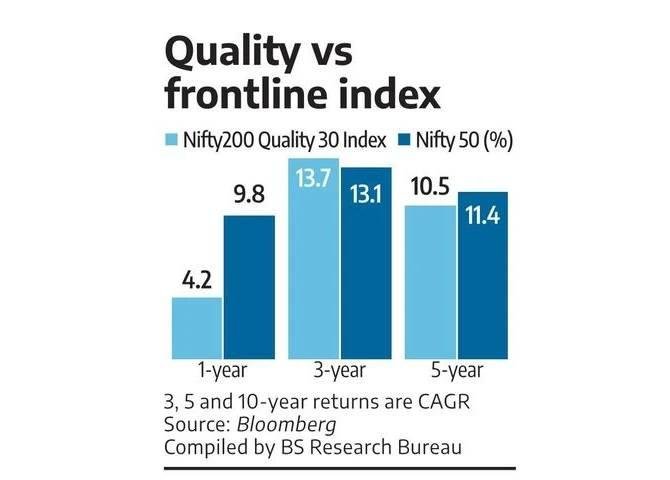
Valuation is a key concern.
“Avoiding overpaying for quality can be a challenge because quality companies seldom come cheap,” says Aarati Krishnan, head of advisory, PrimeInvestor.in.
Awasthi highlights another risk: the lack of a long-term track record because the category is still evolving in the mutual fund domain.
Who should invest
Long-term investors seeking sustainable gains from resilient, fundamentally strong companies may go for these funds.
“Investors with a high-risk appetite who seek returns well above underlying earnings potential may find quality funds less suitable,” says Sharwan Goyal, fund manager and head — passive, arbitrage and quant strategies, UTI AMC.
Active vs Passive Quality Funds
Investors should choose between active and passive options based on whether they prioritise cost or conviction.
“Passive strategies offer a rule-based, low-cost structure that removes human bias,” says Goyal.
Krishnan highlights that they can help investors avoid style drift risk and the risk of a change in fund manager.
However, passive strategies lack the qualitative insights that experienced active managers bring.
“Active fund managers look beyond financial statements and monitor shifts in competitive advantage,” says Goyal.
SIP Strategy and 5-Year Horizon
Active quality funds can apply filters such as management quality that cannot be reduced to quantitative screeners.
They can also adjust portfolios proactively before changes reflect in numbers.
On the flip side, active funds seek alpha, but there is always the risk of them underperforming their benchmarks.
What should you do?
Investors must have a horizon of five years or more for allocating to quality funds. They should adopt the systematic investment plan (SIP) approach to benefit from volatility and reduce the impact of market timing.
Pros and cons of quality funds
Advantages
- Potential to deliver consistent long-term growth while withstanding market volatility
- Combines stability with growth for long-term wealth creation with relatively lower risk
- Offers downside protection because strong balance-sheet companies tend to fall less in market declines
- Invests in stocks with greater earnings visibility, which can reduce uncertainty for long-term investors
- Invests in businesses that rely less on external funding, which can help navigate slowdowns and tight financial conditions
- Over a full market cycle, can perform well as stock prices reflect fundamental growth rather than short-term market trends
Disadvantages and risk
- Carry valuation risk (risk of overpaying) because high-quality companies often trade at high valuations
- Lack of a long-term track record because the category is still evolving in mutual funds
- Short-term performance can suffer if portfolios avoid stretched or costly market segments
- Typically underperforms in the early phase of a recovery led by cyclical and high-beta equities
- Can underperform in the last leg of a bull market when investors chase returns.
Feature Presentation: Ashish Narsale/Rediff