

Images By Tang Ming Tung | Digitalvision | Getty Images
Actively managed exchange-traded funds are a growing trend in the investment space.
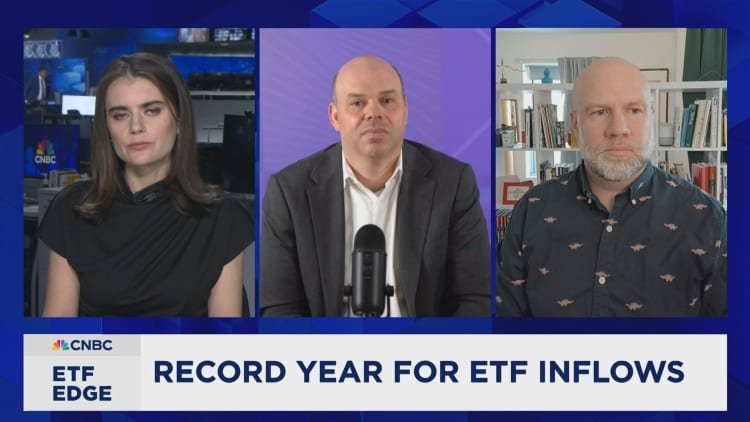
To that point, investors have pulled money from active mutual funds and sought out actively managed ETFs in recent years. Investors yanked about $2.2 trillion from active mutual funds from 2019 through October 2024, according to Morningstar data. At the same time, they added about $603 billion to active ETFs.
Active ETFs had positive annual inflows from 2019 through 2023 and are on pace for positive inflows in 2024, according to Morningstar. Meanwhile, active mutual funds lost money in all but one year (2021); they shed $344 billion in the first 10 months of 2024.
“We see [active ETFs] as the growth engine of active management,” said Bryan Armour, director of passive strategies research for North America at Morningstar. While acknowledg
“It’s still in the early innings,” he said. “But it’s been a bright spot in an otherwise cloudy market.”
At a high level, mutual funds and ETFs are similar.
They are legal structures that hold investor assets. But investors have gravitated toward ETFs in recent years due to cost benefits they generally enjoy relative to mutual funds, experts said.
Why fees matter
Fund managers who use active management are actively selecting stocks, bonds or other securities that they expect to outperform a market benchmark.
This active management generally costs more than passive investing.
Passive investing, used in index funds, doesn’t require as much hands-on work from money managers, who basically replicate the returns of a market benchmark like the S&P 500 U.S. stock index. Their fees are generally lower as a result.
Active mutual funds and ETFs had an average asset-weighted expense ratio of 0.59% in 2023, versus 0.11% for index funds, according to Morningstar data.
Data shows that active managers tend to perform worse over the long term than their peer index funds, after accounting for fees.
About 85% of large-cap active mutual funds underperformed the S&P 500 over the past 10 years, for example, according to data from S&P Global.
As a result, passive funds have attracted more annual investor money than active funds for the past nine years, according to Morningstar.
“It’s been a rough couple decades for actively managed mutual funds,” said Jared Woodard, an investment and ETF strategist at Bank of America Securities.
But, for investors who prefer active management — especially in more niche corners of the investment market — active ETFs often have a cost advantage versus active mutual funds, experts said.
That’s mostly by virtue of lower fees and tax efficiency, experts said.
ETFs generally carry lower fund fees than mutual fund counterparts, and generate annual tax bills for investors with much less frequency, Armour said.
In 2023, 4% of ETFs distributed capital gains to investors versus 65% of mutual funds, he said.
Such cost advantages have helped lift ETFs overall. ETF market share relative to mutual fund assets has more than doubled over the past decade.
That said, active ETFs represent just 8% of overall ETF assets and 35% of annual ETF inflows, Armour said.
“They are a tiny portion of active net assets but growing rapidly at a time when active mutual funds have seen pretty significant outflows,” he said. “So, it is a big story.”
Converting mutual funds to ETFs
In fact, many money managers have converted their active mutual funds into ETFs, following a 2019 rule from the Securities and Exchange Commission that allowed for such activity, experts said.
So far, 121 active mutual funds have become active ETFs, according to a Nov. 18 Bank of America Securities research note.
Such conversions “can stem the tide of outflows and attract new capital,” according to the Bank of America note. “Two years before converting, the average fund saw $150 [million] in outflows. After converting, the average fund gained $500 [million] of inflows.”
That said, there are caveats for investors.
For one, investors who want an active ETF are unlikely to have access to one within their workplace retirement plan, Armour said.
ETFs, unlike mutual funds, are unable to close to new investors, Armour said.
This may put investors at a disadvantage in ETFs with certain “super niche, concentrated” investment strategies, because money managers may not be able to execute the strategy as well as the ETF gets more investors, he said.