
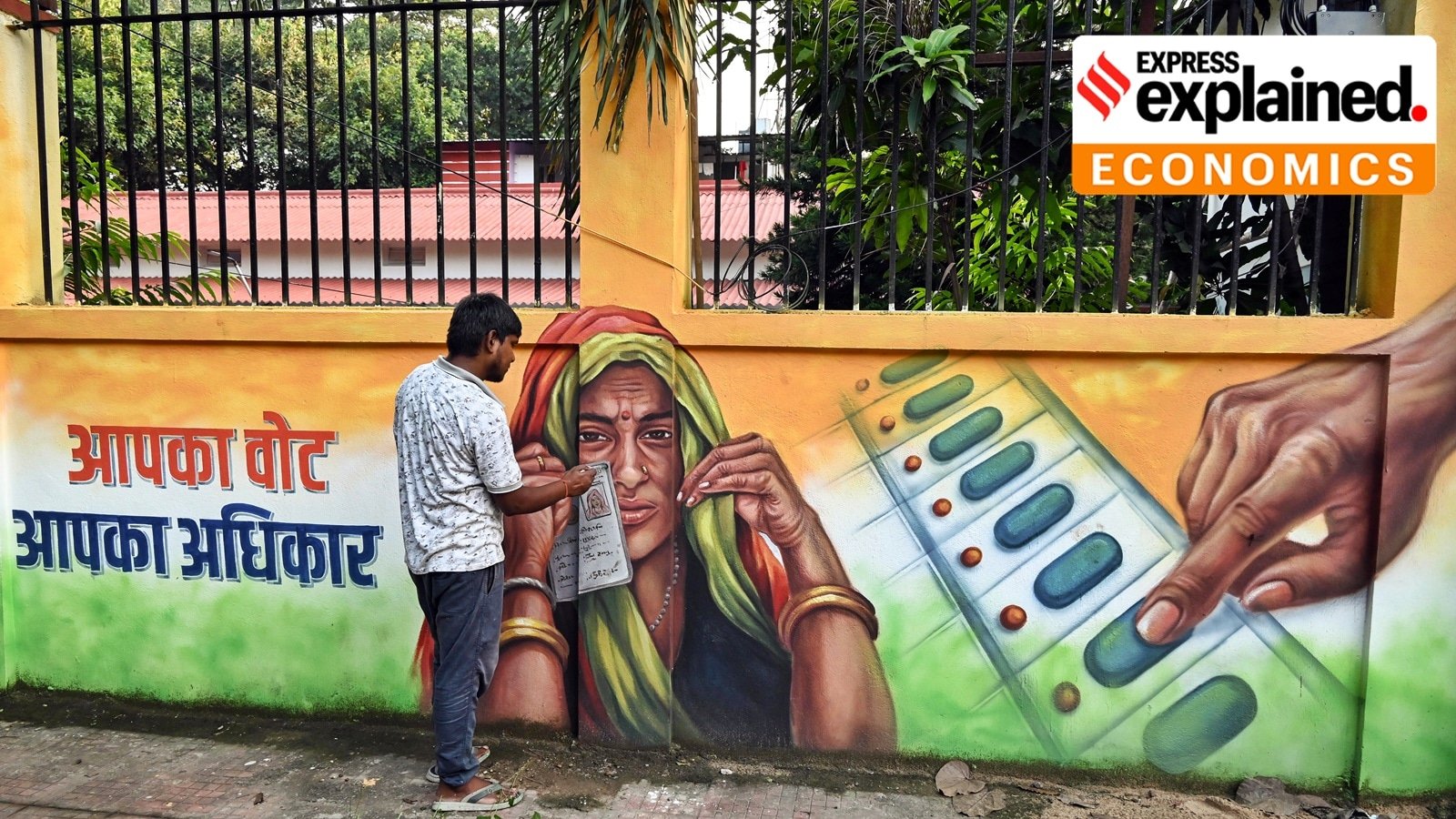
In just over a month from now, the residents of Bihar will know who will shape their fortunes for the next five years. And while every election is important, the votes tallied on November 14 could shape the next decade or more, considering the current Chief Minister, Nitish Kumar, has led the state for nearly 20 years.
Like every other Indian state, Bihar needs to create jobs for its residents – 3.16 crore Biharis have registered on the government’s e-Shram portal in search of jobs, second only to Uttar Pradesh. And if jobs are not found within the state, they will keep looking for employment elsewhere. This continued out-migration in search of work reduces the possibility of the state being able to reap a return on its investments.

As per latest data from the government’s Periodic Labour Force Survey (PLFS), while Bihar’s unemployment rate in the April-June quarter was a fairly low 5.2 per cent, compared to the all-India average of 5.4 per cent for those aged 15 years and above, this was largely due to the Labour Force Participation Rate (LFPR) in the state being just 48.8 per cent. It means that less than half the working-age population of the state was actively looking for work. Only Haryana and Delhi had lower LFPRs.
It gets worse when one considers the youth, or those falling in the 15-29 age bracket – in Bihar, only 33.9 per cent of them are looking for jobs. This is not only significantly lower than the all-India average of 42 per cent, but also the lowest in the country.
It is no surprise then that employment generation has been a key pitch from political parties ahead of the state elections. On Thursday (October 9), Rashtriya Janata Dal (RJD) leader Tejashwi Yadav announced that the party, if elected, would pass a law that would ensure one person from every household in the state had a government job within 20 months.
But are government jobs the way forward for the state?
Pressure on state finances
As per Bihar’s budget for 2025-26, the state expects to spend Rs 1.12 lakh crore on salaries, pensions, and interest on its loans. These expenses are called ‘committed expenditure’ – they cannot be postponed. The problem is that these committed expenses make up nearly 40 per cent of the government’s total expenditure.
Story continues below this ad
Of course, there are several states that use up more than 40 per cent of their total expenditure on salaries, pensions, and interest payments. But it is safe to say the addition of a guaranteed government job per household will not burnish the state’s finances.
Questions have also been raised about the credibility of the state government’s numbers.
“The purpose of revised estimates in the budget is to provide a more realistic picture of the ongoing financial year, based on actual data for 9-10 months. However, in Bihar, expenditure estimates at the revised stage are often unrealistic, leading to fiscal deficit estimates being above the permitted limit,” PRS Legislative Research noted in its analysis of Bihar’s budget for 2025-26.
“From 2022-23 to 2024-25, the budget estimate for fiscal deficit has been 3-3.5 per cent. However, these estimates increase to almost 9 per cent at the revised stage. The actual fiscal deficit was 2.8 percentage points less than the revised estimate in 2022-23, and 4.7 percentage points less in 2023-24. However, actual expenditure is 4 per cent less than budgeted,” PRS added.
The development agenda
Story continues below this ad
Government jobs have not been the only promise offered to voters so far. Cash transfers to women, which worked exceedingly well for the ruling BJP-led National Democratic Alliance (NDA) in previous state elections, have appeared in Bihar as well. Under the Mukhyamantri Mahila Rozgar Yojana, Rs 10,000 has been given to 25 lakh women – or Rs 2,500 crore in total – to start small businesses. If successful, they will get an additional Rs 2 lakh. Nitish Kumar has promised to expand the scheme further if voted back to power.
There have been other schemes too, including a revamped self-help allowance scheme under which the state government will give a monthly allowance of Rs 1,000 for up to two years to up to 5 lakh unemployed permanent resident youth of Bihar who have passed the 12th grade, are not pursuing further studies, and are seeking employment.
Whether or not these schemes are ‘freebies’ – the word has no legal definition – is irrelevant; what we do know is that they will all add to the state’s expenditure, specifically, revenue expenditure. At a time when the central government is pushing hard on capital expenditure and calling on the private sector to invest more, it should be a concern if Bihar’s revenue expenditure as a percentage of total expenditure rises.
Capital expenditure for 2025-26 has been estimated at just under Rs 42,000 crore – or a third of the committed expenditure and just 14 per cent of total expenditure. And Bihar needs more and more investments for it to generate jobs and lift its residents out of poverty.
Story continues below this ad
According to the NITI Aayog, at 33.76 per cent, Bihar had the highest proportion of multidimensionally poor people in the country in 2019-21. Even if measured in consumption terms, an updated version of the Rangarajan poverty line – constructed by economists from the Reserve Bank of India (RBI) – shows that for urban Bihar, the minimum Monthly Per Capita Consumption Expenditure (MPCE) needed to not qualify as poor in 2022-23 was Rs 2,277 – the third lowest in the country. For rural areas, the figure was Rs 1,724, which was the sixth-lowest.
Progress made, and required
None of this is to say progress has not been made in Bihar; its performance in reducing poverty over the last decade has been particularly noteworthy.
In terms of the headline number, its growth rate has outstripped that of India as a whole in recent years. Over the last three years, Bihar’s Gross State Domestic Product (GSDP) has grown 11.1 per cent per year on average in real terms, nearly one-and-a-half times India’s average growth rate of 7.8 per cent. While this is commendable, it must be noted that Bihar’s rapid growth is over a low base – its GSDP in 2024-25 was less than Rs 10 lakh crore, making up only 5 per cent of India’s GDP.
Retail inflation, meanwhile, has generally been lower in Bihar, the last couple of years notwithstanding.
Story continues below this ad
However, this is clearly not enough. The sector powering the rest of the country – services – has shrunk in Bihar. According to statistics ministry data, the net value added by Bihar’s services sector has reduced as a percentage of the total net state value added to 54.8 per cent in 2024-25 from 61.2 per cent in 2019-20. The share of the secondary sector (manufacturing, construction, and utilities) has risen from 19.2 per cent to 26.6 per cent, while the primary sector (agriculture and mining) has remained broadly steady around the 19-20 per cent mark.
While a rising share of the secondary sector is good for Bihar, India’s growth story over the last two decades or so has been about the services sector, which can offer high-paying jobs – which is key to retaining good local talent.
Even in terms of number of factories, Bihar had just 3,386 in 2023-24, as per the latest Annual Survey of Industries. This was just 1.3 per cent of all factories in the country. And of the total number of workers employed by the Indian industry, Bihar housed just 1.17 lakh, or 0.75 per cent. These are troubling figures for India’s third-most populous state.