
Long-term investments refer to the process of purchasing assets, such as stocks, bonds, or real estate, with the expectation that they will generate returns over an extended period – usually several years or even decades. These investments are generally characterized by their stability and the potential to grow in value over time, rather than offering quick, short-term profits.
The goal of long-term investing is typically to accumulate wealth steadily, with an eye toward meeting future financial goals like retirement, education funding, or other substantial financial needs.
While there is no single formula to calculate long-term investments, investors often use several methods to assess the return on their investments over time. These methods include calculating the expected rate of return, understanding the time horizon, and adjusting for factors like inflation and risk.
The basic calculation for the return on a long-term investment can be broken down as follows:
Annual Return Formula
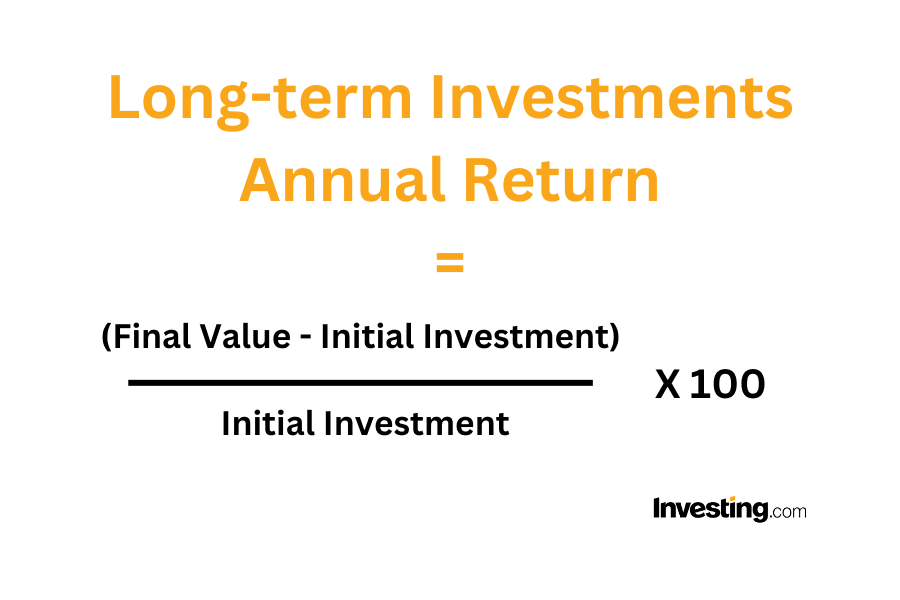
Annual Return = (Final Value − Initial Investment) / Initial Investment ×100
This formula helps to determine the annual percentage return on your investment.
Compound Interest Formula
Long-term investments often benefit from compound interest. The compound interest formula is:
A = P × (1 + r / n) ^ (n×t)
In this formula,
- A = the amount of money accumulated after n years, including interest.
- P = principal amount (the initial sum of money).
- r = annual interest rate (decimal).
- n = number of times that interest is compounded per year.
- t = time the money is invested or borrowed for, in years.

Let’s consider an example of a long-term investment in the stock market:
- Initial Investment: $10,000
- Annual Return: 8%
- Time Horizon: 20 years
Using the compound interest formula:
A = 10,000 × (1 + 0.08/1) ^ (1×20)
A = 10,000 × (1.08)^ 20 = 10,000 × 4.66 = 46,600
So, after 20 years, an initial investment of $10,000 would grow to approximately $46,600, assuming a consistent 8% annual return.
Long-term investments play a crucial role in wealth creation, financial security, and achieving future financial goals. Unlike short-term investments, which may focus on rapid market movements, long-term investments aim to benefit from the compounding effect, yielding profits through appreciation and dividends over time.
This strategy has several key advantages that make it an essential component of a sound financial plan.
Wealth Accumulation
Long-term investments allow for the gradual accumulation of wealth. By staying invested over an extended period, you can take advantage of compound growth. Over time, even small gains can grow significantly due to reinvested returns.
Mitigation of Short-term Market Volatility
While short-term investments are vulnerable to market fluctuations, long-term investments can benefit from the natural growth trends in the economy. The longer you hold an investment, the less likely short-term market downturns will affect your overall returns. While the market can experience significant volatility over short periods, long-term investments are less likely to be negatively impacted by short-term fluctuations.
Inflation Hedge
Long-term investments in assets like stocks or real estate tend to outpace inflation. This means that your purchasing power remains strong over time, even as the value of money declines due to inflation. For instance, the stock market has historically provided returns above the inflation rate, ensuring that the value of your investment grows faster than the increase in living costs.
Retirement Planning
Long-term investments are crucial for retirement planning. The more you invest early and consistently, the more comfortable your retirement will likely be. Many retirement savings accounts, such as 401(k)s and IRAs, are designed to support long-term growth. These accounts typically offer tax advantages, making them an effective tool for growing wealth for retirement.
Tax Efficiency
In many countries, long-term investments are more tax-efficient compared to short-term investments. In the United States, long-term capital gains (for assets held for more than a year) are taxed at a lower rate than short-term capital gains. This tax benefit makes long-term investing a more attractive option for wealth accumulation.
This tax advantage increases the overall return on investment, as investors don’t have to give up a large portion of their gains to taxes.
Interpreting long-term investments requires an understanding of how different asset classes perform over time. Here’s how to evaluate them:
- Growth Potential: Examine the potential for growth in different sectors, such as technology, real estate, or emerging markets. High-growth sectors may offer higher returns but come with greater risk.
- Historical Performance: Analyzing historical data can help you gauge the performance of an asset class over an extended period. For example, long-term returns from the stock market have historically averaged 7% to 10% annually.
- Risk vs. Return: Higher returns typically come with higher risk. As such, you’ll need to determine your risk tolerance when investing long-term. Diversification can help balance risk.
- Dividends and Interest: For certain assets like stocks or bonds, understanding the dividend or interest payments is key to gauging long-term income potential. These payments can provide consistent cash flow while your investment grows.
A good long-term investment aligns with your financial goals, risk tolerance, and time horizon. Some characteristics of a good long-term investment include:
- Strong Growth Potential: Assets that are likely to grow over time, such as stocks in industries with strong future demand, tend to be good long-term investments.
- Consistency: Look for investments with a proven track record of steady returns. Blue-chip stocks and government bonds are often considered reliable options for long-term growth.
- Dividend Income: Investments that provide dividends offer the opportunity to reinvest earnings, contributing to wealth accumulation over time.
- Diversification: A diversified portfolio helps reduce the overall risk of long-term investments. Spreading investments across multiple asset classes and sectors can provide a buffer against downturns in any one area.
Long-term investments are a vital component of any wealth-building strategy. By choosing stable, high-growth assets and holding them for extended periods, investors can benefit from the compounding effect and weather short-term market volatility. However, as with all investment strategies, understanding the risks and limitations is key to maximizing returns.
- Liquidity Constraints: Long-term investments are not easily liquidated. This can be a drawback if you need quick access to your funds in an emergency. Real estate, for example, can take months or even years to sell.
- Market Volatility: While long-term investments are generally less sensitive to short-term volatility, they are still exposed to long-term economic downturns, like recessions or market crashes, which can significantly affect returns.
- Opportunity Cost: By tying up your capital in long-term investments, you may miss out on other potentially lucrative short-term opportunities.
- Unpredictability: Some assets, such as stocks or real estate, are subject to market risks that can make long-term projections uncertain. Even historically stable investments can experience periods of underperformance.
Unlock Premium Data With InvestingPro 📈💸
Gain instant access to Long-term Investment data within the InvestingPro platform
🛠 Access to 1200+ additional fundamental metrics
🔍 Competitor comparison tools
📊 Evaluate stocks with 14+ proven financial models
How long should I hold my investments for them to be considered long-term?
Typically, a long-term investment is held for at least five years, but many investors aim for a much longer time horizon, such as 10, 20, or even 30 years.
Can long-term investments lose value?
Yes, while long-term investments generally carry less risk than short-term ones, they can still lose value, especially in volatile markets. However, historically, they tend to recover and grow over time.
Are long-term investments safe?
Long-term investments are generally safer than short-term investments, but they are not risk-free. The key is to choose investments with a strong historical performance and a growth outlook.
What’s the best way to start investing long-term?
The best way to begin long-term investing is to start early, stay consistent with contributions, and focus on diversification. Many investors use retirement accounts, such as 401(k)s or IRAs, to build long-term wealth.