
I’m watching a graph charting the value of my new investment, and it’s not looking good.
There’s a flicker of hope every time the arrow ticks up, only for it to take a rapid turn back down. I’m hoping for the numbers to turn green, but they remain stubbornly red.
My new investment is a contract for difference (usually just referred to as CFD).
All CFDs are high-risk investments, so I had to demonstrate knowledge and experience with CFDs to trade. When I applied, I didn’t have either of them, but I was accepted anyway.
According to the Financial Conduct Authority (FCA), eight in 10 people lose money when investing in CFDs. And it was all too easy for me to become one of them.
What are CFDs?
When you trade CFDs, you make a bet on which way the price of an asset will move, and you profit based on the difference between the buy and sell price.
You don’t own any of the underlying investment, so you can bet on a price rising or falling, but you’re not buying anything with intrinsic value.
CFD trading comes with heightened risk because you must use leverage. For a £33 trade, with a leverage of 30:1, you’d have nearly £1,000 on the line, although leverage can go as low as 2:1. You can’t lose more than the total funds in your account, thanks to FCA rules, but you can lose more than you put on a given trade.
Research by the FCA found that the average outcome for a CFD trader is a loss of £2,200.
CFDs have also been historically confined to niche apps, but you can now find them alongside stocks and shares Isas or general investment accounts on popular platforms. It’s possible for trading apps to offer ‘no-fee’ or low-cost stocks and shares Isas through cross-subsidising with CFD profits.
Although Which? reviews stocks and shares Isa providers, we don’t award Which? Recommended Provider endorsements to platforms that offer CFDs, given the risks these pose to investors.
- Find out more: Should you start investing?
Trading or gambling?
With its high-risk and addictive nature, trading CFDs has a lot in common with gambling.
Dr Philip Newall, senior lecturer at the School of Psychological Science at the University of Bristol, said: ‘Even though some people do gamble to try to win money, I think most – if, for example, they’re betting with a bookie – recognise that the odds are against them and it doesn’t make sense to risk large amounts of money, at least initially.
‘Whereas with trading, the whole sell is that this is a rational long-term thing that’s going to make you better off in the future. So what should you do then? You should risk even larger amounts of money.’
Those who may have previously had issues with gambling who go on to invest in financial markets
Countries such as the US and Belgium have already banned CFDs from being sold directly to consumers. And in 2020, the FCA banned CFDs trading on crypto in the UK, stating they were ‘ill-suited for retail consumers due to the harm they pose’.
Raminta Diliso, senior partnerships manager at gambling harms charity GamCare, said: ‘This year, GamCare’s National Gambling Helpline is recording the highest concentration of callers experiencing issues with financial markets.
‘Just like gambling, day trading and investing in volatile financial products like CFDs can often lead to financial difficulties, mental health struggles, relationship breakdowns and, in the most serious cases, thoughts of suicide. We are also concerned about those who may have previously had issues with gambling who go on to invest in financial markets, as our research shows they may be at increased risk of harm.’
Anyone affected by gambling or trading-related harm can contact GamCare’s National Gambling Helpline on 0808 802 0133 or chat online for free and receive confidential support.
Spreading the word
CFDs aren’t new, but their popularity ticked up around 2010 and boomed during Covid when younger generations piled into investing and trading. Despite being a technical product that you need to pass a test to trade, there are plenty of CFD ads aimed at a broad audience.
Ads for Trading 212 on YouTube offered viewers the opportunity to ‘trade oil long and short’, as well as another promoting silver on similar terms, while IG also highlighted ‘oil prices are fluctuating’. These ads included a risk warning and the percentage of that platform’s CFD customers who lose money, as all CFD adverts must do.
Beyond legitimate ads, the FCA has also been cracking down on illegal promotions from financial influencers – aka ‘finfluencers’ – on social media who peddle CFDs from unregulated providers. Earlier this year, reality TV personalities linked to programmes including Love Island and Geordie Shore were fined for unauthorised financial promotions following an FCA investigation.
A recent investigation from the Bureau of Investigative Journalism found that influencers promoting offshore CFD firms came from all corners of the internet, whether that’s so-called wellness, the ‘manosphere’, or accounts otherwise focused on motherhood content.
Despite their different backgrounds, they all shared promises of unrealistic returns and a drastic change in lifestyle, in exchange for commission on every trade made by someone they encouraged to sign up, regardless of whether they win or lose.
- Find out more: Crackdown on finfluencers – how to spot risky advice
Will I be accepted as a CFD trader?
With the high risks in mind, UK-regulated CFD brokers must conduct an ‘appropriateness test’ of prospective customers.
I applied for CFD accounts with five apps that offered both a stocks and shares Isa and CFDs: IG, Interactive Brokers, eToro, Trading 212 and XTB.
The tests are split into knowledge of CFDs, risk tolerance and the state of your finances. The FCA doesn’t require specific questions, but platforms must gauge a customer’s CFD trading experience and knowledge. The tests can usually be taken up to three times, with a 24-hour cooling-off period between attempts.
Despite my job as an investment writer, I wasn’t hugely knowledgeable about CFDs at the time of taking the tests and have no trading-specific qualifications. If that wasn’t enough to rule me out, I thought my personal risk-averse nature would show I wasn’t an appropriate candidate for high-risk trading. I would be answering every question honestly, so I expected to fail all tests on every metric.
In most cases, this turned out to be true – on XTB, I was rejected before I even made it to the knowledge questions. XTB told me I could try again in 24 hours, although I didn’t expect any big changes to my income or personality in that time.
Interactive Brokers and eToro both failed me and didn’t give me a timeframe to try again. Those interested in gaming the system would, naturally, have a much easier time of passing and could look up answers to questions, even modifying their answers to risk-appetite questions until they were accepted.
But they’re not the only ones who could pass when they shouldn’t.
- Find out more: Would you be better off copying someone else’s investments?
Passing the test
IG had one of the longest tests, including 10 knowledge questions, but it was the only test I passed. Many of IG’s questions, while not easy, could either be worked out by eliminating unlikely multiple-choice options, or they had little to do with how CFDs worked and were instead more about maths and reading comprehension.
Dr Philip Newall, senior lecturer at the School of Psychological Science at the University of Bristol, said: ‘The knowledge tests are a well-meaning bit of regulation, but I definitely could see it backfiring in terms of potentially promoting overconfidence. After all, if your app tells you that you’re a knowledgeable investor, then all the more reason to crack on.’
The knowledge tests are a well-meaning bit of regulation, but I definitely could see it backfiring in terms of potentially promoting overconfidence
When we approached IG, it told us: ‘Appropriateness testing is not designed to be easy or hard – it’s designed to meet FCA requirements by assessing whether a customer has the knowledge and experience necessary to understand the risks of CFDs.
‘It’s just one of a number of safeguards we have in place. Customers are presented with clear and prominent risk warnings throughout the customer journey in line with FCA requirements, and we have additional controls around customer eligibility, financial circumstances and vulnerability.’
Failing the test – and getting the go-ahead anyway
Although I didn’t pass Trading 212’s test, it gave me access to CFD trading anyway – something which is allowed within the FCA’s rules on appropriateness testing.
Trading 212 told us this meant I hadn’t failed completely, in which case I would have been prevented from trading. While I could have clicked the ‘X’ in the corner to close the window and end the process, the natural onward journey was to click the large confirmation button.
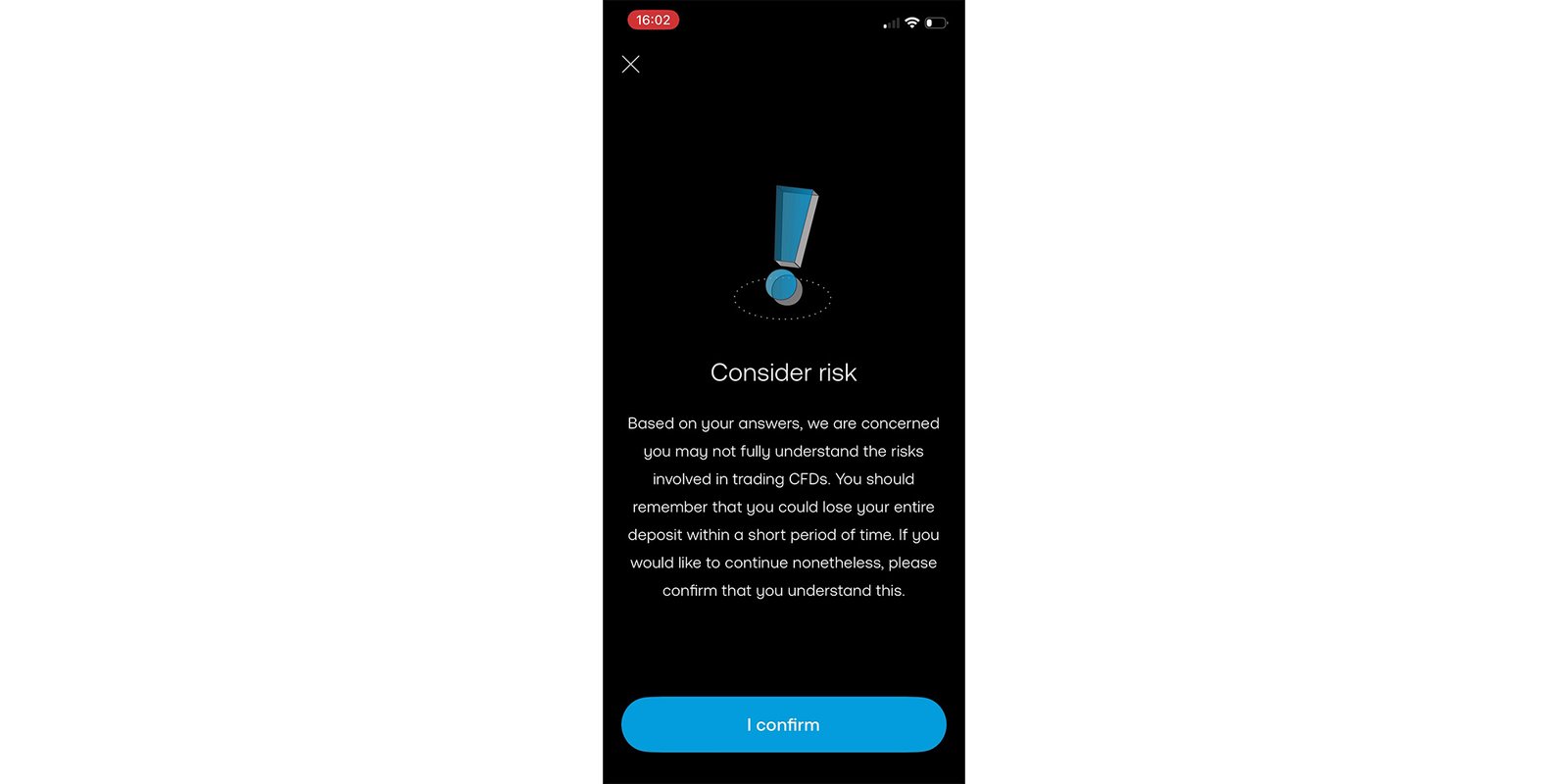
Trading 212 told us that of the small subset of users who begin the CFD sign-up process (less than 3% of Isa users), very few ever finish it and execute a trade, so are successfully deterred where it’s inappropriate.
The platform came under scrutiny in one 2020 Financial Ombudsman Service case concerning a man who was allowed to trade CFDs and lost £17,000, despite evidence in his application that an account would be inappropriate for him. He flagged that he had minimal income and savings, was currently unemployed, and failed the knowledge test. The man told the ombudsman he had medical conditions that meant he struggled to understand the account and its risks.
The ombudsman found that, while Trading 212 had followed the rules, it didn’t take into consideration any of the guidance, and in doing so, its test hadn’t gone far enough. Trading 212 disputed the issue throughout and emphasised the man’s personal responsibility. Trading 212 later told us this was a highly specific example, and not a representative case.
- Find out more: How to complain to the Financial Ombudsman Service
Keeping me on the hook
After downloading the apps and doing the tests, my phone lit up with notifications. I was notified of rises and falls in share prices by eToro, Trading 212 and XTB, while IG let me know when markets opened and closed.
In just five days, I had 23 notifications from Trading 212, 19 from eToro, 16 from IG and seven from XTB.
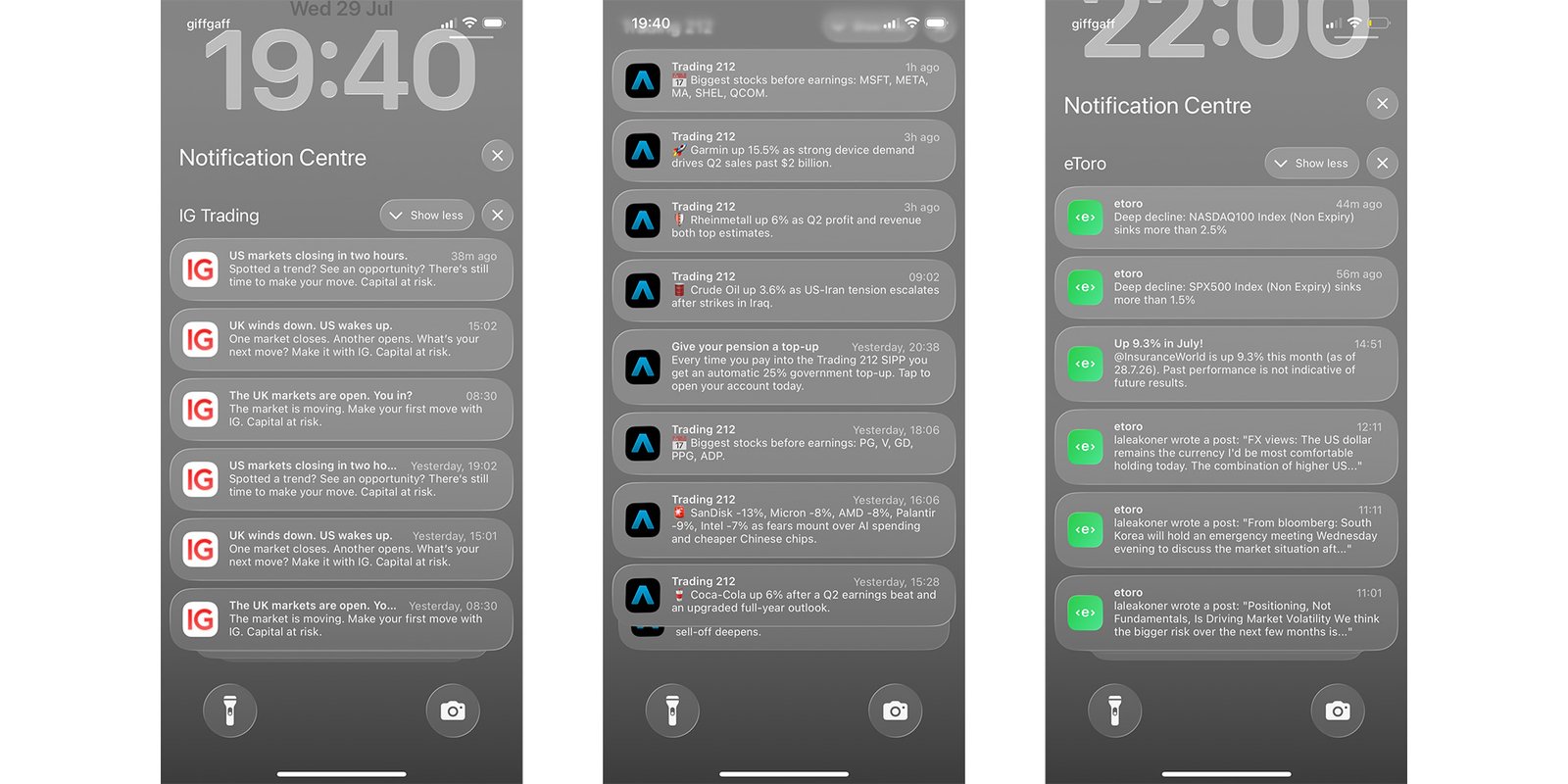
The FCA ran an experiment in 2024 to see the impact that digital engagement practices, such as push notifications, had on trading app users’ behaviour. It found that push notifications increased the frequency of trading, number of shares bought and the risk taken on.
I received emails with training courses so I could learn more and have another crack at accessing CFD trading. One titled ‘Trader’s Glossary – CFDs’ from XTB extolled the virtues and popularity of CFDs (with a warning about the high risk) and encouraged me to read more. But I failed XTB’s test because of my low appetite for risk and had never reached the stage of answering the knowledge questions, so my access to CFDs was still restricted.
The platforms said the content passed on is educational and enables customers to develop their knowledge before reattempting the tests or to reflect on engaging with high-risk trading, but isn’t pushing customers towards trading. They also emphasised that notifications can be turned off.
They all emphasised the importance of learning and personal discipline, undercutting the reality that a huge amount of trading with CFDs comes down to luck. But as CFD brokers attract new customers through cheap and free stocks and shares Isas, they may not appreciate luck’s outsized role in CFD trading compared to regular, long-term investing.
Only flimsy tests stand between them and some of the most harmful investments in the market.