
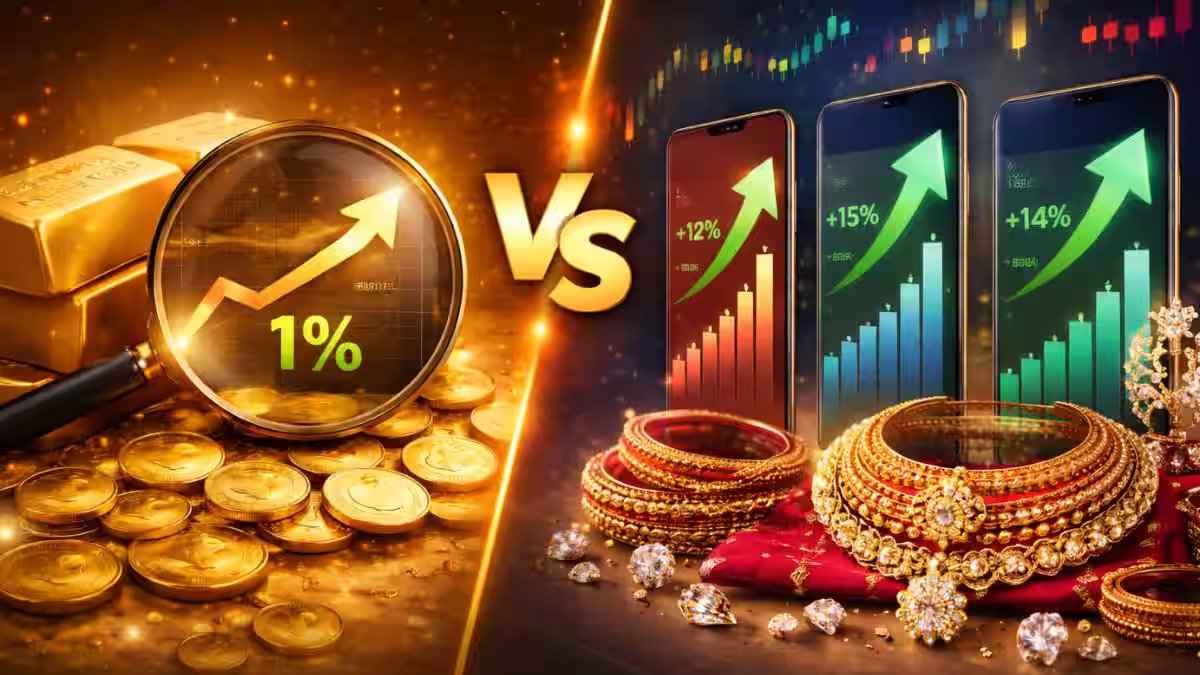
Buying gold on Akshaya Tritiya is a long-followed tradition in India, but the way people invest in the yellow metal is changing. Experts say that while gold continues to hold importance in portfolios, investors are now moving beyond jewellery and looking at smarter financial options such as ETFs and mutual funds.
Harshvardhan Roongta, CFP at Roongta Securities, said the shift from physical gold to financial products has increased in recent years.
“It was earlier a common practice to buy physical gold or silver on an auspicious day like Akshaya Tritiya. The sentiment was linked to bringing something valuable home. But in the last three to five years, acceptance of paper gold such as ETFs and gold funds has increased,” he said.

He added that investors now focus more on the purpose of buying gold rather than the form. “The idea is to buy gold on that day. Whether you buy physical gold or paper gold does not matter. Due to convenience, many people are opting for ETFs or gold funds,” he said.
Diversifying Gold Investments
Shweta Rajani, Head – Mutual Funds at Anand Rathi Wealth, said investors are becoming more aware and are diversifying their gold investments.
“We have seen a clear change over the years. Earlier, people preferred jewellery or gold bars. Now investors are increasingly buying gold ETFs, gold funds and even combining gold with silver through funds,” she said.
She noted that gold ETFs have seen strong growth in assets. “As per recent data, gold ETFs have reached around Rs 1.7 lakh crore in assets, which was much lower a few years ago. This shows rising investor interest in financial forms of gold,” she added.
Gold as part of asset allocation
Experts emphasised that gold should be seen as part of a broader investment strategy rather than just a festive purchase.
“It is important to allocate only a certain portion of your portfolio to gold. This is not just consumption. It becomes part of a long-term investment. Investors should decide what percentage of their portfolio should be in gold,” Rajani said.
She added that investors do not necessarily need to buy gold every Akshaya Tritiya. “If your gold allocation is already high, you can consider other investment options. The key idea is long-term wealth creation,” she said.
Roongta also stressed the importance of maintaining balance. “If you are investing Rs 100, decide whether 10 per cent, 15 per cent or 20 per cent should be in gold or precious metals. Do not allocate everything to one asset class,” he said.
Returns comparison across asset classes
Rajani explained how different asset classes have performed over the long term. “If you had invested Rs 1 lakh in fixed deposits at around 7 per cent annual return, it would have grown to about Rs 4 lakh in 20 years. In equities, with 14-15 per cent returns, the same amount could grow to around Rs 16 lakh,” she said.
“In gold, long-term average returns have been around 10 per cent. So Rs 1 lakh could grow to roughly Rs 10 lakh over 20 years,” she added.
She said this comparison highlights the need for diversification. “Each asset class has a different risk and return profile. Gold lies between fixed income and equities in terms of volatility,” she said.
Do not rely on recent returns
Experts cautioned investors against making decisions based on recent sharp gains in gold prices.
“In the last year, gold has given around 60-65 per cent returns. But investing based on such short-term performance can be a mistake,” Roongta said.
“Over the long term, gold typically delivers returns close to inflation, around 7-8 per cent. Investors should not expect the same high returns going forward,” he added.
He advised investors to follow a disciplined allocation strategy. “Do not look at past returns to decide future investments. Stick to your allocation plan,” he said.
Physical vs paper gold
Roongta highlighted the limitations of physical gold. “There are concerns around purity and storage in physical gold. You also have to bear making charges in jewellery. These issues do not exist in paper gold,” he said.
“In ETFs or gold funds, you do not have to worry about storage or purity. It is a more efficient way to invest,” he added.
However, he acknowledged the emotional value attached to physical gold. “On festive occasions, people may still prefer buying a small quantity of physical gold. But for investment purposes, paper gold is better,” he said.
Things to watch while buying gold
Rajani advised investors to be cautious about promotional schemes offered by jewellers. “Many schemes, such as zero making charges or price lock, may have hidden costs. Investors should look at the total cost rather than just the gold price,” she said.
She added that comparisons are important. “Compare prices across jewellers and also compare with gold ETFs or funds before making a decision,” she said.
Best investment options
Experts suggested multiple options for investing in gold. Roongta said, “Investors can consider gold ETFs, gold mutual funds, or even sovereign gold bonds available in the market.”
Rajani said ETFs are more cost-effective. “If you have a demat account, gold ETFs are a better option due to lower costs. If not, you can invest in gold mutual funds,” she said.
She added that investors can also look at funds that combine gold and silver for diversification.
Tradition vs smart investing
Experts said investors can balance tradition with financial discipline. Roongta said, “If the tradition is important, you can buy a small quantity of physical gold. But for larger investments, focus on financial products.”
Rajani added, “If not gold, investors can even consider equities or other assets. The idea is to invest wisely on an auspicious day.” Experts said gold remains an important asset class, but its role should be limited and strategic within a diversified portfolio.