
Last Updated:
Article explains how EPF, NPS and equity mutual funds differ in returns, tax and flexibility, arguing they are complementary tools for building a sufficient retirement corpus




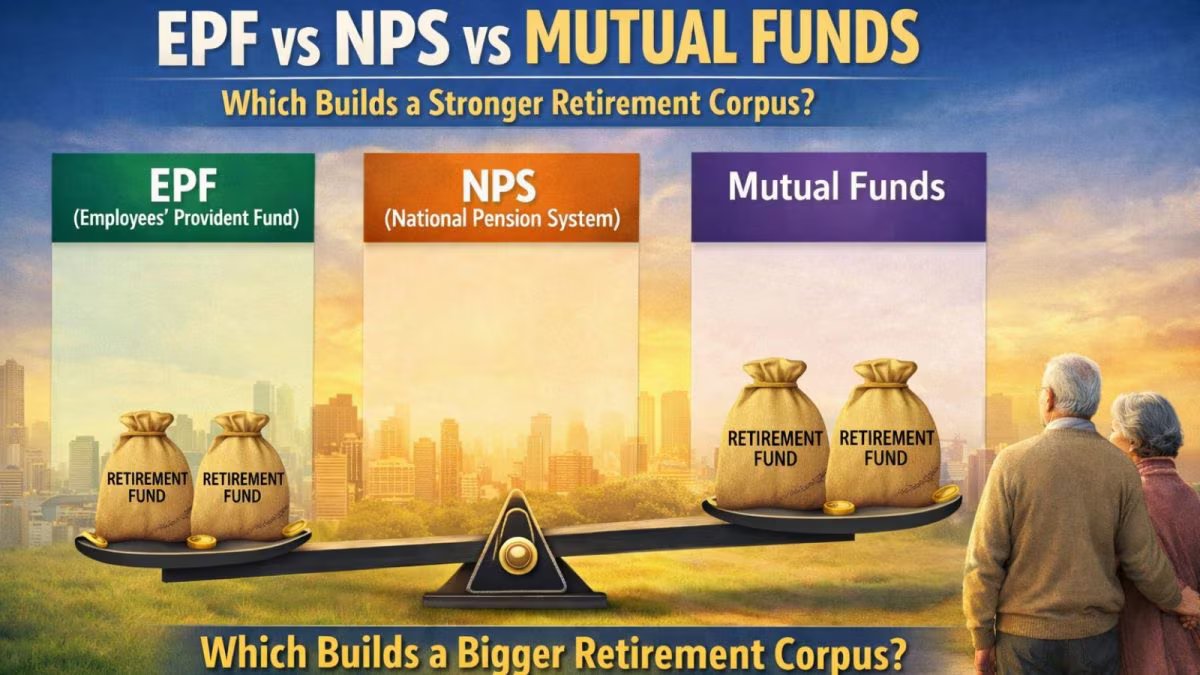
EPF vs NPS vs Mutual Fund
Retirement planning in India often revolves around three familiar choices: EPF, NPS and Mutual Funds. Most investors don’t consciously compare them. They simply continue with what their employer offers or what they are comfortable with.
But when you step back and look at the numbers, the difference in outcomes can be meaningful. The real question is not which product is “best” in isolation, but which one helps build a larger, more reliable retirement corpus over time.
What makes this comparison interesting is that all three serve a purpose. None of them are flawed products. The gap emerges not because one is right and the others are wrong, but because they are built with very different objectives.
EPF, for instance, is designed for stability. It has done that job well over the years. Returns have largely stayed in the 8 to 8.5 percent range, and the comfort of a government-backed, tax-free accumulation makes it a natural starting point for most salaried individuals. For many, it quietly becomes the backbone of retirement savings.
NPS takes a slightly more evolved approach. It introduces market participation through a mix of equity, corporate bonds and government securities. Over time, depending on how the allocation is structured, returns tend to settle in the 9 to 11 percent range. It brings discipline into the process, but it also brings structure and structure, in investing, often comes with conditions attached.
Mutual funds, especially equity-oriented ones, operate differently. They are not built for stability. They are built for growth. Over long periods, they have delivered returns in the range of 11 to 13 percent, but more importantly, they have been one of the few avenues that consistently outpace inflation over decades.
The real difference between these three does not show up in the early years. For a long time, the journey looked quite similar. Contributions go in, balances build up, and the variation appears manageable. It is only in the later years, when compounding begins to accelerate, that the gap starts widening in a meaningful way.
A simple illustration makes this clearer. A monthly investment of Rs 20,000 over 25 years, growing at around 8.25 percent, builds a corpus of roughly Rs 2.0 crore. Increase that return to 10 percent and the number moves closer to Rs 2.72 crore. At 12 percent, the same discipline can take the corpus to nearly Rs 3.79 crore.
At one level, these are just numbers. But in real terms, this is the difference between maintaining a lifestyle and having the freedom to upgrade it.
A closer look at what investors actually get
| Category | Return Assumption | Maturity Value | Tax Treatment |
| EPF | 8.25% | ~Rs 2 crore | Fully tax-free (EEE) |
| NPS | 10% | Rs 2.72 crore | For Non Govt:
80% withdrawal: 60% tax-free, 20% taxable; 20% Annuity(mandatory) For Govt Employees 60% withdrawal: 60% tax-free; 40% Annuity(mandatory) |
| Equity Mutual Funds | 12% | Rs 3.79 crore | LTCG @12.5% above Rs 1.25 lakh |
Numbers, however, don’t tell the full story unless you look at what portion of that corpus is actually available for use.
EPF is straightforward. What you see is what you get. The entire corpus is tax-free and fully accessible. That simplicity is its biggest strength.
NPS is slightly more layered. While the accumulated value may look attractive, the structure at maturity matters. Only 60 percent can be withdrawn upon maturity by government employees & 40 per cent annuity is mandatory whereas non government employees can withdraw up to 80 per cent in which 60 per cent is tax free & 20 per cent is taxable as per slab & 20 per cent annuity is mandatory. The balance is directed into an annuity, which provides income but limits flexibility. So, the headline number and the usable number are not the same.
Mutual funds sit at the other end of the spectrum. There is taxation, but only on gains, and even after that, the investor retains full control over the corpus. There are no restrictions on how and when the money is used. Over long periods, this flexibility becomes as important as the returns themselves.
This is where many investors tend to misjudge risk.
Volatility is visible. You see it in market movements, in portfolio values, in daily fluctuations. But the more subtle risk is not visible. It is the risk of falling short. A portfolio that feels safe but grows too slowly may not be able to sustain rising expenses over a 25–30 year retirement horizon.
That is why the conversation cannot be about choosing one over the other.
EPF does what it is meant to do. It protects. NPS adds a layer of discipline and diversification. Mutual funds, despite their ups and downs, do the heavy lifting when it comes to long-term growth.
Seen this way, they are not competing products. They are complementary pieces of a larger strategy.
And that is perhaps the more practical takeaway. Retirement planning is not about finding the safest option. It is about building a structure where safety, growth and access work together.
Because in the end, retirement is not just about reaching a number. It is about ensuring that the number is enough.
The views expressed in this article are those of the author and do not represent the stand of this publication.
April 06, 2026, 15:19 IST
Read More