
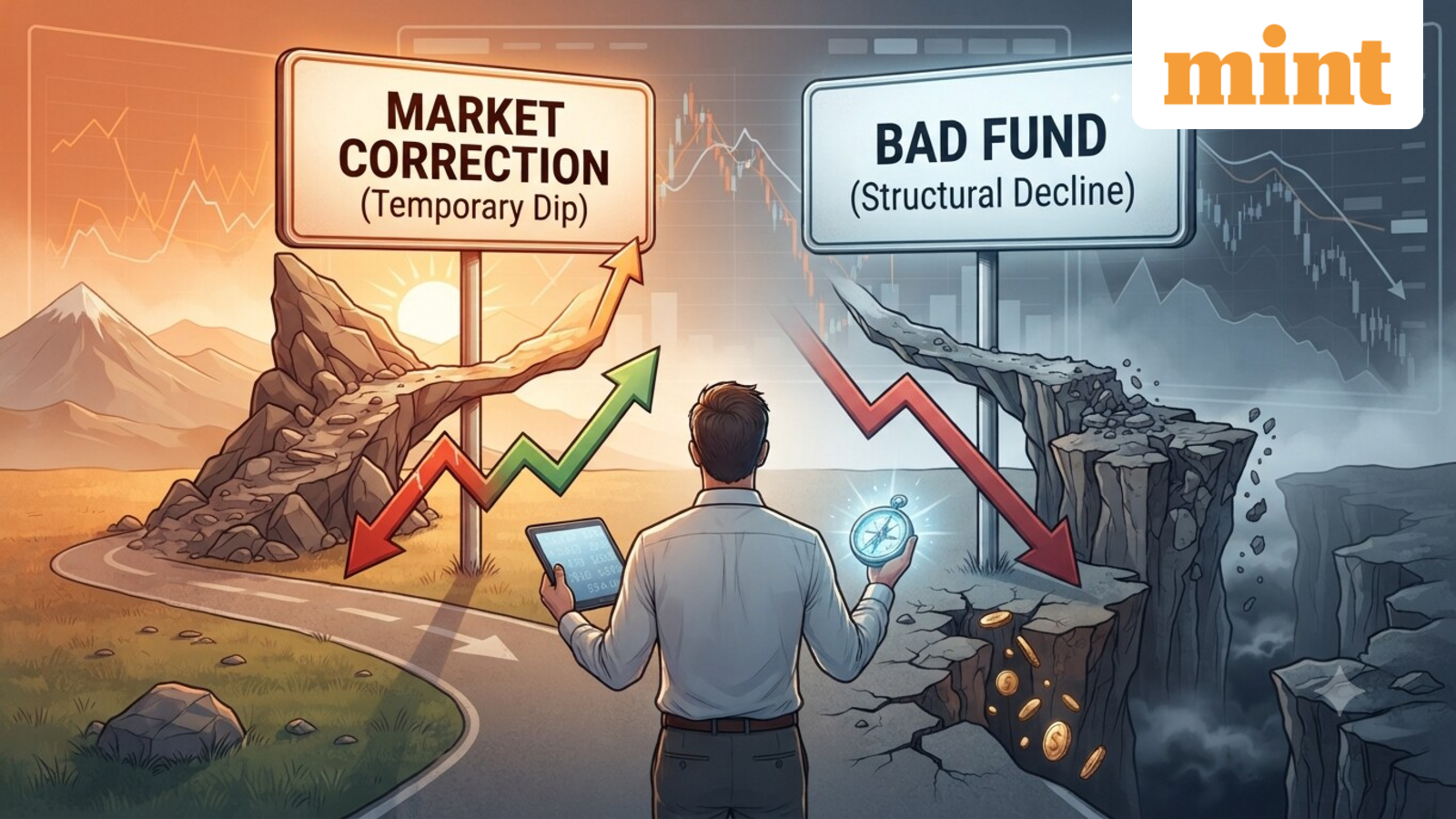
A falling stock market can make even long-term mutual fund investors question their investment decisions. When a scheme starts underperforming, the temptation to redeem and move to a better-performing fund can be strong. But a fund losing value during a market correction does not necessarily mean its investment strategy has failed.
The more important question is whether the underperformance reflects a temporary shift in market conditions or a deterioration in the fund’s investment process. Exiting too early could mean missing a recovery, while holding on to a fund that has consistently lost its investment edge could hurt long-term wealth creation.
Investors should therefore look beyond recent returns before deciding whether to stay invested or redeem their units. Madhu Lunawat, Founder, MD and CEO of The Wealth Company Mutual Fund, says investors need to evaluate a fund across different market conditions rather than judge it on a single year’s performance.
Here are five checks investors should make before exiting an underperforming mutual fund.
1. Check whether underperformance is temporary or structural
Not every period of underperformance signals a problem with a mutual fund. Different investment styles and market segments perform differently across market cycles. Large-cap stocks may outperform during one phase, while mid-cap and small-cap stocks may lead during another. A fund can therefore lag its benchmark when its investment style is temporarily out of favour.
The key is to understand why the fund is underperforming. Investors should examine whether the portfolio continues to reflect the scheme’s stated investment philosophy and whether its stock-selection decisions remain consistent with that approach.
An unexplained change in the portfolio or deterioration in the quality of underlying holdings warrants closer scrutiny.
“Investors should not judge a fund on one year’s performance. Look at its performance across different market conditions, compare it with the appropriate benchmark and category, and understand what is happening in the underlying portfolio,” Lunawat said.
Investors should also compare a scheme with funds in the same category. Comparing a small-cap fund with a large-cap benchmark, for instance, can give a misleading picture of its performance.
2. Look for warning signs beyond falling returns
Consistent underperformance against the benchmark and comparable schemes across multiple periods is one reason to review a mutual fund. However, investors should also examine how the fund manages risk and responds to changing market conditions.
A fund that falls more sharply than its benchmark during corrections but fails to participate adequately in subsequent recoveries deserves closer examination. Frequent or unexplained changes in investment strategy and increasing portfolio risks without commensurate returns are other warning signs.
Investors should also examine whether the underlying businesses and securities continue to align with the fund’s stated investment objective.
However, higher volatility alone does not mean a fund is poorly managed. A small-cap scheme will naturally carry a different risk profile from a large-cap fund. The assessment should account for the category, investment mandate and benchmark.
3. Evaluate risk-adjusted returns, not just absolute performance
A mutual fund delivering higher returns is not necessarily the better investment. Investors must also assess how much risk the scheme has taken to generate those returns.
Metrics such as the Sharpe ratio, Sortino ratio, maximum drawdown, downside capture and upside participation can help investors understand a fund’s risk-return profile.
The Sharpe ratio measures excess returns relative to overall volatility, while the Sortino ratio focuses on downside volatility. Maximum drawdown indicates the steepest fall from a peak to a subsequent low. Downside capture shows how a fund performs relative to its benchmark when markets decline, while upside participation indicates how much of the market’s gains it captures during rallies.
Lunawat said downside protection matters because large losses can take considerably longer to recover from. For instance, a 30% fall in an investment requires a gain of approximately 43% to return to its original value.
However, the fund with the lowest drawdown is not automatically the best choice. A scheme that takes a more conservative approach may protect investors during corrections but also miss a significant portion of the recovery.
“What matters is the balance between protecting capital during difficult markets and participating adequately when markets recover,” she said.
4. Reassess your investment horizon and financial goals
A mutual fund that remains suitable for one investor may no longer be appropriate for another. The decision to stay invested should depend on when the money is needed and how much volatility the investor can withstand.
Someone investing for retirement 20 years away may have sufficient time to ride out a market correction. However, an investor saving for a house purchase or a child’s education in the next two to three years has less room to absorb equity-market losses.
Lunawat said investors with short-term financial goals should prioritise protecting their capital over maximising returns.
Money earmarked for an important financial commitment within two to three years should not be exposed to significant equity-market volatility simply in the hope of earning higher returns. Depending on the investor’s requirements, more stable and liquid investment options may be appropriate.
Investors should also review their portfolios as financial goals approach rather than wait until the last few months. Changes in income, liabilities, family responsibilities and liquidity requirements can alter the suitability of an investment.
5. Avoid switching funds based on recent performance
One common mistake investors make during market corrections is redeeming a poorly performing scheme and moving the money into a fund that has recently delivered strong returns.
This can result in investors exiting after a fall and entering another scheme after a rally, effectively buying high and selling low.
Instead, investors should evaluate the fund’s performance through rolling returns across different market conditions. They should also examine whether its investment philosophy, portfolio quality and risk-management approach remain intact.
There is no universal waiting period before exiting an underperforming fund. While some investors may use three- or five-year performance periods as reference points, the appropriate evaluation period depends on the fund category, investment strategy and financial goal.
Investors should not continue holding a scheme simply because they have already stayed invested for several years. Equally, they should not exit just because of one weak year.
Lunawat said the decision should be based on the quality of the investment and the investor’s requirements, rather than emotions or the amount of time already spent in the scheme.
The bottom line
A market correction and a poorly managed mutual fund are not the same thing. Before redeeming units, investors should establish whether the fund’s underperformance is driven by market conditions or a weakening investment process. They should also assess risk-adjusted returns, their financial goals and the scheme’s suitability for their investment horizon.
The objective should not be to chase the latest top-performing fund but to maintain a portfolio that can help meet financial goals without taking risks the investor cannot afford.