
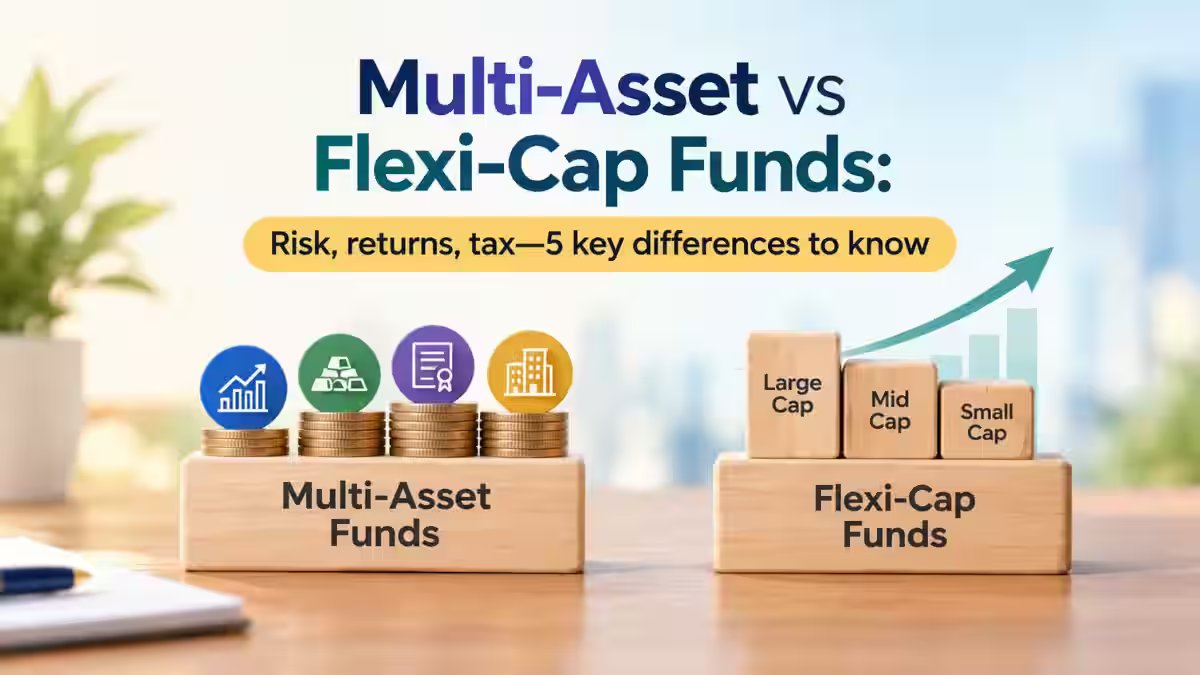
Multi-Asset vs Flexi-Cap Funds: Multi-asset allocation funds and flexi-cap funds follow different investment strategies, experts told Zee Business. While multi-asset funds invest across asset classes such as equities, debt, gold and silver, flexi-cap funds primarily invest in equities and have the flexibility to move across large-cap, mid-cap and small-cap stocks.
The difference between the two fund categories has come into focus as multi-asset funds have witnessed a sharp rise in assets under management (AUM). The AUM of multi-asset funds grew 487 per cent over the past three years, while flexi-cap funds recorded 115 per cent growth during the same period, as per Zee Business research.
Mrin Agarwal, Founder of Finsafe, and Vikas Puri, Senior Partner at Complete Circle Capital, explained the differences between the two categories and the factors investors should consider before choosing between them.
Multi-Asset vs Flexi-Cap Funds: 5 key differences
1) Asset allocation
The most fundamental difference between the two categories is their asset allocation.
Agarwal explained that multi-asset funds invest across different asset classes. These can include bonds, equities, commodities such as gold and silver, international stocks and REITs, depending on the fund’s strategy.
Flexi-cap funds, meanwhile, are equity-oriented funds with a requirement to invest at least 65 per cent in equities. Within the equity allocation, the fund manager has the flexibility to allocate across large-cap, mid-cap and small-cap stocks.
In simple terms, multi-asset funds provide diversification across asset classes, while flexi-cap funds provide flexibility within the equity market across different market capitalisations.
2) Diversification and portfolio construction
According to Puri, diversification is one of the factors behind the rise in multi-asset funds. A single fund can provide exposure to debt, gold, commodities, international or overseas investments and, in some cases, REITs.
However, Puri stressed that investors should not choose a multi-asset fund simply because it contains multiple asset classes.
“The equity component should not be so high that ultimately there is no difference between a flexi-cap fund and a multi-asset fund,” Puri said.
He explained that if a flexi-cap fund and a multi-asset fund both have around 60-70 per cent equity exposure, the difference between the two becomes smaller.
Puri also highlighted the importance of understanding how a multi-asset fund is constructed and how the fund manager dynamically manages the allocation between asset classes. Investors should examine the fund’s equity, debt, gold and other asset exposures before making a decision.
Agarwal also said investors should examine their existing portfolios before choosing either category. They should check how much exposure they already have to different asset classes and, when considering an equity fund, also look at stock overlap.
3) Risk profile
Diversification across asset classes does not mean that a multi-asset fund is a low-risk investment.
Puri specifically cautioned investors against treating multi-asset funds as low-risk funds.
“Don’t consider a multi-asset fund to be a low-risk fund,” Puri said.
He explained that such funds can still carry risks associated with different asset classes. Equity exposure brings equity-market risk, while gold and silver can also be volatile. Overseas investments carry their own risks, while the debt portion can involve credit and interest-rate risks.
Therefore, the presence of multiple asset classes does not eliminate investment risk. Investors need to consider the risks associated with each underlying asset class.
Agarwal said investors should first understand why they are buying a multi-asset fund—whether they want their asset allocation to be managed through a single fund and want diversification compared with a 100 per cent equity fund.
4) Investment horizon and growth objective
The experts also differentiated between the two categories based on investment objectives and time horizon.
Agarwal said multi-asset funds are generally not meant to beat equity benchmarks over the long term. Instead, their role is more focused on risk management and diversification.
She said that if an investor has a long-term goal of seven years or more and can tolerate volatility, they can look at flexi-cap funds.
On the other hand, if the investment horizon is around five years and the investor wants exposure to multiple asset classes within a single fund, Agarwal said a multi-asset fund can be considered.
Puri also linked flexi-cap funds with the growth objective. He said that if investors are looking for a growth engine in their portfolio, a flexi-cap fund makes sense because of its equity exposure.
Puri added that, based on the long-term track record, equities have outperformed other asset classes.
5) Taxation
Tax treatment is another factor investors need to consider when evaluating a multi-asset fund.
Agarwal pointed out that the equity allocation of a multi-asset fund is important from the taxation perspective. She said that if the equity allocation is not above 65 per cent, different taxation may apply.
This means investors should not assume that all multi-asset funds have the same tax treatment. The actual asset allocation and structure of the particular fund need to be examined.
Why has multi-asset fund AUM grown 487%?
The sharp rise in multi-asset fund AUM has coincided with strong performance from gold and silver over the period, the experts said.
Agarwal said gold had delivered around 34-35 per cent per annum over the previous three years. She also pointed to the performance of REITs, saying that REITs had delivered around 12-13 per cent returns over the previous year.
Puri said gold and silver exposure provided a significant boost to several multi-asset funds. He also said that retail investors often chase returns, which can influence their preference when one category is performing better than another.
Agarwal described the recent shift towards multi-asset funds as partly a FOMO-driven trend, saying some investors may be looking at recent returns and investing based on that performance.
However, Puri also pointed out that the category’s sharp AUM growth needs to be viewed against its relatively smaller starting base. He said that even after more than 400 per cent growth, the multi-asset fund corpus was around Rs 2 lakh crore and represented roughly 2-3 per cent of the overall mutual fund industry.
Is money moving from flexi-cap funds to multi-asset funds?
Puri said it would be difficult to conclude that money was moving directly from flexi-cap funds to multi-asset funds.
He noted that flexi-cap funds had continued to see substantial inflows in month-on-month numbers. According to him, recent outflows were more visible in large-cap funds.
Puri said flexi-cap funds had not performed particularly badly, apart from one or two funds, and that their appeal remained intact.
Therefore, he did not view multi-asset funds simply as an alternative that investors were using to replace flexi-cap funds.
Should investors hold both multi-asset and flexi-cap funds?
The experts said the decision should depend on the investor’s financial goals, risk-taking ability, investment horizon and existing portfolio.
Agarwal said investors should consider why they are choosing a multi-asset fund and whether they actually need multiple asset classes within a single fund.
She also said that, generally, keeping different asset classes separately can be better because it allows investors to manage their allocation according to their goals.
“If your time frame is seven years to 10 years, certainly you should look at a flexi-cap,” Agarwal said.
She also cautioned investors against judging mutual funds only on short-term performance, saying investments in mutual funds are generally made with a long-term perspective.
Puri similarly said that if the objective is growth, his preference would be towards flexi-cap funds, while a multi-asset fund could have a limited role for diversification.
He added that in his own portfolio, a multi-asset fund could form a small allocation of around 5-10 per cent, particularly if he wanted exposure to REITs and commodities without taking those exposures directly. He said he would prefer a multi-asset fund with relatively low equity allocation for this purpose, while keeping the majority of his investment in flexi-cap funds.
What allocation did experts suggest for different investor profiles?
While explaining flexi-cap and multi-asset funds, Puri gave illustrative allocation ranges for different types of investors.
| Investor Profile | Flexi-Cap Allocation | Multi-Asset Allocation |
|---|---|---|
| Conservative | 10–20% | 40–50% |
| Moderate | 25–40% | 30–40% |
| Aggressive | 40–55% | 15–25% |
Puri said conservative investors seeking greater diversification could have a higher allocation to multi-asset funds, while investors seeking a greater growth component and willing to take higher equity-market risk could have a higher allocation to flexi-cap funds.
These were the expert’s illustrative ranges for the comparison and should not be treated as a universal allocation formula for all investors.
Multi-Asset vs Flexi-Cap: What should investors check?
Before choosing between the two categories, investors should consider:
- Asset allocation: Check where the fund invests across equities, debt, gold, silver, REITs and other assets.
- Equity exposure: Examine the equity component of a multi-asset fund and compare it with the equity exposure of a flexi-cap fund.
- Portfolio construction: Check how the fund manager allocates and dynamically manages exposure across asset classes.
- Existing portfolio: Check existing exposure to different asset classes and potential stock overlap.
- Investment horizon: Match the fund with the time frame of the financial goal.
- Risk appetite: Do not assume that diversification across asset classes eliminates investment risk.
- Taxation: Check the fund’s equity allocation and the applicable tax treatment.
Multi-Asset vs Flexi-Cap Funds: What do the experts say?
The experts’ insights indicate that the two categories can serve different portfolio requirements. Multi-asset funds focus on diversification across asset classes through a single fund, while flexi-cap funds provide predominantly equity exposure with flexibility across large-cap, mid-cap and small-cap stocks.
For investors, the decision depends on their financial goals, investment horizon, risk-taking ability and existing portfolio exposure.
Agarwal’s comments suggest that investors with a seven-to-10-year horizon may consider flexi-cap funds, while a multi-asset fund can be considered when the objective is to get exposure to multiple asset classes through a single fund.
Puri similarly linked flexi-cap funds with the growth objective while highlighting the diversification role that a multi-asset fund can play. Both experts stressed the importance of looking beyond short-term performance and examining how a fund fits into the investor’s overall portfolio.