
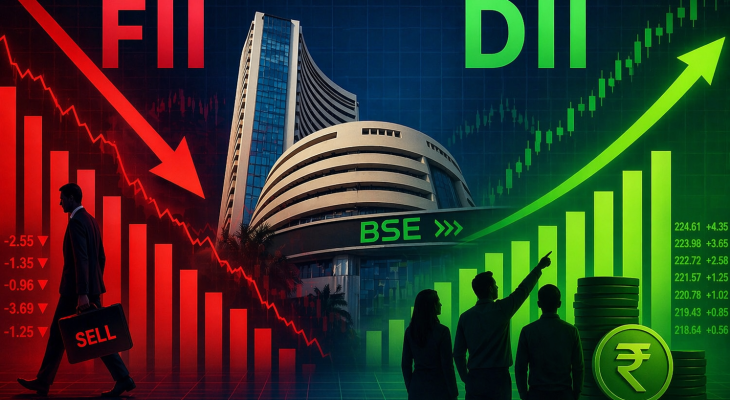
Foreign capital has been steadily exiting Indian equities in 2026, but the market has not cracked under the pressure. Instead, it is being held up by a powerful domestic counterforce.
Foreign institutional investors (FIIs) have pulled out nearly USD 19 billion from Indian equities so far this year. A significant portion of this, about USD 14.2 billion, came during the sharp market correction between late February and March-end, followed by another USD 3 billion of selling even as markets attempted a recovery in April.
On the contrary, domestic institutional investors have stepped in aggressively, deploying over Rs 2 lakh crore during the same period and effectively absorbing a large part of the foreign selling.
In 2025 as well, DIIs invested over Rs 6 lakh crore into equities, nearly three times the foreign outflows, signalling a structural shift in market dynamics.
SIP Investors Thirsty For Returns
Retail investors are doubling down on discipline even as returns disappoint. A recent report by Kotak Institutional Equities highlighted that equity-oriented mutual funds attracted active inflows of Rs 1.1 trillion in the first quarter of calendar 2026, despite a meaningful correction in markets and SIP inflows reached Rs 32,000 crore in March.
This surge in inflows has come at a time when the weighted average net asset value (NAV) of equity funds has declined 14 per cent from its September 2024 peak, slipping below June 2024 levels by March 2026.
Data from the report also showed that internal rates of return (IRR) for a large section of SIP investors, especially those who began investing between mid-2024 and early 2026, have turned negative following the recent correction.
“Markets have remained sideways for the past 18 to 20 months, something that many investors are experiencing for the first time. However, data is clearly showing that SIP investors continue to remain buoyant as inflows are only increasing month-on-month, with barely any sign slowing down. Since March 2024, SIP inflows have grown by a whopping 67 per cent, despite markets being turbulent the entire time,” said Thomas Stephen Director & Head, Anand Rathi Shares and Stock Brokers.
Mutual Funds’ Low Cash Holdings
Mutual funds reduced their cash holdings to a 16-month low in March, deploying capital into equities during a sharp market correction triggered by rising geopolitical tensions and elevated crude oil prices.
According to data, cash holdings fell by Rs 24,319 crore, or 12 per cent, to Rs 1.86 lakh crore in March from Rs 2.1 lakh crore in February.
“Cash levels of active Mutual Funds had dropped to Rs. 1.5 trillion a few days back, which was still at normal levels of close to 5 per cent. If we consider the period of 16 months, the cash levels seem to be low, but they are at normal levels. The current cash levels do not materially impair the ability to participate in opportunities,” said Aparna Shanker, CIO— Equity, The Wealth Company Mutual Fund.
Cash as a proportion of assets under management (AUM) also declined to a four-month low of 4.73 per cent, compared with 4.86 per cent in February and 5.76 per cent a year earlier.
“With cash-to-AUM levels around 4-5 per cent, the system remains within a healthy range for normal operations and redemptions. Buying capacity would only become constrained if SIP inflows slow meaningfully, large-scale redemptions rise, or valuations become excessively stretched, forcing cautious positioning,”said Ajit Mishra, SVP- Research, Religare Broking.
Financials Sucking Mutual Funds’ Cash
Domestic mutual funds aggressively bought in financial stocks during March, investing nearly Rs 55,413 crore in the sector. The purchases accounted for almost 50 per cent of total secondary market inflows by mutual funds, which bought equities worth Rs 1.13 lakh crore during the month.
The buying came despite a steep sell-off in banking stocks, with the Nifty Bank falling 17 per cent and the Nifty Financial Services declining 15.6 per cent in March, marking their sharpest monthly drop since March 2020.
“DIIs are rupee-denominated, long-duration investors. They look at HDFC Bank trading near a multi-year valuation trough, at ICICI Bank compounding ROE at 18.5 per cent with a fortress balance sheet, at private banks growing credit at 15 to 18 per cent while NPAs hit historical lows and they see a buying opportunity, not a crisis,” said Vaqarjaved Khan, CFA, Sr. Analyst – Fundamental, Angel One.
Banking and financial services continue attracting domestic institutional interest because of earnings visibility, rupee returns, 3 to 5 year horizons and fundamental business quality, added Khan.
Financial stocks also remained under pressure as rising sovereign bond yields raised concerns over potential mark-to-market losses on banks’ government securities portfolios.
“Financials is the most dominant sector in the key domestic market indices where FII ownership is also high. So when FIIs withdraw money from the market, financials are more likely to witness selling pressure from these foreign investors,” said Nilesh D Naik, Head of Investment Products, Share.Market (PhonePe Wealth).
Markets Without FIIs & Road to Their Return
Mukherjee, said the growing pool of domestic capital has played a critical role in cushioning the impact of foreign outflows and limiting volatility during global risk-off phases. However, he cautioned that it would be premature to view this as a complete structural shift, as foreign investors continue to influence liquidity, valuations and overall market direction.
Mishra echoed a similar view, noting that domestic institutional investors largely act as stabilisers rather than drivers of sustained bull markets. He added that continued market outperformance will still depend on a revival in foreign inflows and supportive global conditions.
Mukherjee further noted that the return of foreign investors will hinge on a combination of global and domestic triggers such easing geopolitical tensions in the Middle East, moderation in crude oil prices, a stable interest rate outlook particularly from the US Federal Reserve and an improvement in overall risk sentiment.
On the domestic front, sustaining macroeconomic stability through controlled inflation, fiscal discipline, continued policy reforms and strong corporate earnings growth will be critical in rebuilding investor confidence and attracting foreign capital back into Indian markets, he said.