
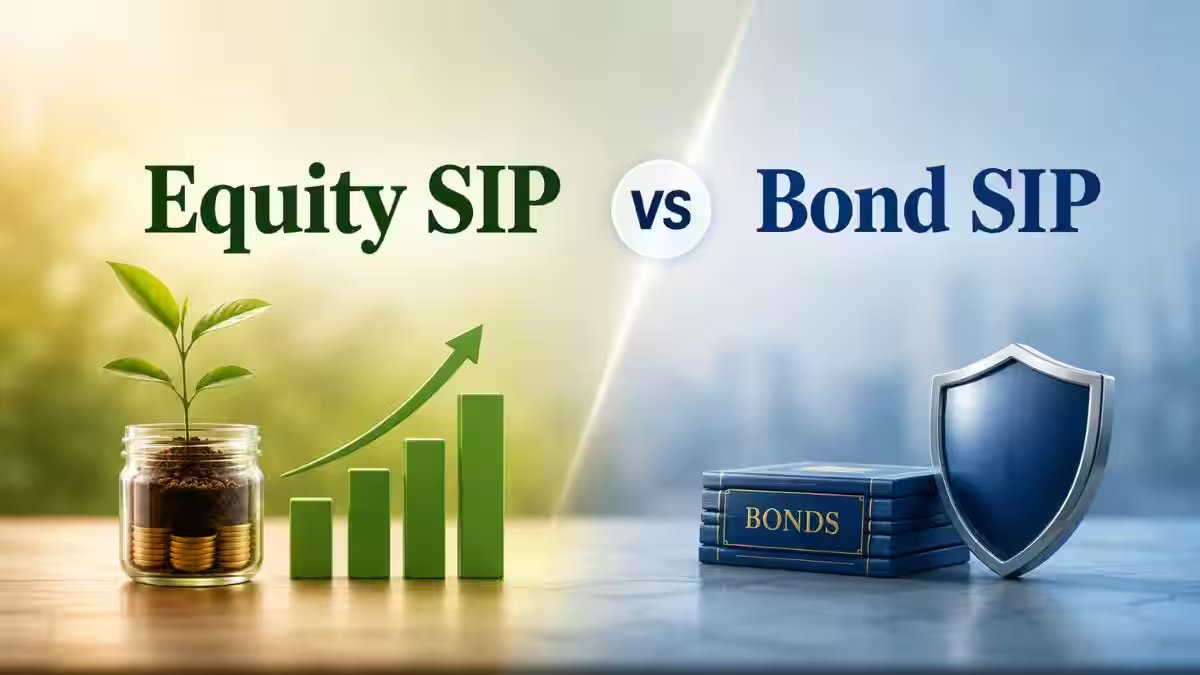
Equity SIP vs Bond SIP: Systematic Investment Plans (SIPs) happens to be one of the most sought-after investments for people seeking to create wealth in the long run. As many people know, Equity SIPs is widely known for helping investors earn profits from the stock market; however, there is another investment scheme being considered these days – Bond SIPs.
Financial advisors state that Bond SIP and Equity SIP serve different purposes and are meant to achieve different financial goals. An investor must decide on which one to choose based on his or her financial goals and risk appetite, among other factors.
What is a Bond SIP?
Speaking on Zee Business, Kalpesh Ashar, Founder of Full Circle Financial Planner, explained that a Bond SIP is essentially a debt-based SIP where investments are made in fixed-income instruments instead of equities.
“A debt-based SIP does not invest in equities. Its source is the fixed-income asset class. Investments are made in fixed-income instruments such as bonds, treasury bills, government securities and other debt instruments,” Ashar said.
He added that while both Equity SIPs and Bond SIPs follow a disciplined investment approach, their underlying assets are entirely different.
“Equity is like an ocean of stocks, whereas Bond SIPs are focused on fixed-income assets,” he said.
Ashar explained that while Equity SIPs primarily benefit from rupee cost averaging, where investors accumulate more units during market volatility, Bond SIPs work differently. Since bond prices are influenced by interest rates, regular investments in Bond SIPs help investors average out interest rate movements over time rather than stock market fluctuations.
Here are six key differences investors should understand before choosing between Equity SIPs and Bond SIPs:
1) Investment type: Equity markets vs fixed-income assets
The biggest difference lies in where the money is invested.
Equity SIPs invest in stocks and equity-related instruments, allowing investors to participate in corporate earnings growth and long-term market appreciation.
Bond SIPs, on the other hand, invest in fixed-income products such as corporate bonds, government securities and treasury bills.
According to Ashar, the objective of debt-based SIPs is to help investors regularly invest in fixed-income instruments, diversify their portfolios, achieve financial goals and benefit from averaging.
“We want investors to regularly invest in corporate bonds or government bonds so that their portfolio gets diversified, financial goals can be achieved and they get the benefit of averaging,” he said.
2) Risk factor: Market volatility vs credit, liquidity and interest rate risks
Risk is one of the most important considerations while selecting an SIP.
Equity SIPs are exposed primarily to market volatility, while Bond SIPs carry different risks, including default risk, liquidity risk and interest rate risk.
Ashar stressed that bond investments should not be viewed as risk-free.
“The biggest risks in bonds are default risk, liquidity risk and interest rate risk,” he said.
Explaining interest rate risk, he noted that bond yields generally move inversely to interest rates. Falling interest rates can support bond yields, while rising rates may negatively affect bond prices and returns.
He also cautioned that investors chasing unusually high fixed-income returns may end up taking significant credit risk and could even face negative returns if defaults occur.
3) Return expectations: Wealth creation vs capital preservation
Equity SIPs are generally considered suitable for long-term wealth creation because they allow investors to benefit from market growth over extended periods.
Bond SIPs, however, are not meant to be viewed simply as high-return alternatives. Their risk and return profile depends largely on the type of bonds being selected.
Speaking on Zee Business, Mrin Agarwal, Founder of Finsafe, said Bond SIP strategies broadly fall into two categories—high-yield strategies and capital preservation strategies.
“In a high-yielding strategy, investments are made in bonds offering higher interest rates. However, these bonds usually have lower credit ratings and higher default risk,” Agarwal said.
According to her, such strategies may generate returns of around 10–12 per cent, but investors should understand that the higher returns come with significantly higher default risk.
For investors seeking capital preservation, Bond SIPs generally invest in higher-rated bonds.
“Capital preservation strategies focus on AAA to AA-rated bonds. These are safer and returns are generally around 7.5–9.5 per cent,” she said.
4) Investment horizon: Long-term goals vs short-term requirements
Experts believe the investment horizon plays a crucial role in deciding between Equity SIPs and Bond SIPs.
Ashar said Equity SIPs are better suited for long-term investors because market volatility works in favour of disciplined investors over time.
“Volatility is the best friend of equity for the long term. An SIP captures that volatility and allows investors to accumulate more units when markets fall,” he said.
However, he said debt-based SIPs may be more suitable for short-term financial goals where capital preservation is more important than aggressive returns.
“For example, if someone wants to accumulate Rs 5 lakh in one or two years, they can invest through a debt SIP. The fluctuations are limited and the probability of achieving the target is higher,” Ashar explained.
5) Investor profile: Who should choose what?
According to Agarwal, investors should not choose Bond SIPs simply because they advertise attractive returns.
“Many investors get attracted after seeing returns of 10–12 per cent. They feel it is the best product because there is no lock-in and there is a predictable cash flow. But investors need to understand the risks involved,” she said.
Agarwal also cautioned investors against assuming that every secured bond is completely safe. She said investors should carefully examine the quality and adequacy of the collateral backing a bond, as recovery after a default can be uncertain and time-consuming, even when collateral exists.
She also raised concerns about Bond SIP platforms, questioning how bonds are selected, what risk management processes are followed and how defaults would be handled if they occur.
Agarwal noted that while Bond SIP platforms now select bonds on behalf of investors, many investors may not know the experience or credit evaluation process behind those decisions.
For investors looking for relatively safer fixed-income exposure, she said she would prefer debt mutual funds over Bond SIPs.
“I am not in favour of Bond SIPs for new investors because the attraction often comes from high returns. Investors should understand who is selecting the bonds and what risk management process is being followed,” she said.
- Short-term goals: Debt mutual funds may be more suitable.
- Long-term wealth creation: Equity mutual funds are generally the preferred option.
6) Portfolio allocation: Should investors choose both?
Experts say investors do not necessarily have to choose only one asset class.
Ashar said debt investments can play an important role in maintaining proper asset allocation, building an emergency corpus and meeting short-term financial goals.
“If someone has 70 per cent of their portfolio in equity, they can keep a portion in debt investments for contingency planning and short-term requirements,” he said.
He added that while Equity SIPs remain better suited for long-term wealth creation, debt-based SIPs can help investors pursue short-term goals with relatively lower fluctuations.
Are Bond SIPs suitable for new investors?
Agarwal said she would not recommend Bond SIPs for new investors.
Instead, she believes debt mutual funds are a more suitable choice for conservative investors because they typically have established fund management and risk mitigation processes.
According to Agarwal, investors currently have limited visibility into how some Bond SIP platforms select bonds, manage credit risk and deal with potential defaults.
“Debt funds may not offer returns of 10–12 per cent like some Bond SIP strategies, but they are comparatively safer,” she said.
Key takeaway for mutual fund investors
The experts highlighted that there is no one-size-fits-all SIP strategy.
For long-term wealth creation, Equity SIPs are generally the preferred choice because they help investors benefit from long-term market growth and volatility through disciplined investing.
For short-term financial goals, emergency planning and maintaining asset allocation, debt investments—including debt mutual funds and suitable debt-based SIPs—can play an important role.
However, experts cautioned that investors should evaluate Bond SIPs carefully instead of focusing only on advertised returns. Understanding the quality of underlying bonds, the credit risks involved and the investment process is equally important before investing.
Ultimately, investors should choose between Equity SIPs and debt-based investments based on their financial goals, investment horizon and risk appetite rather than chasing higher returns alone.