

India’s mutual fund industry clocks SIP inflows of over Rs.32,000 crore a month. In the PMS universe, the trend is far less visible in the data, but a gradual shift towards systematic investing is beginning to emerge.
According to data from PMS Bazaar, one of India’s largest PMS research and distribution platforms, out of 576 PMS strategies surveyed, 220 strategies run by 86 portfolio managers are currently accepting SIPs, while 261 strategies of 102 PMSes are not accepting SIPs. Meanwhile, 33 portfolio managers running 95 strategies did not respond. Is this the beginning of a broader shift in how affluent Indians invest, or is it still a niche practice?
PMS-SIP tracker
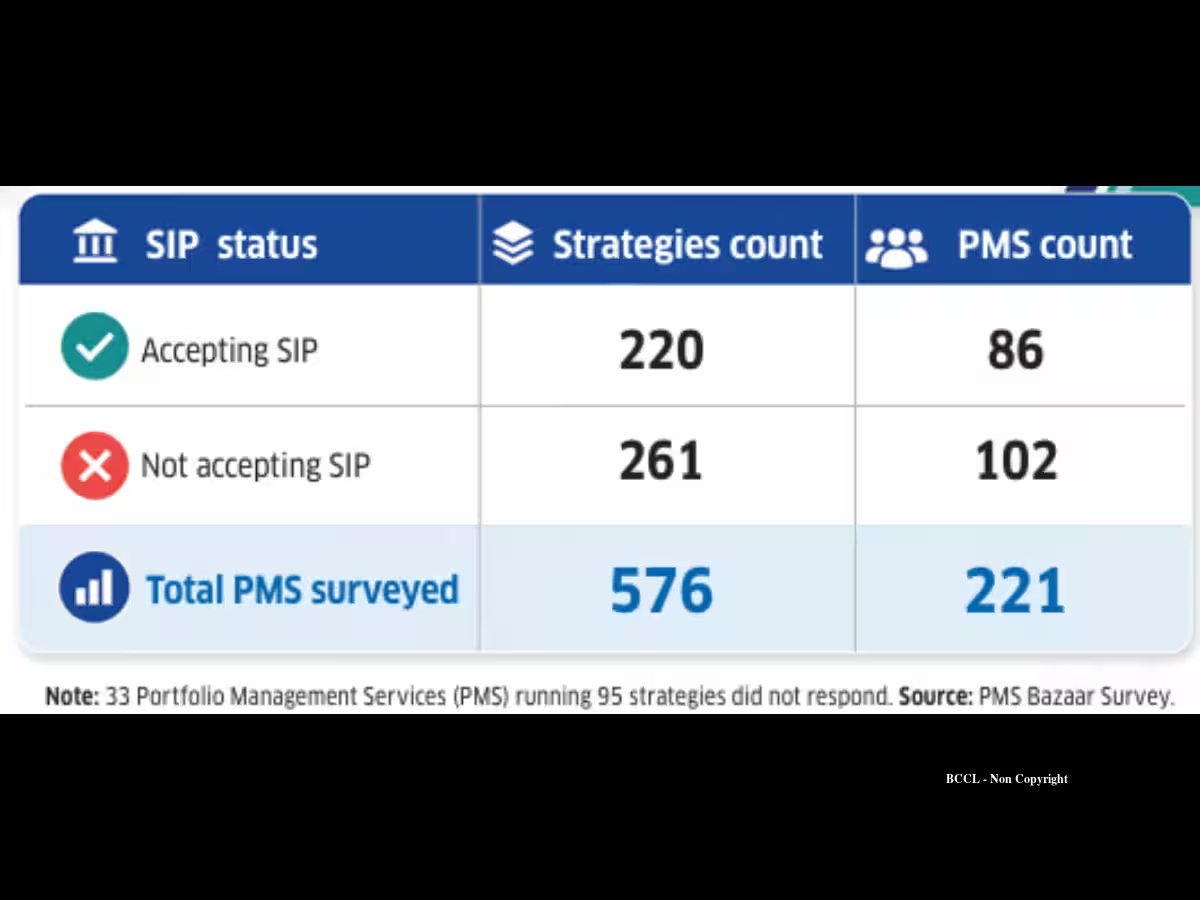
Mapping the trend
The strongest data on adoption comes from Dezerv, a wealth management platform. “More than 15% of our PMS clients also invest through SIPs,” says Sandeep Jethwani, Dezerv Co-founder, adding that the average monthly SIP ticket is Rs.85,000. “Individual SIPs range from Rs.50,000 to Rs.1 crore a month,” says Jethwani.
At the other end of the spectrum, adoption remains thin. “Currently, less than 5% of (our) PMS investors opt for the SIP route,” says Sameer Narayan, Head, Alternates and Offshore at Aditya Birla Sun Life (ABSL) Asset Management Company. “For this segment, lump sum alloca tions continue to be the more established approach, while systematic deployment is emerging as an alternative for managing entry-point risk,” adds Narayan.
The gap between SIP adoption at Dezerv and ABSL AMC likely reflects differences in investor profile and business mix. But Narayan highlights a somewhat similar trend. He says that more than 50% of investors enquiring about PMS at his firm are considering a Systematic Transfer Plan (STP) approach to deployment.
An STP is not the same as a recurring SIP. In an STP, a client commits the full investible corpus upfront, parks it in a liquid or low-risk holding within the PMS structure, and then moves tranches into the equity portfolio every month. Prashasta Seth, Chief Executive Officer of Prudent Investment Managers, describes a common industry practice: “It is also common industry practice to collect the minimum Rs.50 lakh upfront, park it across two approaches, an equity approach and a liquid approach, and move money from the liquid approach to the equity approach every month.”
Why SIP in PMSes?
Jethwani describes the typical SIP investor at Dezerv as an “emerging wealth creator whose wealth grows each year from what they earn. They are usually investing towards a defined goal, most often retirement. Their priority is to put each month’s surplus to work consistently, whatever the market is doing.” Market conditions add another layer. “With the Nifty around 14% below its January high, FPIs selling and crude oil above $100 a barrel, markets remain volatile,” notes Seth. “Staggered investments can help spread entry points and reduce the regret of investing at a peak, although it does not eliminate market risk or guarantee better returns. This approach may also suit business owners and professionals who generate investible surpluses throughout the year rather than hold a large idle corpus,” adds Seth.
For R. Pallavarajan, Founder of PMS Bazaar, the motivation is more straightforward. “Whether it’s a mutual fund SIP or a PMS SIP, the main motivation is to capture the volatility. That’s a key reason why investors want to choose it,” he says.
Safety or illusion?
The most important distinction for prospective PMS SIP investors is the one between spreading timing risk and reducing portfolio risk. These are not the same thing.
Mayur Shah, PMS Fund Manager at Anand Rathi Advisors, says, “The biggest misconception is that an SIP makes PMS inherently safer or guarantees better returns. An SIP changes the timing of capital deployment; it does not change the underlying investment risks of the portfolio. Market corrections can still lead to substantial losses, and systematic investing does not guarantee profits or eliminate the possibility of negative returns.”
Rushabh Desai, Founder of Rupee with Rushabh Investment Services, notes one clear case where SIPs do not fit the structure. “SIP doesn’t make sense in a very aggressive thematic or a sectorial equity product, because it requires a precise entry and exit, and it can give you no returns for a very, very long period of time as well. In standard portfolios, in PMSes, SIP should be fine.”
When money goes in at different times, the usual return figures can mislead. Investors need to know which number tells them what. XIRR shows what you actually earned, because it accounts for how much you put in and when. “XIRR is the investor’s actual experience,” says Shah. To judge whether your PMS SIP is working, Jethwani suggests a simple test: “Run the same SIP cash flows through the benchmark and compare the two XIRRs.” In other words, check what the same instalments, invested on the same dates, would have earned in the index. And give it time. “Judge it over a full market cycle, ideally five years or more, not a few months of returns,” he says.
Not your mutual fund SIP
PMS SIPs differ significantly from mutual fund SIPs. The Rs.50 lakh minimum investment requirement remains unchanged.
Under Sebi rules, SIPs are an additional funding option for investors who have already committed Rs.50 lakh.
The structure is also different. In a mutual fund, investors buy units in a pooled scheme, and the fund’s buying and selling does not create a tax liability for individual investors. In a PMS, the shares sit in the client’s own demat account.
So every time the manager sells a stock, whether to rebalance, book profits or exit, the gain is taxable in the investor’s hands. Buying shares, including with a fresh SIP instalment, does not trigger any tax. SIPs add a wrinkle. Each instalment buys shares on a different date, so the same stock in the portfolio can have several holding periods. When it is sold, part of the gain may be short-term and part long-term.
Nehal Mota, Co-Founder of Finnovate Financial Services, explains: “Check for management and performance fees, bro kerage, transaction, custodian and demat charges, and applicable taxes.”
Fees, too, are calculated on the total value of the portfolio rather than on individual instalment amounts. Narayan notes that “the management fee is calculated on Average Monthly AUM, irrespective of whether capital is deployed through a lump sum, SIP or STP.”
The PRIM opportunity
Experts attribute the slow growth of PMS SIPs partly to operational complexities. Recurring debits, stock purchases and client-level record-keeping are more cum bersome than automated mutual fund unit allocation.
“For a mutual fund, there is a mandate to debit the money; it can be easily debited from the bank account, and then units get allotted easily. The operation is very difficult here (in PMSes) in SIP,” says Pallavarajan. The technology infrastructure that makes mutual fund SIPs seamless, instant debits, NAV-based unit allotment, and account statements does not yet exist in the same form for PMS.
That could change with recent regulatory developments. Sebi has created a new category called PRIM (Portfolio Manager Investing in Mutual Funds), which allows portfolio managers to build client portfolios using mutual funds and exchange-traded funds (ETFs) as underlying instruments, with a lower minimum investment threshold of Rs.25 lakh.
“I strongly believe SIPs in PMS will get more popular with the PRIM regulations coming in,” says Pallavarajan.
PRIM could see stronger SIP adopt, as younger investors bring regular cash flows, says Pallavarajan. Jethwani adds that PMS managers can leverage their existing expertise in asset allocation through mutual funds, ETFs, index funds and smart-beta strategies.
Still a niche, for now
PMS SIPs remain a niche option as they neither lower the entry threshold nor reduce portfolio risk or guarantee better returns. They simply allow investors to channel regular surpluses into an existing portfolio.
“Investors should first determine whether the investment strategy, risk profile and minimum commitment suit their financial circumstances,” says Seth.
Wider adoption will depend on better technology, smoother operations and regulatory changes, with PRIM potentially giving the trend a boost.
What does an SIP actually change?
What it can do
*Spread investments across different entry points.
*Build a habit of investing surplus cash.
*Reduce dependence on one investment date.
*Reduce the pressure to time the market perfectly.
What it cannot do
*Eliminate market or stock-specific risk.
*Guarantee better returns than a lump sum.
*Protect an investor from a poorly performing strategy.
*Make a mid-cap or small-cap portfolio inherently safer.
SIP or STP? Two ways to stagger investments
PMS SIP
Investing fresh money periodically
*Additional money enters at regular intervals.
*Suitable for investors with recurring investible surpluses.
*Each contribution is invested according to the provider’s arrangement.
PMS STP
Moving an existing corpus gradually
*A lump sum is committed upfront.
*Money is shifted periodically from a liquid allocation into the equity strategy.
*Suitable for investors reluctant to deploy all their capital immediately.