
Key Takeaways
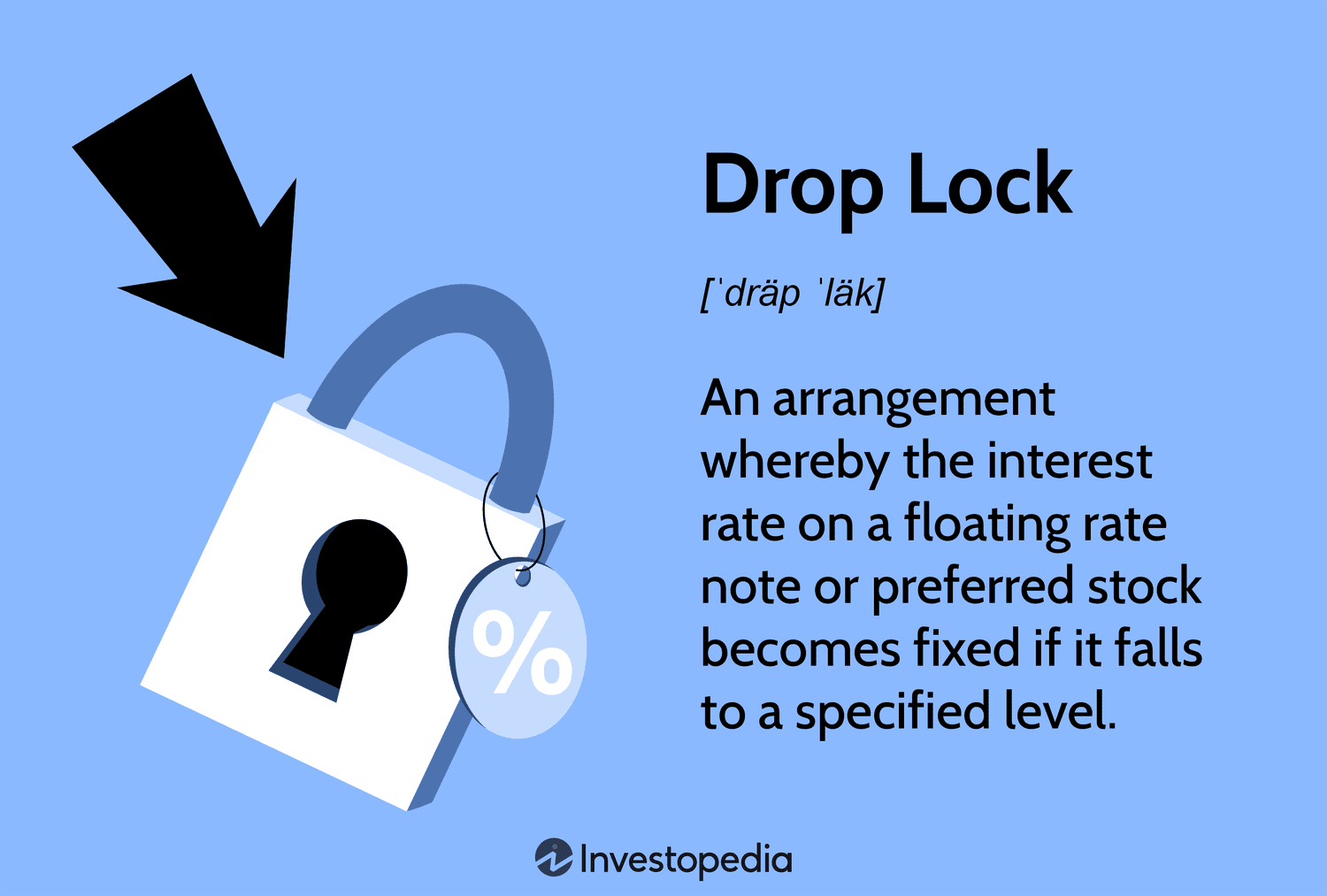
- A drop lock is a feature of a floating-rate note that converts the floating rate to a fixed rate at a predetermined level.
- Investors prefer drop lock bonds for their potential to fix interest rates and their maturity timetables.
- Issuers benefit by locking in interest rates if they drop, protecting against future increases.
- Drop lock bonds typically reset semiannually, based on market benchmarks like the Treasury bill rate.
What Is a Drop Lock Bond?
Drop lock bonds combine features of floating-rate and fixed-rate securities. The drop lock effectively sets a rate floor for the floating rate and provides a guaranteed minimum return to the lender or investor. When it drops below that floor, the rate becomes fixed. While it remains above that floor, the rate floats based on a benchmark rate, typically with a semiannual reset. The drop lock feature is used with floating-rate notes and preferred stock.
How Drop Lock Bonds Function
Drop lock bonds are issued to investors with a floating-rate interest which can reset on a semiannual basis, at a specified margin that hovers above a declared base rate linked to a particular benchmark. Most floating-rate instruments pay coupons equal to some widely followed interest rate or a change in a given index over a defined time period, such as the London Interbank Offered Rate (LIBOR), U.S. Treasury Bills (T-Bills), or the Consumer Price Index (CPI).
Once the benchmark is established, this floating interest rate continues until the base rate falls below a specified trigger rate, on an interest fixing date or on two consecutive interest fixing dates, at which time the interest rate becomes fixed at the specified minimum rate for the remaining lifetime of the bond.
Once the benchmark is chosen, issuers establish the additional spread that they are willing to pay in excess of the reference rate—generally expressed in basis points, which are added to the reference rate, in order to determine the overall coupon. For example, take a drop lock bond issued with a spread of 50 basis points above the three-month T-Bill rate of 3.00% on the day the bond is issued. Its initial coupon will be 3.50% (3.00% + 0.50% = 3.50%). The spread for any particular floating rate will be based on a variety of factors including the credit quality of the issuer and the time to maturity. The initial coupon is typically lower than that of a fixed-rate note of the same maturity.
Advantages and Disadvantages of Drop Lock Bonds
The fixed-rate behavior of drop lock bonds may appeal to securities investors who enjoy the comfort of locking fixed interest rates with fixed maturity timetables. Bonds held to maturity offer investors preservation of their principal and guaranteed cash flow. However, there are potential downsides for investors who sell their bond holdings prior to maturity, because the market value of fixed-rate securities fluctuates with changing interest rates, and in a dropping-rate climate, market values will change to a degree that’s determined by the time left remaining until maturity or call date, potentially triggering capital gains.
What Is a Bond Lock?
A bond lock, or Treasury lock, is a tool used by traders to counter interest-rate risk. It allows the market participant to basically secure the trading day’s interest rates on bonds to pay future costs that will be funded by borrowing.
What Is a Fixed-Income Investment?
A fixed-income investment is a financial instrument that provides reliable interest income for a specified period of time. Examples include government and corporate bonds, as well as fixed-income mutual funds or exchange-traded funds (ETF).
Which Bonds Provide the Highest Yield?
High-yield bonds provide the most yield, but there’s a price. High-yield bonds are so-called ‘junk bonds’ issued by companies. They typically provide a higher yield than bonds that are considered investment grade, as they have a lower credit rating, but they also have more of an inherent risk of default.
The Bottom Line
A drop lock bond such as a floating T-note has a feature that turns the floating rate into a fixed rate if the floating rate drops to a certain pre-determined level. Investors like drop lock bonds because they guarantee them a minimum return in a decreasing interest rate environment while offering the potential for greater returns if the rate remains floating. The disadvantage for investors who need to sell their bonds is that if the rate gets fixed, their bond may lose appeal for bond buyers as interest rates rise. Preferred stock can also have the drop lock feature.