

In an era of rising interest rates, attention is shifting not just to savings, but also to government bonds for individuals. Whether you decide to buy them or not, I will summarize the basics and types of government bonds from a beginner’s perspective.
Over the past few years, it feels like we have gradually returned to a “world with interest rates.”
Until a few years ago, even if you deposited money in a bank, the interest was truly negligible.
There was a feeling that neither ordinary savings nor time deposits were growing at all.
However, interest rates have started to rise little by little since around 2023, and recently, we have started to see higher interest rates than before for time deposits and government bonds for individuals.
Compared to the era of around 0.05% interest rates in the past, the current rates in the 1% range or around 2% feel quite significant.
Of course, not all products have high interest rates.
There are conditions, fixed terms, and interest rates that change depending on the timing of the purchase.
Even so, there is no doubt that we have entered an era where we need to think about “where to keep our money.”
Among these options, what I have been interested in lately is “government bonds for individuals.”
Honestly, I didn’t know much about government bonds myself.
I felt more familiar with investment trusts, the new NISA, and stock investments, and I thought government bonds were a bit plain.
But as interest rates rise, my perspective on government bonds is changing a little.
Whether you buy them or not, I think it is very important to know about them. Even if you aren’t interested now, at some point in your future life,
“I’m glad I knew at least a little bit about this back then”
you might find yourself thinking that.
This time, I will briefly summarize what government bonds for individuals are and what types exist, from a beginner’s perspective.
What are government bonds for individuals?
Government bonds for individuals are financial products that make it easier for individuals to buy bonds issued by the government.
Simply put, it is a mechanism where you lend money to the government and receive interest in return.
If you hold them until maturity, you will basically get your principal back at face value, so they have a slightly different nature from products like stocks or investment trusts that can fluctuate significantly in value due to price changes.
Of course, since they are investment products, it’s not something you should just buy without thinking.
However, I think they are products that are easier to consider as a relatively stable place to keep your funds, with less price movement than stock investments.
Government bonds for individuals can be purchased from a minimum of 10,000 yen in 10,000-yen increments. According to the official guidance from the Ministry of Finance, three types of government bonds for individuals are issued every month: “10-year floating rate,” “5-year fixed rate,” and “3-year fixed rate,” and they can be redeemed early one year after issuance.
Therefore, it is not a product only for people with large amounts of money.
I think the fact that you can start with a small amount is easy for beginners to understand.
Also, interest is received twice a year, every six months.
Some people might think of it in a similar sense to a bank time deposit.
However, since the mechanism is different from a time deposit, it is important to understand its characteristics.
Interest rates rising from 2024 to 2026
What we want to pay attention to regarding government bonds for individuals is the rise in interest rates from 2024 to 2026. In the era of low interest rates, even when hearing about government bonds, there was an impression that “they don’t grow much.”
However, the interest rate has been rising little by little since around 2024, and by 2026, the outlook has changed significantly.
For example, the 5-year fixed rate has risen to 0.71% per annum for the December 2024 offering, 1.22% per annum for the October 2025 offering, and 2.24% per annum for the September 2026 offering.
Of course, it is not guaranteed to continue rising in the future.
Even so, the fact that we have entered an era where interest can be expected even on “defensive money” like deposits and government bonds is, I think, a trigger to think about where to place your money.


Reasons why government bonds for individuals are attracting attention
One of the reasons why government bonds for individuals are attracting attention is, after all, the rise in interest rates.
In an era like before where there was almost no interest, I think it was difficult to feel the appeal even if you bought government bonds.
However, as interest rates rise, the interest on deposits and government bonds gradually begins to have meaning.
Especially for those who are not comfortable with things that fluctuate significantly in value, such as investment trusts or stocks, government bonds can easily become one of the options.
Also, when thinking about how to place living defense funds or money that you do not plan to use in the near future, government bonds for individuals become a candidate.
It is unsettling to put all your money into investments.
But it is also a bit of a waste to leave it in a regular savings account.
For those who feel this way, I think there is value in knowing about government bonds.
Types of government bonds for individuals
There are mainly three types of Japanese Government Bonds for individuals.
・Floating 10-year
・Fixed 5-year
・Fixed 3-year
Each has different maturity periods and methods for determining interest rates.
According to official information from the Ministry of Finance, the floating 10-year bond is a floating-rate type where the applicable interest rate changes every six months, while the fixed 5-year and fixed 3-year bonds are fixed-rate types where the interest rate at the time of issuance remains unchanged until maturity.
How you choose depends on how long you want to keep your money invested and what your outlook is for future interest rates.
1. Floating 10-year
As the name suggests, the floating 10-year bond is a Japanese Government Bond for individuals with a 10-year maturity.
Its feature is that the interest rate is reviewed every six months.
In other words, if interest rates rise in the future, the interest you receive will also increase. Conversely, there is a possibility that interest will decrease if interest rates fall.
However, a minimum interest rate is guaranteed.
The Ministry of Finance states that for all three types of Japanese Government Bonds for individuals, a minimum interest rate of 0.05% per annum is guaranteed even if market interest rates fall.
Even if interest rates drop, there is a certain floor, which provides peace of mind.
If you think interest rates might continue to rise, the floating 10-year bond is an option worth considering.
However, the 10-year maturity is relatively long.
Although you can redeem them early, there is a condition that one year must have passed since issuance. Therefore, it is better to consider this with money you can set aside for a while rather than money you plan to use soon.
2. Fixed 5-year
The fixed 5-year bond is a Japanese Government Bond for individuals with a 5-year maturity.
Its feature is that the interest rate determined at the time of purchase remains unchanged until maturity.
Since the interest rate is fixed, a benefit is that it is easier to forecast the interest you will receive in the future.
For example, if you can purchase when the current interest rate is high, you can lock in that rate for five years.
This becomes an advantage if interest rates fall in the future.
On the other hand, if interest rates rise further after purchase, the floating 10-year bond might potentially be more advantageous.
I think the fixed 5-year bond is suitable for those who want to “keep money they won’t use for a while in a stable place” or who find it “easier to understand when the interest rate is fixed.”
3. Fixed 3-year
The fixed 3-year bond is a Japanese Government Bond for individuals with a 3-year maturity.
Like the fixed 5-year bond, the interest rate at the time of purchase does not change until maturity.
However, the period is 3 years, which is shorter than the fixed 5-year bond.
It feels a bit uneasy to keep money tied up for a long time.
But I want to be a bit more conscious of interest than with a regular savings account.
That is when I think the fixed 3-year bond is easy to consider.
With a 3-year period, the psychological hurdle might be lower than for 10 or 5 years.
However, the interest rate changes depending on the interest rate environment at that time.
Which of the fixed 3-year, fixed 5-year, or floating 10-year is best depends on the interest rates at that time and your own objectives.
Benefits of Japanese Government Bonds for individuals
The benefit of Japanese Government Bonds for individuals is that they are relatively easy to understand.
They are bonds issued by the government, and you can purchase them starting from as little as 10,000 yen.
Interest is received every six months.
Also, a feature is that a minimum interest rate is guaranteed.
Unlike stocks or investment trusts, it is not a product where the price fluctuates significantly every day, so I think it is easier to consider for those who are uncomfortable with price movements.
Also, early redemption is possible after one year has passed since issuance.
However, when redeeming early, the equivalent of the two most recent interest payments will be deducted, so it is different from a regular savings account where you can withdraw money completely freely. The Ministry of Finance’s product overview also states that upon early redemption, an amount calculated by multiplying the equivalent of the two most recent interest payments by a predetermined coefficient will be deducted.
This requires caution.
Points of Caution for Japanese Government Bonds for Individuals
While Japanese government bonds for individuals are relatively stable products, there are points to be aware of. First, they are not suitable for money you plan to use soon.
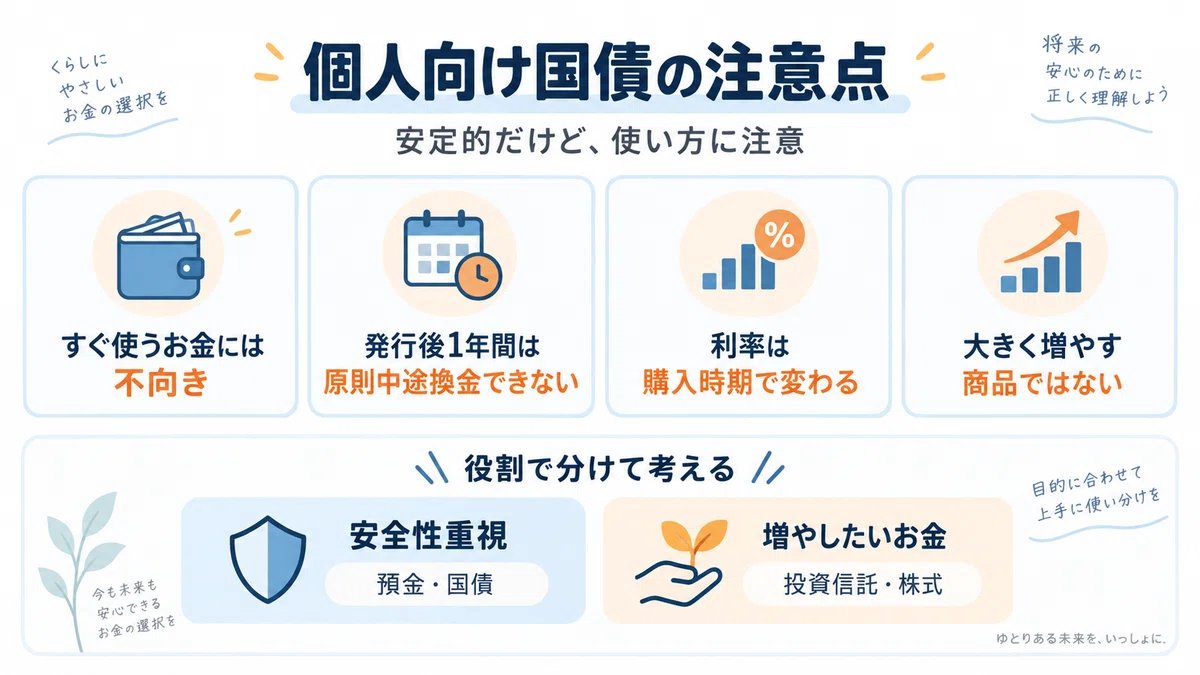
In principle, you cannot redeem them early for one year after issuance.
It is safer to keep money for unexpected expenses in a place where it can be used immediately, such as a regular savings account.
Also, the interest rate changes depending on the time of purchase.
Even if the conditions are good this month, they may change next month.
Especially in the case of fixed-rate types,the interest rate at the time of purchase continues until maturity, so the timing of the purchase is also importantFurthermore,
Japanese government bonds for individuals are not products for significant growth.
They are not intended to aim for large price increases like stocks or investment trusts, but areproducts for receiving interest stably.
Money you want to grow significantly should go into investment trusts or stocks.
Money you want to keep while prioritizing safety should go into deposits or government bonds.
It seems good to think about it by dividing roles in this way.
Thinking about Deposits, Investments, and Government Bonds Separately
I don’t think you need to decide on just one place to keep your money.
Money you use immediately goes into a regular savings account.
Money you won’t use for a while goes into time deposits or Japanese government bonds for individuals.
Money you want to grow over the long term goes into a new NISA or investment trusts.

Thinking about it by dividing it according to your purpose makes it easier to consider.
I myself am scared to put everything into investments.
But it is also a bit of a waste to keep it only in a regular savings account.
Thinking about it that way, I feel it is important to know about options like Japanese government bonds for individuals.
Whether you buy them or not is a separate matter, but having the knowledge is useful.
I think that alone increases your options when considering where to keep your money.
Summary
When studying money, it is easy to focus solely on “growing it.”
New NISA, investment trusts, individual stocks, ETFs, and so on—when we hear the term “asset formation,” it is easy to imagine aggressive investment strategies. However, after researching Japanese Government Bonds for individuals this time, I felt that
protecting and waiting are also parts of asset management.
Some money is for immediate use, while other money is set aside for the future.
Instead of keeping everything in the same place, consider where to put it based on its purpose. Just having that mindset, I feel, changes how you approach money a little bit.
Japanese Government Bonds for individuals are not flashy products.
They are not something that will grow significantly in a short period.
That is precisely why I had not paid much attention to them until now.
However, as we enter an era with interest rates, I think these modest options start to have meaning.
Investment is for offense.
Deposits and government bonds are for defense.
Thinking of it this way, it becomes important to consider how to allocate your money as a whole.
It is not about whether to buy them right now, but about knowing they exist first.
Even just that will serve as a basis for judgment when you are unsure where to put your money in the future.
From now on, I want to continue studying not only how to grow my money, but also how to protect it, little by little.
Now that we have returned to a world with interest rates, how should I place my money?
I thought that broadening those options would lead to better asset formation in the future.
*This article is based on personal study notes. It does not recommend any specific product or purchase. Since interest rates and offering conditions change every month, please be sure to check the official information from the Ministry of Finance or financial institutions before purchasing.