
UK 30-year yields fall back from 28-year high
Encouraging news! The UK’s long-term cost of borrowing has dropped this morning.
The yield (or interest rate) on Britain’s 30-year bonds has dropped to 5.808%, a drop of four basis points (0.04 of a percentage point) today.
That pulls 30-year yields down from the 28-year high of 5.85% set on Friday afternoon, when the City was fretting about a potential UK leadership race.
Andy Burnham’s attempt last weekend to reassure the markets by pledging “I support the fiscal rules” may be calming investors’ nerves, after UK bond yields pushed higher last week.
Those fiscal rules are designed to reassure the markets that the government is committed to bringing down the national debt in future years, which gives investors more confidence to lend London money.
Neil Wilson, Saxo UK investor strategist, says:
Andy Burnham says he will stick to the fiscal rules but this Labour leadership debate is turning the microscope on a much broader issue; whether the UK can find the leadership to deliver a credible plan to fix the nation’s finances. Tough medicine is required but no one seems willing to administer.
Key events
Speaking of oil….Ryanair has said it is “confident” it will not face a jet fuel shortage this summer amid fears over widespread cancellations linked to the Iran war.
Neil Sorahan, the chief financial officer at the budget airline, said he was “increasingly confident that we will not see any supply shocks this summer”.
The airline said fares had fallen in recent weeks due to uncertainty around conflict in the Middle East, with prices expected to fall by a “mid-single digit percentage” in the three months ended in June.
IEA’s Birol warns commercial oil inventories are falling rapidly
International Energy Agency executive Director Fatih Birol has issued a new warning that oil inventories are shrinking fast.
Speaking to reporters on the sidelines of the G7 finance ministers’ meeting in Paris, Birol flagged that the tally of commercial oil inventories is shrinking at an accelerated pace.
Bloomberg has the details:
“I think it is depleting very fast,” he told reporters at the sidelines of a meeting of Group of Seven finance ministers in Paris, echoing comments from last week. It will be “several weeks, but we should be aware of the fact that it is declining rapidly,” he said.
He also highlighted that the spike in fertilizer and diesel prices comes at the start of the travel and planting season.
UK 10-year yields ease back
After hitting their hitting their highest levels since 2008 this morning, UK 10-year borrowing costs have eased back too.
The yield, or interest rate, on 10-year gilts is down 2.5 basis points (0.025 of a percentage point) to 5.14%.
That follows the easing in the oil price, after Tehran said it had responded to a new US proposal aimed at ending the Iran war (see earlier post).
It also follows early losses in global bonds, with Japan’s long-term borrowing costs hitting record highs (see opening post).
Dominic Caddick, economist at the New Economics Foundation (NEF), argues that borrowing costs will stay high regardless of who leads the Labour party.
“Borrowing costs will stay high regardless of who takes over the Labour Party – the real drivers are Trump’s Iran policy, UK inflation exposure, and pension market shifts that no austerity candidate can fix. Ending Britain’s bond market crisis requires direct intervention on inflation and better coordination between the Treasury and the Bank of England so that borrowing costs come down.
“Meanwhile, government must urgently address Britain’s weak demand to boost the economy. Through an essential energy guarantee government can help address inflation and deficient demand at once. A clear, credible economic strategy will bring borrowing costs down, and can be funded through progressive tax levers.”
[‘Pension market shifts’ refers to the shrinking market for defined benefit pensions, which had been a major purchases of long-term gilts such as 30-year bonds in the past]
In another example of the bond market sell-off, foreign investors sold China’s onshore yuan bonds for the 12th consecutive month in April, Reuters reports, citing official data.
Foreign institutions held 3.12trn yuan (£340bn) in bonds traded on China’s interbank market as of the end of April, the central bank’s Shanghai head office said, down from 3.19trn yuan a month earlier.
European Central Bank head Christine Lagarde was asked by reporters if she was worried about the bond market sell-off when she arrived in Paris for the G7 meeting.
Lagarde replied:
“I always worry, that’s my job.”
Pound rises, after a bad week
After falling every day last week, the pound is recovering some ground this morning.
Sterling has risen by over half a cent to $1.338 against the US dollar so far this morning.
Last week the pound fell by over three cents, its biggest weekly loss since last 2024, amid fears of higher fiscal spending if Andy Burnham became PM.
This morning, traders are digesting Burnham’s support for the existing fiscal rules, and warnings that the Manchester mayor faces a perilous race to win the Makerfield seat.
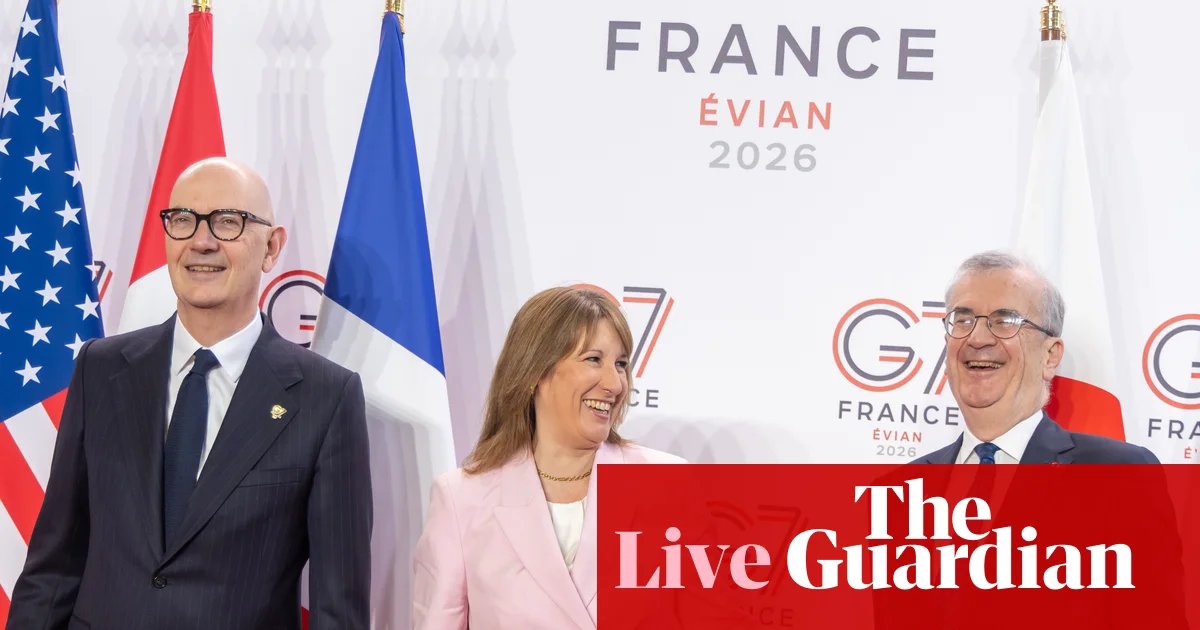
Some more photos of arrivals at the G7 finance meeting in Paris have arrived:
Iran has revealed it has responded to a new US proposal aimed at ending the war in the Middle East.
Foreign ministry spokesman Esmaeil Baqaei told a press briefing:
“As we announced yesterday, our concerns were conveyed to the American side.”
Brent crude oil has slipped back to $110.40 a barrel, up 1% today, having hit $112/barrel early today.
UK 30-year yields fall back from 28-year high
Encouraging news! The UK’s long-term cost of borrowing has dropped this morning.
The yield (or interest rate) on Britain’s 30-year bonds has dropped to 5.808%, a drop of four basis points (0.04 of a percentage point) today.
That pulls 30-year yields down from the 28-year high of 5.85% set on Friday afternoon, when the City was fretting about a potential UK leadership race.
Andy Burnham’s attempt last weekend to reassure the markets by pledging “I support the fiscal rules” may be calming investors’ nerves, after UK bond yields pushed higher last week.
Those fiscal rules are designed to reassure the markets that the government is committed to bringing down the national debt in future years, which gives investors more confidence to lend London money.
Neil Wilson, Saxo UK investor strategist, says:
Andy Burnham says he will stick to the fiscal rules but this Labour leadership debate is turning the microscope on a much broader issue; whether the UK can find the leadership to deliver a credible plan to fix the nation’s finances. Tough medicine is required but no one seems willing to administer.
Germany’s top central banker, Joachim Nagel, has declared that central bankers can do “a lot more” to calm the financial markets, as he arrived in Paris for the meeting of G7 finance chiefs.
Bank of England interest rate-setter Megan Greene has warned that the inflationary impact of the Iran war may not be temporary.
Speaking at a Financial Times event this morning, Greene says:
“This is our third negative supply shock in five years. We do have to worry about wage and price setting.
“Traditionally you look through negative supply shocks, but I think when you have successive ones, actually that’s outdated folklore and we shouldn’t be looking through them anymore.”
Greene was among the eight policymakers who voted to leave UK interest rates on hold at the Bank’s latest monetary policy meeting at the end of April, when chief economist Huw Pill cast the lone vote for a rate rise.
Shares in hotel group Whitbread have jumped 2.4% this morning as an activist hedge fund urges the company to put itself up for sale.
In a letter to Whitbread’s board seen by the FT, Corvex Management’s managing partner Keith Meister said:
“It is imperative that the board immediately retains an independent investment bank and makes a public commitment to conduct a rigorous and comprehensive sale process.”
Last month, Whitbread announced it would shut its remaining Beefeater and Brewers Fayre restaurants as the Premier Inns owner resets its five-year business strategy following pressure from Corvex.
UK 10-year bond yields hit new 18-year high
Boom! Britain’s cost of borrowing for a decade has hit its highest since the financial crisis in 2008.
Despite Andy Burnham’s attempts to reassure bond investors by saying he supports the fiscal rules, UK government bonds are still being buffeted by the global turmoil in the markets today.
This pushed the yield (or interest rate) on 10-year gilt yields up to 5.19%, over the 18-year high hit last Friday.
Mohit Kumar, economist at investment bank Jefferies, says inflation and deficit worries are weighing on the bond market, and the political crisis in the UK may have focused attention on these problems:
Inflation and deficit concerns have been in the background for a while. UK was probably the catalyst for bringing these concerns to the fore.
Political uncertainty and the challenge to PM Starmer has raised concerns of a policy shift towards the left. UK fiscal picture has already been in a poor shape as the Government was unable to delivery on spending cuts.
A shift to the left would imply a further increase in public spending, even though the government does not have the fiscal room to do so. Tax rises have already reached a stage where further rises in taxes are likely to be prove unproductive and unlikely to generate additional revenue.