

Active ETFs have evolved from a relatively small corner of the investment industry into one of its fastest-growing segments. Once viewed primarily as specialized alternatives to traditional mutual funds, active ETFs are increasingly becoming core portfolio holdings, offering investors professional management alongside the flexibility, potential tax advantages, and transparency associated with the ETF structure. The appeal extends well beyond individual investors, with financial advisors and institutional investors increasingly using active ETFs to build diversified portfolios, manage risk, and access investment opportunities.
For investors, one of the biggest attractions is knowing what they own.
Traditional mutual funds generally disclose their complete portfolios periodically, meaning investors may be looking at holdings that have already changed significantly. ETFs, by contrast, can offer much more timely information about their underlying investments. While this transparency can vary based on adopted structure, it is increasingly becoming an important selling point as investors seek greater control over portfolio exposures, concentration risks, and investment costs.
Active ETFs Are No Longer a Niche Investment
The numbers don’t lie, and they show that the active ETF movement is here to stay.
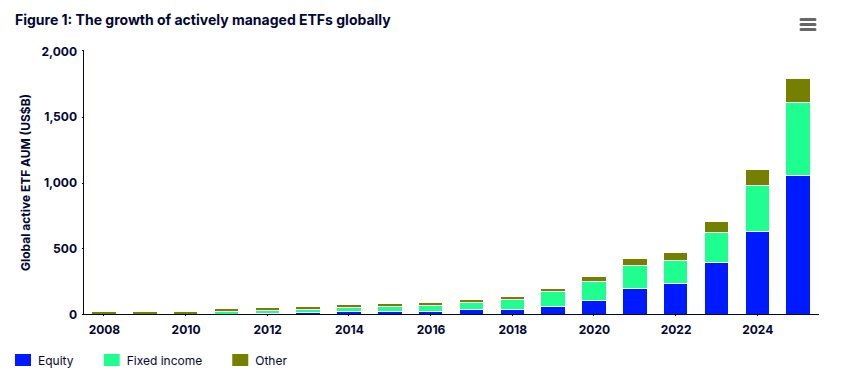
According to First Trust data, actively managed equity ETFs held approximately $1.27 trillion in assets at the end of August 2026, representing 9.8% of all U.S.-listed equity ETF assets. Active fixed-income ETFs held another $639.8 billion, accounting for 24.1% of bond ETF assets.
This chart from State Street highlights the organic growth of global active ETF launches and assets through the end of last year.
Source: State Street Global
More importantly, these figures illustrate a meaningful shift in how investors view active ETFs.
Rather than treating them as niche investments for specialized strategies, investors are increasingly using active ETFs as foundational portfolio holdings. Actively managed bond funds can provide core fixed-income exposure, while active equity strategies offer alternatives to traditional market-cap-weighted indexes.
The growth also reflects changing preferences among asset managers. Established mutual fund providers are introducing ETF versions of existing strategies, launching new products, and expanding their offerings to reach investors who prefer the ETF structure.
Transparency Is Helping Fuel the Active ETF Boom
Perhaps the most interesting aspect of active ETF growth extends beyond the possibility of outperforming traditional indexes. As portfolios grow more complex, investors increasingly demand greater visibility into how their money is managed, and that desire for transparency has become a key competitive advantage and growth driver for active ETFs.
Traditional mutual funds generally disclose their complete holdings quarterly, often with a 30- to 60-day reporting delay. Some provide monthly updates, but even those reports represent a snapshot of where the portfolio was rather than what it holds today. By the time investors read an updated prospectus or holdings list, those shares could already be gone from the fund’s assets.
Fully transparent active ETFs offer something different: daily disclosure of actual portfolio holdings, allowing investors to see which securities a manager owns, how positions are weighted, and how the portfolio changes over time.
J.P. Morgan Asset Management argues that this visibility is particularly valuable for active strategies. Rather than relying entirely on a manager’s stated philosophy or periodic commentary, investors can examine how investment decisions are being implemented—a distinction that matters because two funds with similar objectives can hold substantially different portfolios.
One active equity manager might emphasize high-quality companies with strong balance sheets, while another pursues more aggressive growth opportunities. Daily holdings allow investors to evaluate those differences directly. For financial advisors, retail investors, and institutions, this makes it easier to identify overlapping positions, unintended sector concentrations, and exposures that may conflict with a client’s investment objectives.
Transparency turns active management into something investors can monitor rather than simply trust. Daily holdings disclosure is particularly valuable when investors own multiple actively managed funds, and it becomes especially important during market volatility, when active managers may adjust portfolios rapidly. A mutual fund’s quarterly holdings report might reveal those changes only after market conditions have shifted again, whereas daily ETF disclosures provide a more current picture of how a manager is responding to risks and opportunities.
While different transparency structures exist—such as semi-transparent, which uses a proxy portfolio designed to behave similarly to the fund’s actual investments without revealing every position or its precise weighting—investors have continued to favor fully transparent active ETFs. Many of the largest issuers, including J.P. Morgan, BlackRock, Fidelity, and State Street, have taken the fully transparent route, and their active ETF assets under management reflect investors’ preference for this approach over more restrictive structures.
An added benefit is liquidity. Semi-transparent ETFs use alternative mechanisms to support efficient trading, but the additional complexity can create differences in transaction costs, including wider bid-ask spreads.
Active ETFs for Better Portfolio Transparency
The expanding active ETF universe gives investors opportunities to incorporate professional management across equities, fixed-income, and income-generating strategies—and investors can see exactly what they own. Using active ETFs as major portfolio building blocks is a smart approach, particularly those with fully transparent structures, which give investors a real-time window into their holdings and support better portfolio decisions.
Popular Active ETFs
These ETFs are sorted by YTD total returns ranging from -2.7% to 7.8%, with expense ratios between 0.17% and 0.36% and assets under management between $5 billion and $30 billion. Current yields range from 0.8% to 9.7%.
| Ticker | Name | AUM | YTD Total Ret (%) | Yield (%) | Exp Ratio | Security Type | Actively Managed? |
|---|---|---|---|---|---|---|---|
| JEPQ | J.P. Morgan Nasdaq Equity Premium Income ETF | $5.58B | 7.8% | 9.7% | 0.35% | ETF | Yes |
| DFUV | Dimensional U.S. Marketwide Value ETF | $8.5B | 6.2% | 1.5% | 0.21% | ETF | Yes |
| DFAC | Dimensional U.S. Core Equity 2 ETF | $20.9B | 5.7% | 0.8% | 0.17% | ETF | Yes |
| JEPI | JPMorgan Equity Premium Income ETF | $29.2B | 4.1% | 7.4% | 0.35% | ETF | Yes |
| MINT | PIMCO Enhanced Short Maturity Active ETF | $9.7B | 2.1% | 5.3% | 0.35% | ETF | Yes |
| JPST | JPMorgan Ultra Short Income ETF | $22.8B | 1.7% | 5.2% | 0.18% | ETF | Yes |
| AVUV | Avantis U.S. Small-Cap Value ETF | $6.7B | 0.80% | 1.4% | 0.25% | ETF | Yes |
| DFAT | Dimensional U.S. Targeted Value ETF | $8.2B | -0.4% | 0.8% | 0.28% | ETF | Yes |
| FBND | Fidelity Total Bond ETF | $5.1B | -2.7% | 4.9% | 0.36% | ETF | Yes |
The rise of active ETFs reflects a fundamental shift in how investors want their portfolios managed. Professional investment expertise remains valuable, but investors increasingly expect greater visibility into the decisions being made on their behalf.
Fully transparent active ETFs deliver that combination, offering professional management alongside daily portfolio disclosure, intraday trading, and the potential tax advantages of the ETF structure.
As active ETFs become mainstream portfolio holdings, transparency could become an increasingly important differentiator among competing funds. Investors no longer need to choose between professional management and understanding what they own, making that combination one of the most compelling reasons to embrace active ETFs.
Bottom Line
Active ETFs have evolved from niche products into essential portfolio building blocks, with transparency being a key driver of their growing popularity. While traditional mutual funds typically disclose holdings quarterly, fully transparent active ETFs provide daily visibility into portfolio positions, helping investors better understand their exposures.