

Similarly, some currency-hedged ETFs have their own suffixes. One example from the same provider is the BMO Long-Term U.S. Treasury Bond Index ETF (Hedged Units) (ZTL.F). It provides exposure to the same underlying bond portfolio as the unhedged version, but uses currency derivatives to mitigate fluctuations between the Canadian and U.S. dollars.
There’s a third suffix worth knowing about, though. And once again, we can turn to BMO for an example: the BMO Ultra Short-Term Bond ETF (ZST.L). The “.L” suffix identifies accumulating units, which fundamentally change how an ETF handles the income generated by its underlying investments.
Accumulating ETFs aren’t unique to Canada. They’re also widely available in Europe, where many ETF providers offer accumulating share classes under the Undertakings for Collective Investment in Transferable Securities (UCITS) regulatory framework. That said, these products remain a relatively small segment of the Canadian ETF market. According to Cboe Canada’s ETF Market Screener, just 93 ETFs are currently classified as accumulating.
Given their relatively limited presence, it’s understandable that many Canadian investors may be unfamiliar with accumulating ETFs or how they differ from conventional distributing funds. So, let’s examine how they work, the practical differences for investors, and, most importantly, how their mechanics affect taxation.
How do accumulating ETFs work?
In Canada, one of the easiest ways to understand the difference is to compare ZST.L with its distributing counterpart ZST. Both hold a diversified portfolio of short-term, investment-grade bonds, generally targeting maturities of one year or less. Their objective is capital preservation and current income, with management expense ratios (MERs) of 0.17% for ZST and 0.16% for ZST.L.
The main difference is how they handle the income generated by their underlying holdings. Most conventional ETFs distribute income to investors periodically, whether monthly, quarterly, semi-annually, or annually. Depending on the ETF’s holdings and structure, those distributions can consist of Canadian eligible dividends, foreign dividends, ordinary income, realized capital gains, or return of capital.
ZST follows this conventional approach, currently offering a 2.59% annualized distribution yield. Investors receive cash monthly in their brokerage accounts, which they can withdraw, spend, or reinvest.
ZST.L works differently. Instead of paying regular cash distributions, it retains and reinvests the income generated within the fund. That income is reflected in the ETF’s net asset value (NAV), allowing investors to compound returns without having to purchase additional units themselves.
However, accumulating ETFs don’t necessarily generate higher returns than their distributing counterparts. Before accounting for taxes and trading costs, two otherwise identical portfolios should deliver approximately the same total return. BMO’s historical performance figures illustrate this.
Over the trailing five-year period, ZST delivered an annualized total return of 3.34%, assuming every distribution was reinvested perfectly. ZST.L reported the same annualized return of 3.34%. The difference is what investors would have needed to do to achieve those results.
With ZST, cash would have arrived in your brokerage account every month. To replicate the reported total return, you would have needed to reinvest those distributions by purchasing additional units. Depending on your brokerage, that could involve placing manual trades, paying commissions, or leaving small amounts of cash uninvested if fractional ETF purchases weren’t available.
With ZST.L, the reinvestment happens within the ETF. You continue holding the same number of units while the retained income contributes compounding to the NAV, completely eliminating the need to reinvest monthly cash payments. You can see this distinction in the price chart below.
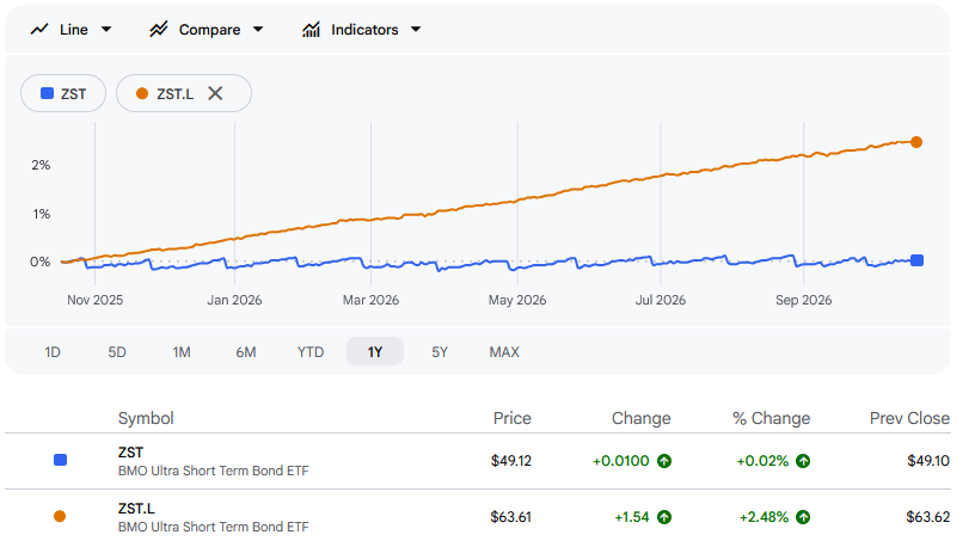
Source: Google Finance
ZST’s market price reflects the periodic reductions associated with its cash distributions, so looking at price appreciation alone understates its total return. ZST.L, by contrast, retains that income within the fund, allowing its NAV and, generally, its market price to reflect the accumulated returns more directly.
That’s the main appeal of accumulating ETFs: they simplify the reinvestment process while providing essentially the same underlying investment exposure. However, as we’ll explore next, retaining income within the fund doesn’t necessarily mean investors can avoid paying taxes on it.
You still have to pay taxes with accumulating ETFs
A common misconception among newer Canadian investors is that accumulating ETFs offer a way to avoid taxes by retaining income rather than distributing it. Unfortunately, that’s not how it works. The easiest way to understand this is to examine the historical distributions of ZST and ZST.L. Throughout 2025, ZST paid a cash distribution every month. Most of these distributions were classified as ordinary income for tax purposes, with smaller amounts attributable to capital gains and return of capital.