

Share price movements are hanging on a single AI trade thread and are increasingly driven by the success or failure of a concentrated suite of companies at the very top of the US stock market. Given the volatility, investors may wish to look for assets that do not move in tandem to cushion the blow of shocks.
True negative correlation within a portfolio is notoriously elusive, however. How different assets move relative to one another is not fixed and changes in times of market crisis. Just because two investments were previously uncorrelated by no means guarantees they will be in the future.
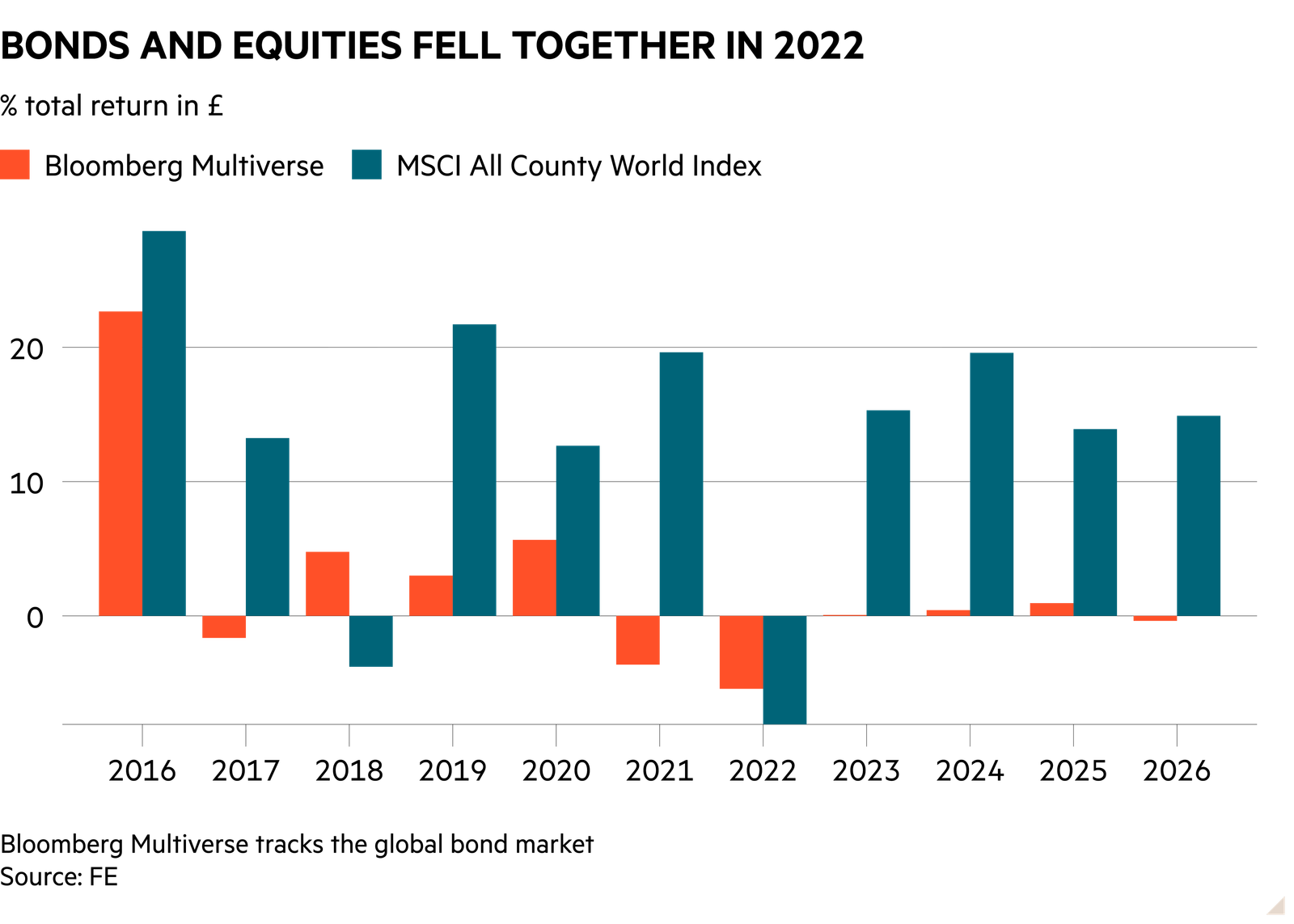
Typically, a mix of bonds and stocks will be selected by investors to ensure their portfolios are uncorrelated. The basic principle is that when one rises, the other will fall. For many years this has worked reasonably well, but in periods of sharply rising inflation and interest rates, such as in 2022, bonds and equities fell together.
Not all uncorrelated funds are created equal
Investors can turn to absolute return funds in search of true negative correlation. These aim to generate positive returns in all market conditions, even if markets fall, which often means they invest in alternative assets that are less correlated to stocks and bonds.
Janus Henderson Absolute Return (GB00B5KKCX12) is a long-short fund that buys shares in companies it expects to rise in value, and shorts companies using derivatives if it expects the price to fall. Its benchmark is the Bank of England base rate, which it aims to beat over any three-year period. It has achieved an annualised return of 4.9 per cent since managers Ben Wallace and Luke Newman took over the strategy in April 2009 against the benchmark’s 1.4 per cent.
Deliberately engineering negative correlation comes with a price, however. If one part of the portfolio is designed to rise when another falls, some of the return from the successful investment is inevitably being offset.
Read more from Investors’ Chronicle
Rather than simply buying negatively correlated assets, another approach is to own investments capable of performing well through a range of economic environments.
Wealth preservation trusts such as Personal Assets (PNL) aim to protect and increase the value of investors’ savings. As such, the portfolio typically maintains a defensive stance, blending a variety of assets. As at the end of July, it had 38 per cent in stocks, 31 per cent in inflation-linked bonds, 12 per cent in short-dated gilts, 9 per cent in Japanese government bonds and 2 per cent in cash.
The fund has only encountered three calendar years since 2009 in which it has lost investors’ money, with the worst being 4.8 per cent in 2013, according to James Scott-Hopkins, founder of Exe Capital. A longstanding zero-discount policy helps to mitigate discount volatility, with Personal Assets typically trading close to par.
Markuz Jaffe, investment companies analyst at Peel Hunt, says the trust is good at complementing higher-risk funds, particularly given “ongoing uncertainty around inflation, geopolitics and stock market valuations”.
Different drivers of performance
Insurance-linked investments can offer low correlation to stock markets because most people and businesses need to buy cover regardless of the economic situation.
Polar Capital Global Insurance (IE00B5339C57) invests in between 30 and 35 underwriting companies within the general insurance sector, employing an active, concentrated stockpicking strategy. It gives investors access to the general insurance sector. Juliet Schooling Latter, research director at FundCalibre, says: “It’s a specialist and often overlooked part of the market that has very little in common with the technology and AI names now dominating global indices.”
One of the attractions of the fund is the insurers’ “float”. This is the pool of money a provider holds between when it collects customer premiums and when it pays out claims. It can invest this money and, in effect, earn a return for free.
The fund has returned 80 per cent over five years compared with a 46 per cent return from peers, and since launch in 1998 it has achieved a compound growth rate of 10 per cent per year, according to Scott-Hopkins.
Commodities can equally offer ballast against a portfolio of stocks as the prices are based on different factors – such as supply constraints and geopolitical tensions, which can increase commodity costs and negatively affect companies.
Rob Morgan, chief analyst at Charles Stanley, likes L&G Multi-Strategy Enhanced Commodities ETF (ENCG), which invests across a spectrum of commodities including oil, soft commodities, precious and industrial metals. The price of soft commodities is based on futures contracts, which roll over every month and can be affected by a market condition known as contango – where the next futures contract is more expensive to buy than the last. To avoid this situation, the L&G ETF takes the well-known Bloomberg Commodities Index and changes the weights of what it tracks to avoid the problematic futures roll, thus minimising contango. This makes it “a smart way of playing commodities without the erosion effect of the natural contango”, says Morgan.
Emma Bird, head of investment companies research at Winterflood, is a fan of Odyssean Investment Trust (OIT) for its differentiated exposure to UK smaller companies. It invests heavily in industrials including Dialight (DIA), Gooch & Housego (GHH) and XP Power (XPP). The underlying stocks tend to generate revenues globally, which helps them perform well even if the UK faces a challenging economic backdrop. As at 30 June, Odyssean’s portfolio derived just 23 per cent of its revenues from the UK, compared with 57 per cent for the FTSE Small Cap Index and 36 per cent for the FTSE 100, according to Winterflood. Bird says that the trust is primarily driven by stock-specific factors, including M&A. Because of this, it is less likely to be correlated with the wider UK stock market or economy.
This lack of correlation is a result of the significant concentration in holdings and sectors. It held just 17 companies as at 31 July, with 85 per cent of assets in the top 10, and 53 per cent of its top 10 holdings are industrials.
Returns are therefore highly dependent on the managers’ stockpicking abilities. Bird says they have “considerable experience in the strategy, building on decades of private equity knowledge”.
The fund has had a strong run since launching in May 2018, with a net asset value total return of 124 per cent as at 14 August. It has outperformed its reference benchmark, Deutsche Numis Smaller Companies including Aim but excluding investment companies, which rose 36 per cent, and its peer group, which had an average return of 63 per cent.
For investors looking to reduce risk in their portfolio, uncorrelated assets serve a useful role. “When we say ‘diversification’, what we mean for the most part is finding uncorrelated things. I think this is more relevant now than perhaps it’s ever been in my career,” Morgan adds.