
The Rural Energy for America Program has for years helped thousands of American farmers pay for solar panels that lower their energy bills and earn them extra income. The Trump administration is putting an end to that.
The program, known as REAP, will no longer help farmers install large solar arrays on their land. Even smaller arrays could be unlikely to get funding under new restrictions on equipment made in China, as outlined in a recent internal Agriculture Department memo obtained by Canary Media.
Since 2014, the program has awarded around $1.1 billion in grants and $2.5 billion in loan guarantees for solar in rural areas nationwide, the vast majority of that on farms. Around 70% of the two-decade-old program’s funds have gone to solar projects over the last 10 years.
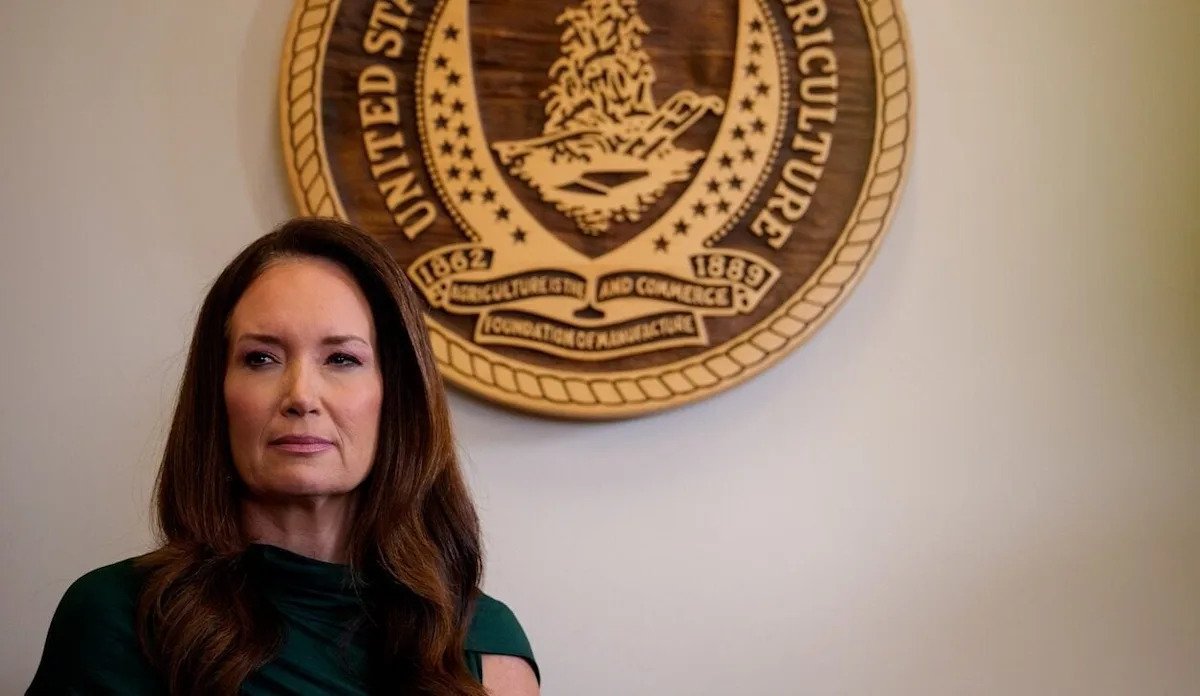
But on Aug. 19, Agriculture Secretary Brooke Rollins announced, “USDA will no longer fund taxpayer dollars for solar panels on productive farmland or allow solar panels manufactured by foreign adversaries to be used in USDA projects.”
The internal memo notes that solar projects with any of four characteristics will be ineligible for REAP loan guarantees and “disincentivized” in the point system used to award REAP grants.
Ground-mounted projects over 50 kilowatts will no longer receive loan guarantees, nor will projects on land certified as cropland by the Farm Service Agency. Loan guarantees will be denied for plots that can’t show “historical energy use,” and for “systems consisting of any component made in a country named as a foreign adversary,” according to the memo.
Large solar arrays are typically on open land that hasn’t previously consumed energy, and smaller installations powering a farm might also be in that situation, so the requirement to show historical use could be a serious blow to eligibility. And almost all solar panels include components from China, which would run afoul of the final provision.
Loan guarantees are a powerful tool for financing the utility-scale solar that provides farmers with extra revenue from selling electricity. The program comes at little cost to the federal government, since the loans are usually repaid without the financial institution needing to tap the guarantee, noted Andy Olsen, a senior policy advocate at the Environmental Law & Policy Center who has extensively analyzed REAP data.
REAP grants, meanwhile, have helped farmers build smaller solar arrays that often power their farm operations and send some energy back to the grid. It’s unclear what effect disincentivizing these projects in the REAP grant scoring system will have. Such solar arrays might not trigger the first three provisions mentioned in the USDA memo, but would likely include parts made in China.
“That’s a major wrench thrown into the works,” said Olsen, noting that the USDA is legally allowed to change the grant scoring system with a notice in the Federal Register. “It’s highly complicated REAP because few installers know where all the components of their systems come from. They’ve raised the bar to a point where it’s nearly impossible to clear it.”
It’s the latest in a string of Trump administration actions aimed at slowing down the development of solar and other clean energy projects nationwide. In July, the Republican-led Congress passed the One Big Beautiful Bill Act, which swiftly phases out key tax credits for the industry. Since then, the administration has issued a series of anti-renewables directives, including an Interior Department order mandating that the agency’s environmental reviews consider how much power a project produces compared to the amount of land it takes up.
REAP dollars were frozen earlier this year as part of President Donald Trump’s attack on the Inflation Reduction Act, which, along with the Farm Bill, funds REAP. The program’s funding was unfrozen in March, but then an application period scheduled for July was canceled at the last minute, raising concerns about the initiative’s future.
“I thought it might be an irrational fear a month or two ago,” said Lloyd Ritter, who helped draft REAP as senior counsel to then-U.S. Sen. Tom Harkin (D-Iowa) in the early 2000s. “But with this latest action, I’m really concerned they might continue to take steps that negate the vast benefits of the REAP program.”
While the Trump administration has framed the REAP changes as a way to preserve farmland, advocates say it will have the opposite effect.
“Farmers themselves are the ones making these decisions — they’re doing it because the economics are really beneficial to them,” said Ritter, adding that Republican-led congressional districts have received the most funding from REAP.
“[Trump administration officials are] making decisions that don’t really make a lot of sense from a policy perspective, and it’s bad politics to boot,” Ritter said. “They’re hurting MAGA farmers that like this stuff, and killing off economic growth across rural America.”
Meanwhile, the amount of farmland converted to solar is far less than that lost for other reasons, including residential growth and artificial intelligence computing.
“We know gigantic data centers are going up all over the place, mostly on prime farmland,” said Olsen. “We’ve got suburban and urban sprawl, housing developments, commercial developments — what’s the USDA doing about that? Suddenly their passion for farmland disappears when it’s anything but solar.”
Unlike those other uses, solar development can coexist with farming — by providing farmers extra income to preserve the bulk of their cropland, or through agrivoltaics wherein crops are grown or animals graze around panels.
The American Farmland Trust, a nonprofit that helps farmers preserve their land and adopt sustainable practices, ardently supports solar as a way to protect agricultural areas. Samantha Levy, the organization’s senior policy manager for conservation and energy, said that if the Trump administration really wants to help farmers, it should support those who want solar.
“American Farmland Trust has worked tirelessly to keep productive land in agriculture for over four decades,” Levy said in a statement. “We look forward to further dialogue with the administration to achieve this shared goal while ensuring that producers voluntarily seeking assistance to build solar to power their farm or ranch can still access REAP funding; and to keep productive land in farming by incentivizing agrivoltaic projects that integrate farming with solar energy generation and guiding solar to be sited on less productive land.”