

As South Africa’s fiscal position continues to face considerable pressure, taxpayers are increasingly finding themselves in the crosshairs of revenue authorities. With a wide array of taxes being levied – income tax, Vat, transfer duties, capital gains tax (CGT), corporate tax, and dividend withholding tax – the burden on individuals is mounting.
In this context, structuring your investments in a tax-efficient manner has never been more critical. This article explores the importance of tax-aware investing and how appropriate portfolio structuring can limit your liabilities, ultimately enhancing your net returns.
ADVERTISEMENT
CONTINUE READING BELOW
Understanding the tax drag on savings accounts
A recent client meeting illustrated the profound impact of taxation on seemingly secure investments. The client had R10 million held in a savings account with a large South African bank, earning a nominal 8% interest rate. On the surface, this generated R800 000 in annual interest income. However, once tax implications were factored in, the reality was less encouraging.
South African residents under 65 receive an annual interest income tax exemption of R23 800. Therefore, of the R800 000, R776 200 was taxable. Assuming this was the client’s sole income, their marginal tax rate of 39% meant a tax liability of R302 718. This reduced the net return to R497 282 – translating to a post-tax yield of under 5%, barely keeping pace with inflation.
Despite the tax inefficiency, many investors continue to park excess cash in savings accounts due to perceived security and liquidity. However, alternative investment vehicles can offer similar risk profiles with significantly improved tax outcomes.
Unit trust vehicles: A conservative and tax-aware alternative
For conservative investors seeking capital preservation with minimal volatility, unit trusts offer a compelling alternative. Diversified income funds and money market funds are structured to provide stable returns through conservative asset allocation strategies.
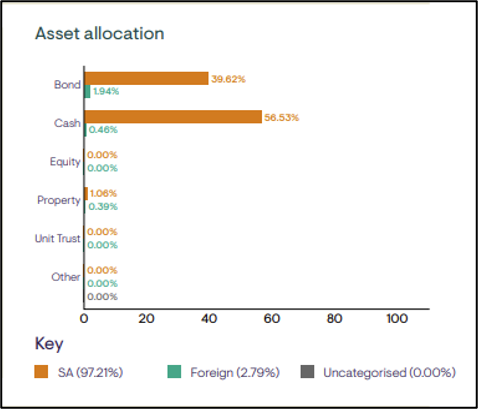
Image: Supplied
Unlike savings accounts, unit trusts are taxed as capital gains rather than income, offering material tax advantages. CGT is levied at a maximum effective rate of 18%, compared to up to 45% for interest income. Furthermore, individuals receive an annual CGT exemption of R40 000, and CGT is only triggered upon withdrawal or sale, allowing for tax deferral and compounding. Liquidity is also comparable, with access to funds typically available within three to five business days.
Tax-free investment accounts: Harnessing the power of compounding
Another valuable instrument in a tax-efficient portfolio is the tax-free investment (TFI) account. These vehicles offer complete exemption from capital gains tax, income tax, and dividend withholding tax. Individuals can contribute up to R36 000 annually, capped at a R500 000 lifetime contribution limit.
ADVERTISEMENT:
CONTINUE READING BELOW
While the contribution limits may seem modest, the long-term benefits are substantial. Consider a 25-year-old investing R3 000 per month until they reach the R500 000 limit by age 39. If the funds are left untouched until retirement at 65, assuming a 10% return, the investment would grow to approximately R12.5 million – all tax-free. This exemplifies the power of tax-free compounding when investments are made early and left to grow.
Endowments and sinking funds: Tax wrappers for high-income earners
For high-income individuals, endowments or sinking funds, also known as “tax wrappers”, offer another route to tax efficiency. These structures are especially beneficial due to their flat CGT rate of 12%, which compares favourably with the 16-18% typically levied on high-earning individuals through direct investments.
Additionally, these wrappers offer administrative simplicity – no tax certificates are issued, and investors do not need to report income or gains to Sars directly. Taxes are handled within the investment itself, and redemptions are made net of tax. Estate planning advantages further strengthen the case for these vehicles. When structured correctly, if beneficiaries are nominated, they can bypass executor’s fees (typically 3.5-4%). Furthermore, in the case of sinking funds, the investment can be seamlessly transferred to a beneficiary without being terminated upon the investor’s death.
Conclusion: Strategic structuring for sustainable returns
In an environment of increasing fiscal strain and rising tax burdens, the importance of structuring investments to maximise tax efficiency cannot be overstated. While many investors default to the security of savings accounts, the tax drag can significantly erode real returns. Alternatives such as unit trusts, tax-free investment accounts, and endowments provide viable, often superior, solutions that address both return certainty and liquidity – and enhance tax efficiency.
By aligning your investment strategy with the tax landscape, you not only protect your returns from unnecessary erosion but also create a more robust, inflation-beating portfolio. In this climate, tax efficiency is not merely a benefit – it is a necessity for preserving and growing long-term wealth.