

Introduction
Many people have built their assets primarily through mutual funds and have recently become interested in individual stocks, such as high-dividend stocks.
You often see articles explaining the allocation of ‘what to hold assets in’ (mutual funds, bonds, stocks, etc.).
However, you rarely see articles that specifically address ‘how many stocks you should diversify into’ when adding individual stocks.
Therefore, this article summarizes the following three points.
-
What kind of risks are reduced (or not reduced) by increasing the number of stocks
-
What number of stocks do studies suggest as a guideline
-
Recommended number of stocks for stable, balanced, and aggressive portfolios
I will explain as concretely as possible while also mentioning actual stock names.
Disclaimer: Investing is at your own risk, and this article is for informational purposes only. The information provided does not guarantee future investment results.
Chapter 1: Mutual funds are diversified from the start; with individual stocks, you must create your own diversification
A single mutual fund is diversified across hundreds to thousands of stocks.
Those who have built their assets solely through mutual funds have been benefiting from very broad diversification without even realizing it.
With individual stocks, you need to create this diversification yourself.
If you buy only one stock, you will be directly affected by that company’s poor performance, dividend cuts, or scandals.
So, how many stocks are enough?
Chapter 2: Risks that can be reduced by diversification and risks that cannot be sufficiently reduced
What you can reduce by increasing the number of stocks are risks specific to individual companies. For example, the following:
On the other hand, there are risks that cannot be sufficiently reduced just by increasing the number of stocks.
-
The risk of the entire stock market falling (market crash)
-
The risk that many stocks will fall together due to rising interest rates
-
Currency risk (e.g., a stronger yen for US stocks)
These risks related to the market as a whole cannot be sufficiently suppressed simply by increasing the number of stocks.
In addition to diversifying by industry, you also need to consider combinations with assets that move differently, such as mutual funds, bonds, and cash.
Increasing the number of individual stocks is merely a means to dilute ‘risks specific to individual companies.’
Chapter 3: What Research Suggests About the ‘Number of Stocks’
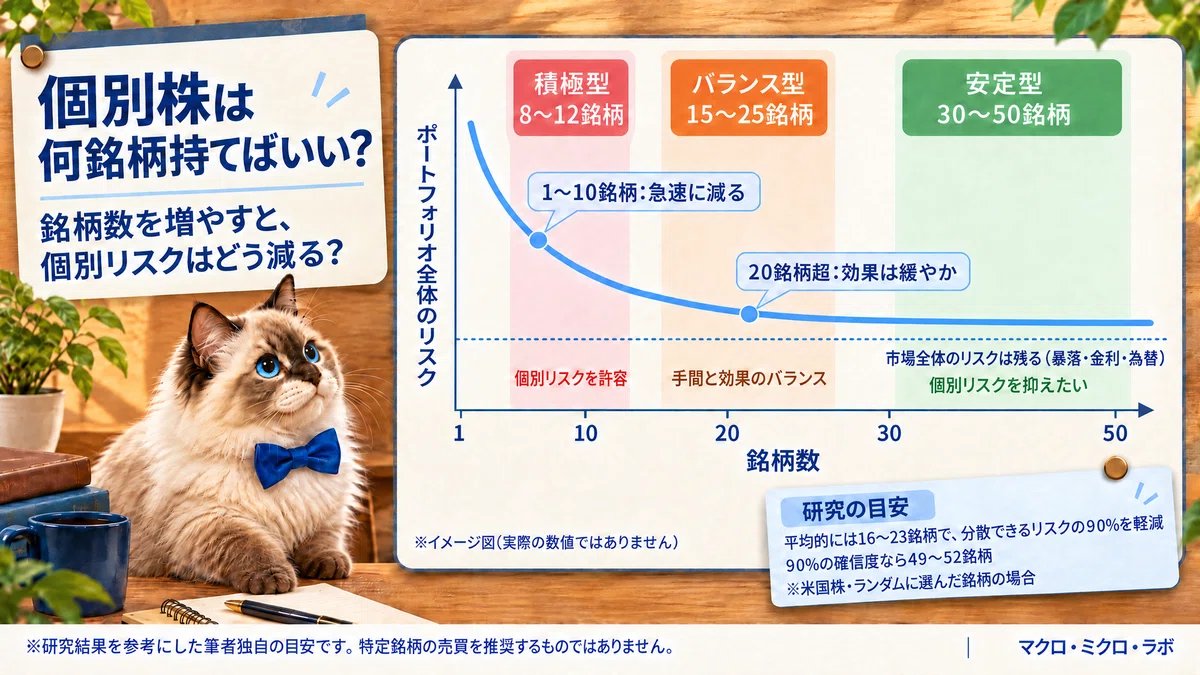
The effect diminishes rapidly as the number of stocks increases
In a classic study, Evans & Archer (1968) showed that most diversification benefits are achieved with an average of 8 to 10 stocks.
However, this result was based on the market data and analytical conditions of that time. It has not been proven that 8 to 10 stocks are sufficient in today’s market.
Since then, while some studies suggest 6 to 15 stocks are sufficient, others argue that 50 or more are necessary, leaving the conclusion divided.
The main reason for this disagreement is the difference in how risk is measured and ‘how much risk one wants to mitigate.’
Benchmarks suggested by recent research
Alexeev & Tapon (2013, discussion paper) estimated the number of stocks required to eliminate 90% of the risk that can be mitigated through diversification, targeting the stock markets of five developed countries.
The results for US stocks are as follows (assuming an equal-weighted portfolio of randomly selected stocks).

Expected shortfall is an indicator that represents how much you lose on average during the worst-case scenarios where losses are particularly large (in this case, the worst 1%).
In summary, for US stocks, the result is that an average of 16 to 23 stocks are needed to eliminate 90% of the mitigatable risk.
However, this is a simulation based on holding randomly selected stocks in equal amounts.
Furthermore, if you want to achieve the same diversification effect with 90% confidence, 49 to 52 stocks are required.
In other words, looking only at average results, 15 to 25 stocks is one benchmark, but if you seek more reliable diversification, around 50 stocks are necessary.
Number of stocks held by individual investors
A study by Goetzmann & Kumar (2008), which analyzed over 40,000 individual accounts at a major US discount brokerage (1991–96), reported that the average number of stocks held was about 4, with a median of 3 (the average number of holdings increased during the period).
However, having a small number of stocks is not a problem in itself. What is important is not just the number of stocks, but whether the risks associated with industries and individual companies are sufficiently diversified.
In the next chapter, we will look at this ‘industry’ diversification.
* The figures above are results based on holding randomly selected stocks from the entire market in equal amounts.
The data used is from 1975–2011 and may differ from the current market environment.
These figures do not apply directly when you are selecting high-dividend stocks yourself. Please view them as a guideline under the premise of ‘past research.’
Note that the abstract of the formal published paper (2014) by the same authors reports that in most cases, more than 73 stocks are needed to achieve the same level of diversification effect.
The numbers change depending on the market and analytical conditions.
Chapter 4: High-Dividend Stocks Tend to Have ‘Industry’ Bias
The research in the previous chapter assumes randomly selected stocks. The situation is different for high-dividend stocks.
Companies with high dividend yields tend to cluster in specific industries, so even if you increase the number of stocks, you often end up just adding more of the same industry.
Looking at the industry composition of high-dividend ETFs clearly shows this bias.
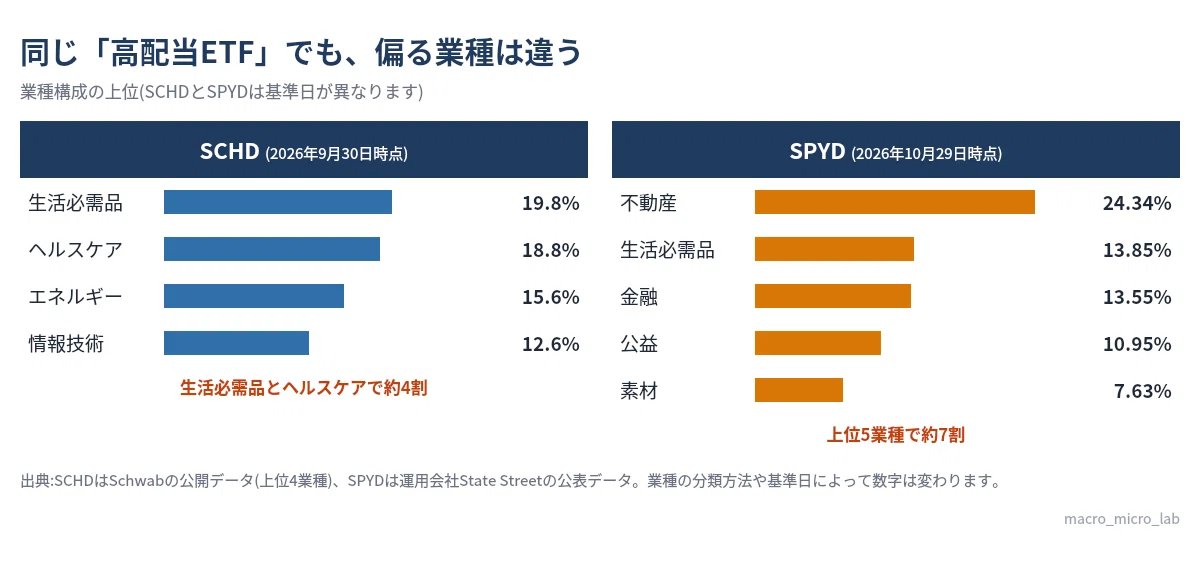
Even among high-dividend ETFs, you can see differences: SCHD is skewed toward consumer staples, healthcare, and energy, while SPYD is skewed toward real estate, consumer staples, financials, and utilities.
Note that the reference dates for the two ETFs differ.
Figures will change depending on the industry classification method and the reference date. Since ETF industry ratios change due to portfolio rebalancing and stock price fluctuations, please view these figures as examples only.
ETF performance is influenced not only by industry composition but also by the stock prices and dividends of individual holdings, as well as exchange rates.
Furthermore, even among similar high-dividend ETFs, differences in which industries are heavily weighted can easily lead to variations in price movement and investment performance.
The characteristics of each ETF and how to choose them based on your goals are explained in detail in the related articles at the end of this post.
Common mistakes when investing in individual stocks
When choosing high-dividend stocks, investors tend to lean toward ‘industries with stable, high dividends’ such as telecommunications, consumer staples, REITs, utilities, and tobacco.
These may exhibit similar price movements during periods of rising interest rates or concerns about dividend cuts during economic downturns.
Even if you hold 10 stocks, you may effectively be betting on only 3 or 4 industries.
Countermeasure: Decide on ‘industry limits’ before the number of stocks
-
Aim for one industry to account for no more than 20-30% of your individual stock portion
-
Include both industries resilient to economic cycles (consumer staples, healthcare, utilities) and industries that grow with the economy (financials, industrials, energy)
-
When adding stocks, first check if they overlap with industries you already hold
※ ’20-30%’ is not a research-backed result but a guideline for this article.
Chapter 5: The required number of stocks changes when mutual funds are your core
The discussion of ‘X number of stocks’ up to this point assumed that your entire portfolio consists of individual stocks. If you use broadly diversified stock mutual funds as your core, the situation is different. This is because the core mutual fund handles investment in the overall market and serves as the foundation for long-term asset building.
Individual stocks are added on top of that for purposes such as dividend income or holding shares in companies you like.
However, stock mutual funds are also subject to the downside risk of the entire stock market. If you want to suppress overall market risk, you also need to consider combinations with assets that move differently, such as bonds or cash.
This is a safeguard against risks that cannot be sufficiently mitigated simply by increasing the number of stocks, as explained in Chapter 2.
When mutual funds are your core, what you should look at is what percentage of your total assets a single stock accounts for.
Suppose a certain stock drops to half its value due to an accident or a significant dividend cut.
Calculating the impact on your total assets based on the ratio of individual stocks and the number of stocks held yields the following.

If the ratio of individual stocks is low, it is easier to suppress the impact of losses on total assets even with a small number of stocks.
Conversely, the higher the ratio, the more stocks you need.
Summary of the approach
-
Risks from overall market crashes or interest rates cannot be sufficiently mitigated by simply increasing the number of stocks, whether in mutual funds or individual stocks
-
Risks specific to individual companies can be diluted by increasing the number of stocks
-
Deciding the ratio of individual stocks comes first, and the number of stocks should be determined according to that ratio
Be aware of ‘overlap’ between mutual funds and individual stocks
If there is overlap between the mutual funds you hold as your core and your individual stock holdings, you need to be careful.
For example, if you hold an S&P 500-linked mutual fund while also purchasing individual shares of KO or PG, which are included in that fund, your effective investment ratio in those companies will increase.
Check your entire portfolio, including the holdings within your mutual funds, to ensure that you are not overly concentrated in any specific company, not just in your individual stock portion.
Guidelines for the maximum limit per stock
The maximum percentage that a single stock should account for in your total assets should be kept within the following ranges, depending on your investment policy (this will be explained in detail in Chapter 7).
-
Stable type: Up to about 1%
-
Balanced type: About 1–3%
-
Aggressive type: About 3–5%
These are guidelines for the maximum limit. In practice, since you will divide your individual stock portion equally among the number of stocks, the ratio for a single stock is usually smaller than the maximum (for example, if you hold individual stocks as 20% of your assets and divide them equally among 30 stocks, each stock will be about 0.7%).
When you are just starting out, it is easier to limit the impact of losses if you begin with a small ratio of individual stocks and gradually increase both the number of stocks and the ratio over time.
Chapter 6: Model portfolio examples for considering sector diversification
Note: These stocks are examples to illustrate the concept of diversification and are not recommendations. The stocks introduced here were not selected solely based on high dividend yields. They are listed as examples of representative large-cap companies in each sector to demonstrate the concept of sector diversification.
How to read this chapter
Here, we consider the portion of your assets allocated to individual stocks as 100%, rather than the entire portfolio.the portion of your assets allocated to individual stocks as 100%as the basis.
For example, if you hold individual stocks as 20% of your total assets, a 10-stock model would mean 2% of total assets per stock, and a 20-stock model would mean 1% of total assets per stock.
Please determine the actual ratio of individual stocks according to your own investment policy, as explained in Chapter 5.
1. 10-stock model (equal allocation of individual stock portion: 10% per stock)
-
Consumer Staples: KO (Coca-Cola), PG (Procter & Gamble)
-
Healthcare: JNJ (Johnson & Johnson), ABBV (AbbVie)
-
Communication Services: VZ (Verizon)
-
Energy: XOM (Exxon Mobil)
-
Utilities: DUK (Duke Energy)
-
Financials: JPM (JPMorgan Chase)
-
Real Estate (REIT): O (Realty Income)
-
Industrials: CAT (Caterpillar)
Consumer Staples and Healthcare are at 20% each, which fits within the ‘one sector should be 20-30% of the individual stock portion’ rule from Chapter 4.
(2) 20-stock model (equal allocation of the individual stock portion: 5% per stock)
Add the following 10 stocks to the 10 stocks in (1), and redistribute all 20 stocks at 5% each (do not leave the initial 10 stocks with a higher ratio).
-
Consumer Staples: PEP (PepsiCo)
-
Healthcare: ABT (Abbott Laboratories)
-
Energy: CVX (Chevron)
-
Utilities: SO (Southern Company)
-
Financials: CB (Chubb), BLK (BlackRock)
-
Industrials: ITW (Illinois Tool Works)
-
Information Technology: TXN (Texas Instruments)
-
Consumer Discretionary: MCD (McDonald’s)
-
Materials: LIN (Linde)
This expands the portfolio to 11 sectors, and even the largest sector accounts for only about 15% of the individual stock portion.
(3) Key points for construction
-
Decide on the limits for each sector first, and place 1-3 stocks in each category
-
Choose stocks within the same category that have different business operations (e.g., for daily necessities, choose both beverages and household goods)
-
Include both sectors that grow with the economy and sectors that are resilient to economic conditions
Chapter 7 Summary: Recommended number of stocks by investment policy
The optimal number of stocks depends on what you prioritize. The more you want to avoid risks associated with individual companies, the higher the number of stocks should be; the more you want to capture gains or dividend increases, the lower it should be.
The following classifications and figures are not optimal solutions derived directly from research results. They are the author’s own investment guidelines based on research data.

Stable type: 30–50 stocks
-
Ratio of individual stocks: Up to about 20% of total assets
-
Upper limit per sector: About 20% of the individual stock portion
-
Upper limit per stock: About 1% of total assets (if the 20% individual stock portion is divided equally among 30–50 stocks, it is actually about 0.4–0.7%)
-
For those who want to minimize the risk of individual companies as much as possible
-
Since management is time-consuming, increase the proportion of mutual funds and lower the ratio of individual stocks. Substituting some with high-dividend ETFs is also effective (for how to choose ETFs, please see the related articles at the end of this post)
-
50 stocks is a guideline corresponding to the ‘90% confidence level’ (49–52 stocks) in research, not an upper limit (some studies suggest that an even higher number of stocks is necessary)
Balanced type: 15–25 stocks
-
Ratio of individual stocks: About 20–40% of total assets
-
Upper limit per sector: About 20–30% of the individual stock portion
-
Upper limit per stock: About 1–3% of total assets
-
For those who prioritize the balance between diversification effects and management effort
-
Corresponds to around 23 stocks, which can reduce the majority of individual risks on average
Aggressive type: 8–12 stocks
-
Ratio of individual stocks: 40% or more of total assets is also an option
-
Limit per industry: Approximately 30% of the individual stock portion (e.g., a maximum of 2 stocks per industry)
-
Limit per stock: Approximately 3-5% of total assets
-
For those who can analyze companies in detail and tolerate the risks of individual stocks
-
Corresponds to classic studies suggesting that most benefits are achieved with 8-10 stocks, but note that these results were under conditions of that time
-
If increasing the ratio of individual stocks, increase the number of stocks or adjust equal allocation to ensure you do not exceed the limit per stock (e.g., if individual stocks are 50% of assets, 10 or more stocks keep each within 5%)
Common to all types
-
Diversify by industry before focusing on the number of stocks
-
Market-wide crashes and interest rate risks cannot be sufficiently mitigated just by increasing the number of stocks. Prepare by combining with mutual funds, bonds, cash, etc.
-
The numbers are guidelines and should be reviewed according to the situation
Read also (Related articles)
[2026 Edition] Thorough Comparison of US High-Dividend ETFs | Which one should you buy now?
This is a past article that compares 9 high-dividend and dividend-growth ETFs such as SCHD, VYM, HDV, SPYD, and JEPI based on yield, dividend growth, downside resistance, sector composition, etc., and summarizes how to choose them according to your goals.
This is useful for those who want to use ETFs instead of increasing the number of individual stocks, or who want to know how to choose and combine ETFs. (Information as of August 2026)
References
-
Evans, J. L. & Archer, S. H. (1968). Diversification and the Reduction of Dispersion: An Empirical Analysis. The Journal of Finance, 23(5), 761–767.
-
Alexeev, V. & Tapon, F. (2013). Equity Portfolio Diversification: How Many Stocks are Enough? Evidence from Five Developed Markets. University of Tasmania, Discussion Paper 2013-16. (Source of the numbers in the text)
-
Alexeev, V. & Tapon, F. (2014). The number of stocks in your portfolio should be larger than you think: diversification evidence from five developed markets. Journal of Investment Strategies, 4(1), 43–82. (Formal published paper)
-
Goetzmann, W. N. & Kumar, A. (2008). Equity Portfolio Diversification. Review of Finance, 12(3), 433–463.
-
Industry composition data published by each ETF management company, etc. (Reference dates are stated in the text)