
Close Menu
Fund Focus News
    Facebook X (Twitter) Instagram
    Trending
    • Equity mutual funds’ average AUM rises 17% in FY26; flexi cap funds lead growth: Abakkus MF
    • Multi-asset fund-of-funds: Active option suits alpha, risk control seekers | Personal Finance
    • Nippon India Mutual Fund Starts Investor Awareness Campaign To Increase Retail Participation | Savings and Investments News
    • XRP News: GraniteShares Just Delayed Its 3x XRP ETFs to May 7
    • Exclusive: UK’s Aviva Investors bought $108m of Israeli government bonds in January sale
    • Montaka Global Investments’ Q1 2026 Investor Letter
    • How AT1 Bonds Could Shape New UBS Banking Regulations in
    • 4 Ways Retirees Should Adjust Their Investments Amid the Iran War
    Facebook X (Twitter) Instagram
    Fund Focus News
    • Home
    • Bonds
    • ETFs
    • Funds
    • Investments
    • Mutual Funds
    • Property Investments
    • SIP
    Fund Focus News
    Home»Mutual Funds»How to handle capital gains from debt mutual funds after tax overhaul
    Mutual Funds

    How to handle capital gains from debt mutual funds after tax overhaul

    August 20, 2025


    The Finance Act, 2023 overhauled how capital gains from debt mutual funds are taxed, and this has made income tax return (ITR) reporting significantly more complex.

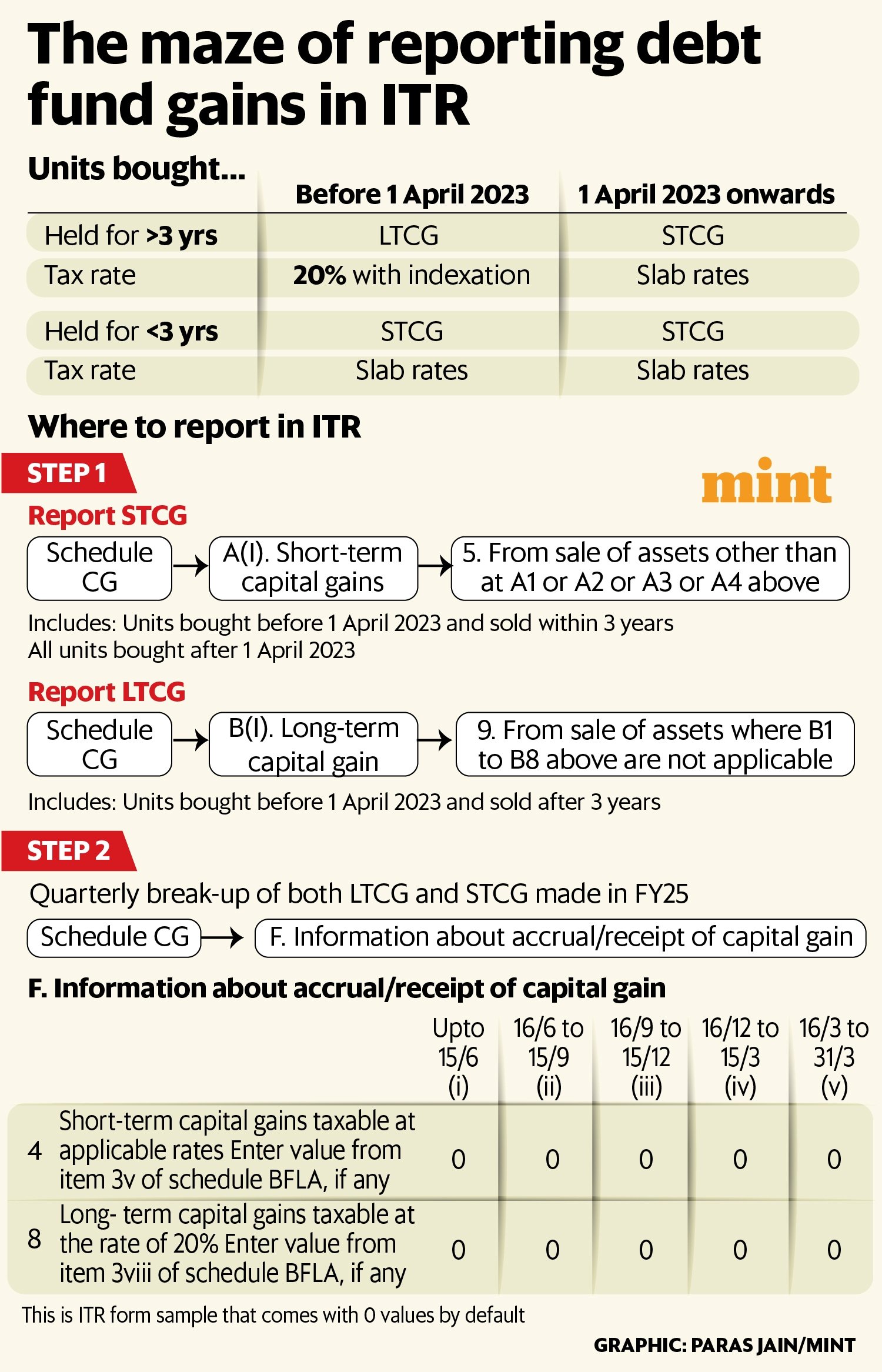
    Until 31 March, 2023, gains from debt mutual funds held for over 36 months were treated as long-term capital gains (LTCG) and taxed at 20% with indexation. From 1 April 2023, all such investments are treated as short-term. This means that irrespective of holding period, gains are taxed at the investor’s income slab rate.

    Depending on the purchase date of the investment, you will need to carefully report gains as short-term or long-term.

    Which ITR to file

    ITR-2: For salaried taxpayers with salary and capital gains.

    ITR-3: For taxpayers with business/professional income.

    Capital gains are reported in Schedule CG. Unlike equity shares, the ITR does not require line-by-line details for debt funds—only consolidated totals of cost of acquisition and sale consideration.
    Graphics: Mint

    View Full Image

    Graphics: Mint

    Reporting in Schedule CG

    Short-term gains: STCG are reported in the section “From Assets Other Than Shares.” If the units were bought on or after 1 April, 2023, all gains will go here. Also, investments purchased before 1 April, 2023 but redeemed within 36 months also belong in this section.

    Long-term gains: Only those units that were purchased before 1 April, 2023 and held for more than 36 months will qualify as LTCG. These gains are to be reported in the section “Long Term Capital Gains – From Assets Other Than Shares.” For these transactions, the benefit of indexation still applies, so adjust the cost of acquisition for inflation.

    According to chartered accountant (CA) Prakash Hegde, mutual funds acquired on or after 1 April 2023 are treated as “specified mutual funds” if they invest not more than 35% in domestic equities.

    “As per this guideline, international funds, exchange traded funds (ETFs), gold ETFs, and gold mutual funds fall in this category and will be taxed the same as debt funds for FY 2023–24 and FY 2024–25, which means all gains from specified mutual funds are taxed as short-term, with no indexation benefit.” 

    “It should be noted this is limited to FY24 and FY25, from 1 April 2025 onwards, the gains can again be LTCG or STCG as per tax and holding period rules announced in Budget 2024,” Hegde added.

    How to calculate gains on SIPs

    Reporting debt MF investments done with systematic investment plans (SIPs) before and after 1 April 2023 is tricky as you would have to identify units bought before the date qualifying as LTCG to report them separately.

    CA Bhawna Kakkar explains that the First In, First Out (FIFO) method applies, meaning each redemption is mapped to the earliest SIP units.

    Investors must separate pre-April 2023 units (eligible for LTCG with indexation if held >36 months) from post-April 2023 units (always STCG). The capital gains statement provides unit-wise details for easy segregation.

    “Investors can segregate units bought before April 1, 2023 from those acquired after this date following FIFO method. The capital gains statement has details of each SIP investment so the investor can identify how much of the gains qualify as LTCG by looking at the date of acquisition of each SIP in the statement.”

    Quarterly disclosure

    After reporting consolidated gains under STCG and LTCG, you must also disclose them in Part F of Schedule CG—a quarter-wise breakup of realised capital gains.

    This is essential for advance tax compliance. If gains were realised in one quarter but advance tax paid later, interest under Section 234C could apply. Hence, correct manual quarter-wise reporting is critical.


    Source link

    Share. Facebook Twitter Pinterest LinkedIn Tumblr Telegram Email

    Related Posts

    Equity mutual funds’ average AUM rises 17% in FY26; flexi cap funds lead growth: Abakkus MF

    April 23, 2026

    Multi-asset fund-of-funds: Active option suits alpha, risk control seekers | Personal Finance

    April 23, 2026

    Nippon India Mutual Fund Starts Investor Awareness Campaign To Increase Retail Participation | Savings and Investments News

    April 23, 2026
    Leave A Reply Cancel Reply

    Top Posts

    The Shifting Landscape of Art Investment and the Rise of Accessibility: The London Art Exchange

    September 11, 2023

    Charlie Cobham: The Art Broker Extraordinaire Maximizing Returns for High Net Worth Clients

    February 12, 2024

    Montaka Global Investments’ Q1 2026 Investor Letter

    April 23, 2026

    The Unyielding Resilience of the Art Market: A Historical and Contemporary Perspective

    November 19, 2023
    Don't Miss
    Mutual Funds

    Equity mutual funds’ average AUM rises 17% in FY26; flexi cap funds lead growth: Abakkus MF

    April 23, 2026

    Equity-oriented mutual funds recorded a 17.38% year-on-year increase in average assets under management (AAUM) in…

    Multi-asset fund-of-funds: Active option suits alpha, risk control seekers | Personal Finance

    April 23, 2026

    Nippon India Mutual Fund Starts Investor Awareness Campaign To Increase Retail Participation | Savings and Investments News

    April 23, 2026

    XRP News: GraniteShares Just Delayed Its 3x XRP ETFs to May 7

    April 23, 2026
    Stay In Touch
    • Facebook
    • Twitter
    • Pinterest
    • Instagram
    • YouTube
    • Vimeo
    EDITOR'S PICK

    Property investor set to transform iconic dockside building

    October 14, 2025

    Can The IVES ETF Lead The Next Wave Of AI Investing? CIO Explains – Global X Robotics & Artificial Intelligence ETF (NASDAQ:BOTZ), Amazon.com (NASDAQ:AMZN)

    June 17, 2025

    Affordable Investment Options for Individual Investors

    February 12, 2026
    Our Picks

    Equity mutual funds’ average AUM rises 17% in FY26; flexi cap funds lead growth: Abakkus MF

    April 23, 2026

    Multi-asset fund-of-funds: Active option suits alpha, risk control seekers | Personal Finance

    April 23, 2026

    Nippon India Mutual Fund Starts Investor Awareness Campaign To Increase Retail Participation | Savings and Investments News

    April 23, 2026
    Most Popular

    🔥Juve target Chukwuemeka, Inter raise funds, Elmas bid in play 🤑

    August 20, 2025

    💵 Libra responds after Flamengo takes legal action and ‘freezes’ funds

    September 26, 2025

    ₹50 lakh retirement corpus: How to invest in SCSS, mutual funds, equities and other assets — CA offers tips

    April 16, 2026
    © 2026 Fund Focus News
    • Get In Touch
    • Privacy Policy
    • Terms and Conditions

    Type above and press Enter to search. Press Esc to cancel.