
Parag Parikh Flexi Cap Fund, launched in May 2013 as Parag Parikh Long Equity Fund, is the flagship scheme from Parag Parikh Mutual Fund.
Owing to its appealing performance and charismatic fund manager – Rajeev Thakkar, the fund attracted investors, and today is the largest scheme in the flexi-cap funds category, managing assets over Rs 1.43 lakh crore. It would not be incorrect to say it is one of India’s favourite funds.
Since its early days, the fund invested across market cap segments, following a multi-cap approach. It followed a “go anywhere” kind of approach. It also invested in international stocks.
But after the capital market regulator, the Securities and Exchange Board of India (SEBI), made a distinction by launching a new flexi cap fund category in November 2020, in line with its investment approach, it chose to specifically recategorize itself as a flexi cap fund (instead of a multi-cap fund), which was a conscious decision.
A flexi cap fund, as you know, invests dynamically — without any upper or lower limit — across large-caps, mid-caps, and small-caps, depending on its outlook.
Since its inception, Parag Parikh Flexi Cap Fund has clocked a compounded average growth rate (CAGR) of 18.3% (as of 21 July 2026). This is appealing on its face.
Report Card of Parag Parikh Flexi Cap Fund
| Absolute | CAGR | Risk Ratios | |||||
| 1 Yr (%) | 3 Yr (%) | 5 Yr (%) | 10 Yr (%) | SI (%) | Std Dev (%) | Sharpe Ratio | |
| Parag Parikh Flexi Cap Fund | -1.7 | 14.5 | 13.9 | 17.6 | 18.3 | 9.9 | 0.85 |
| Category Median | 2.3 | 13.7 | 13.1 | 14.2 | – | 15.3 | 0.6 |
| BSE 500 TRI | 0.5 | 12.1 | 12.5 | 13.8 | – | 15.3 | 0.5 |
The Risk Measures have been calculated using calendar month returns for the last three years and are as of 30 June 2026.
The returns data is as of 21 July 2026.
Source: Value Research
However, the fact is that in the past one year, the scheme’s performance has lagged. The fund has clocked a negative 1.7% absolute return, lower than the category median return of 2.3% and 0.5% clocked by the BSE 500 – Total Return Index (TRI), as of 21 July 2026.
In comparison, HDFC Flexi Cap Fund (the second largest fund with an AUM over Rs 1.06 lakh crore) over the past 1 year has clocked 3.3% absolute returns for its investors, higher than the category median and the benchmark index.
What is the reason for the underperformance of Parag Parikh Flexi Cap Fund over the short-term?
Well, there are a variety of factors behind it.
The fund is very value-conscious in its stock-picking approach. Its portfolio price-to-equity (PE) and price-to-book PB ratios at 16.8 and 2.9, respectively, are among the lowest in the category.
The fund has consistently maintained low valuation ratios, respecting margin of safety and focusing on companies with strong fundamentals.
It has paid a price for not chasing growth and momentum stocks, which certain schemes, such as Quant Flexi Cap Fund and Bank of India Flexi Cap Fund, have deliberately targeted such stocks to push up their returns.
Moreover, certain flexi cap schemes have indulged in high portfolio churning, which Parag Parikh Flexi Cap Fund has steered clear of; on the contrary, it held the portfolio with high conviction (portfolio turnover ratio of 17.5% excluding equity arbitrage, as per June 2026 portfolio).
The fund has also taken cash calls at certain times given its value investing style. For example, during the 2024 and 2025 mid-and-small cap rally, it chose not to chase expensive valuations. It was sitting on roughly 15-20% cash and cash equivalents as a tactical buffer.
Even this year, i.e., 2026, Parag Parikh Flexi Cap Fund is holding, on average, around 15% in cash and cash equivalents. As per the latest portfolio as of June 2026, if we consider the arbitrage positions, the fund has nearly 14.5% cash allocation.
This cautious, defensive, and value-conscious stance is also the reason for the fund’s performance lagging over the short term.
Making a higher allocation to cash and cash equivalents is a double-edged sword. Keeping the powder dry limits the drawdown or downside risk for its investors when the markets see a sharp correction amidst the geopolitical and macroeconomic uncertainty. It provides a window of opportunity to invest in quality value buys when markets correct significantly. However, when the market moves up contrary to the expectations of the fund manager, the high cash allocation acts like a dead weight; there is an opportunity loss involved.
Apart from this, a consistent dominance of large caps over the past one year (91-93% of the fund’s total domestic equity environment) — and even before that — is also a factor behind the lagging performance. In comparison, the peers that have dynamically and tactically approached mid- and small-cap plus pursued growth and momentum investing, such as Quant Flexi Cap Fund, Motilal Oswal Flexi Cap Fund, and Bank of India Flexi Cap Fund among others, have outperformed.
The reason why Parag Parikh Flexi Cap Fund has held a very strong large-cap-biased portfolio is perhaps because of its valuation discomfort towards mid-and small-caps and its fund size.
Besides, certain stocks from the top 10 holdings (which comprise around 50% of the portfolio) haven’t fared well in the last couple of years.
Top Holdings of Parag Parikh Flexi Cap Fund
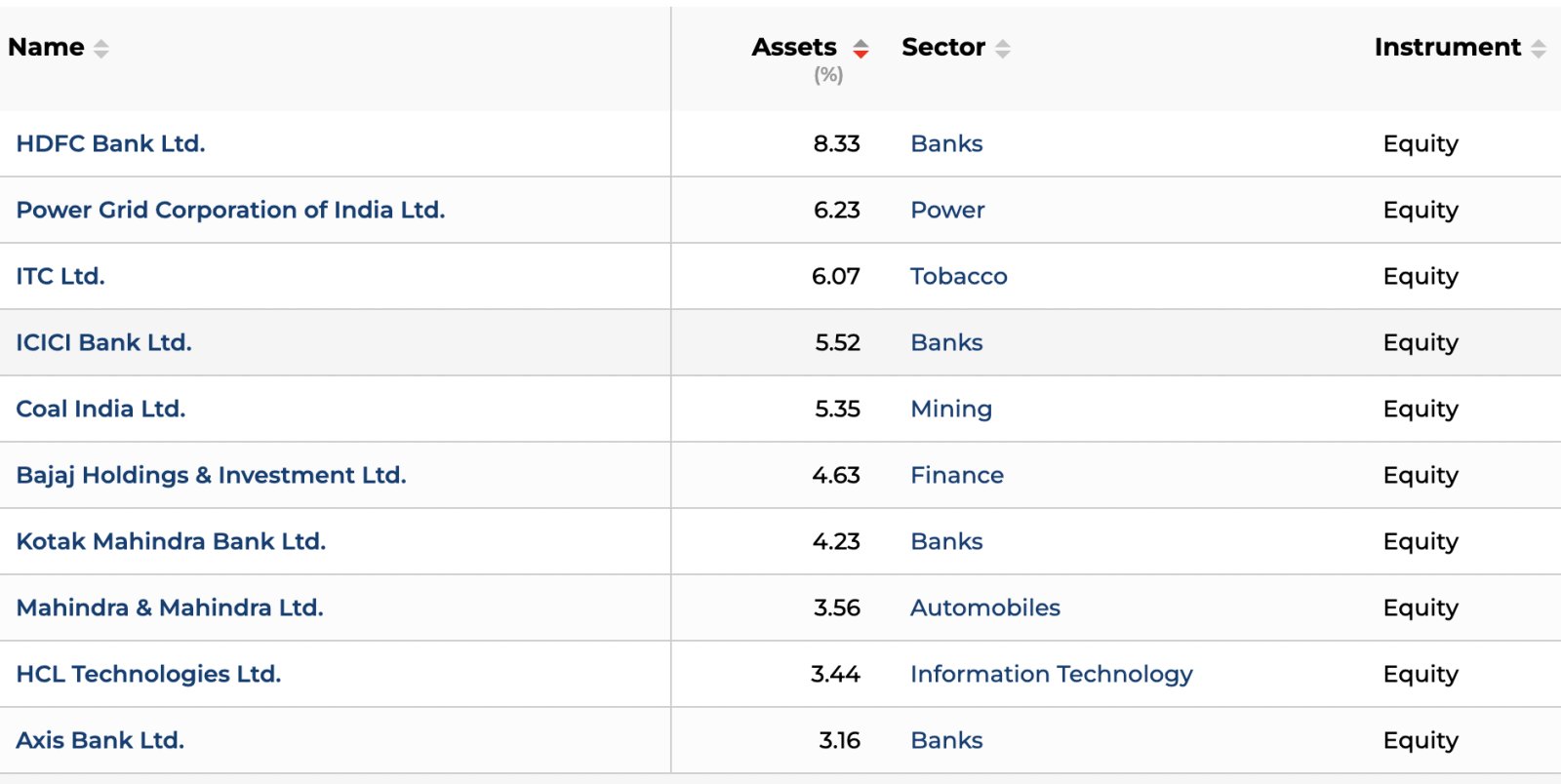
For instance, HDFC Bank has fallen by nearly a quarter percentage point in the last one year. The stock has consolidated after the merger with its parent company, HDFC Ltd.
Similarly, Kotak Mahindra Bank has been a laggard since April last year. ICICI Bank has also moved flat over the last one year; it is only recently that the stock has been reporting sharp up moves. Bajaj Holdings & Investments has also reeled under pressure over the last one year (as previously the stock traded at a higher premium valuation multiple).
HCL Technologies, too, has fallen since January last year, although it has steady margins and lapped large enterprise cloud deals,
ITC, as well, after a multi-year rally, has fallen over 30% in the last one year and over 40% in the three years on absolute returns.
On the other hand, PSUs like Power Grid (due to the national power transmission expansion and solid dividend yield) and Coal India (due to robust demand for coal and high dividend yield), alongside core manufacturing/auto components like Mahindra & Mahindra (due to strong revenue growth led by SUV, EV dominance and tractors), have been relatively resilient and compounded wealth impressively over the longer periods. Axis Bank, too, in the past one year, has fared well, driven by steady loan growth, improving asset quality with reduced bad loan provisions, and sustained profitability.
If we look at the top 3 sectors of the fund – which are banking & financials (26.8%), technology (20.4%) and consumer discretionary (8.7%), comprising 55.9% of the total portfolio – being underweight on the banking & financial sector compared to the category peers has impacted the fund returns. Being overweight on technology has not turned out well. The IT sector has faced heightened volatility due to global macroeconomic slowdowns and emerging headwinds around AI disruption.
In the case of the domestic consumer discretionary sector, where the rally was primarily driven by automobile sales, premium retail segments, and e-commerce in the last 1-2 years, being underweight in this sector compared to its peers has also impacted its performance.
The cap on international investments (as per the regulatory guidelines) is also a factor that affected the fund’s performance over the short term. In such a case, the fund is forced to either hold cash or make allocations to domestic equities.
Currently, 10.6% of the total portfolio is invested in international equities, which includes stocks such as Alphabet Inc (Google), Meta Platforms, Amazon, and Microsoft. Out of these, Alphabet Inc (Google) has delivered extraordinary capital appreciation over the last 1 and 2 years. Amazon too has clocked double-digit returns, while Meta, after a sharp run-up, has seen some profit booking, and so has Microsoft in the past one year.
Is Parag Parikh Flexi Cap Fund still a good fit for your portfolio?
This fund keeps the environment in context when deploying hard-earned money of investors. Meaning, the investment portfolio is regularly monitored to understand the impact of changes in business and economic trends.
It is even highly value-conscious, wherein it looks at business prospects and intrinsic value, management quality, a reasonable price approach (rather than a cigar butt kind of value), decent return on capital, and predictable cash flow, among a host of other aspects, while pursuing a bottom-up approach.
However, the massive size of the fund (AUM of over Rs 1.43 lakh crore) seems one of the key issues. The fund has not restricted inflows into the scheme, and whatever is coming is predominantly deployed into largecaps (91% as of June 2026) and/or held as cash.
So, despite having a flexi-cap mandate, it is functioning like a large-cap fund. It is not seeing enough value and margin of safety in mid-and-smallcaps to deploy investors’ hard-earned money.
Plus, the cap on overseas investments is currently weighing down on the short-term performance.
That being said, overall, the fund is not just chasing returns like many of its peers, but also managing risk well to generate optimal risk-adjusted returns.
Parag Parikh Mutual Fund – a fund house following robust investment processes and systems – categorically states on its website that the scheme is suitable only for ‘true’ long-term investors. These investors are defined as those having a horizon of at least 5 years, who have a high-risk appetite, who know the perils involved in instant gratification, who get excited rather than repelled when stock prices and valuations are low, and for whom purchasing a stock is no different from purchasing a business.
Parag Parikh Flexi Cap Fund is not a scheme for you if you have an investment horizon of 1-2 years, or are looking for excitement, or cannot handle stock market volatility, or believe that fund managers are magicians when it comes to generating returns.
While it is true that the fund has underperformed some of its peers over the short term, the long-term performance is appealing. It is still among the best-performing schemes in the flexi cap funds category.
Whether the current underperformance is a reflection of its philosophy and nothing more, only time will tell.
Happy investing!
Note: We have relied on data from www.valueresearchonline.com, www.financialexpress.com, and the factsheets published by the respective fund houses throughout this article. Only in cases where the data was not available, have we used an alternate, but widely used and accepted source of information.
Returns data as of 21 July 2026. Direct Plan and Growth Option Considered. The Risk Measures have been calculated using calendar month returns for the last three years. The Risk Measures have been calculated using calendar month returns for the last three years and are as of 30 June 2026.
Standard Deviation is a measure of the total volatility of the fund. The Sharpe Ratio is a measure of risk-adjusted return that shows how much excess return an investment generates for each unit of risk taken.
Portfolio data as of 30 June 2026. The average of the price-to-book value ratios and price-to-equity ratios of all underlying stock holdings in proportion to their portfolio weights is considered.
Disclaimer:
Disclaimer: The above content is for informational purposes only. Mutual Fund investments are subject to market risks. Past returns are not indicative of future returns. Please consult your financial advisor before investing.
Rounaq Neroy has over 20 years of experience in the financial markets and investments. He is a close observer of the Indian economy and writes deeply on the capital markets, mutual funds, stocks, precious metals, asset allocation, wealth management, and investment strategy. His editorials provide interesting, actionable investment ideas to guide readers in the journey of wealth creation and make wise decisions. Rounaq was the Head of Content at PersonalFN (Quantum Information Services Pvt. Ltd.), which also owns Equitymaster.com – India’s oldest and trusted equity research house.