
Close Menu
Fund Focus News
    Facebook X (Twitter) Instagram
    Trending
    • Kotak MF temporarily suspends 4 international funds – Business News
    • How equity funds are positioned in a broader mutual fund investment journey
    • JPMorgan says 3 trends are quietly reshaping the $19.5 trillion ETF market. If you hold index funds or ETFs, here’s what’s coming
    • Who won money in Norfolk in the May 2026 Premium Bonds?
    • Premium Bonds May winners revealed: Who won the jackpot?
    • NS&I Premium Bonds winners for May include £50,000 prizes for Manchester
    • Bitcoin ETFs Post Strong April Inflows as Ether Turns Positive
    • Who won money in Suffolk in May’s Premium Bonds prize draw?
    Facebook X (Twitter) Instagram
    Fund Focus News
    • Home
    • Bonds
    • ETFs
    • Funds
    • Investments
    • Mutual Funds
    • Property Investments
    • SIP
    Fund Focus News
    Home»SIP»SIP vs lump sum returns: How Rs 1,000 monthly SIP compares with Rs 1 lakh investment in 20 years – Money News
    SIP

    SIP vs lump sum returns: How Rs 1,000 monthly SIP compares with Rs 1 lakh investment in 20 years – Money News

    February 4, 2026


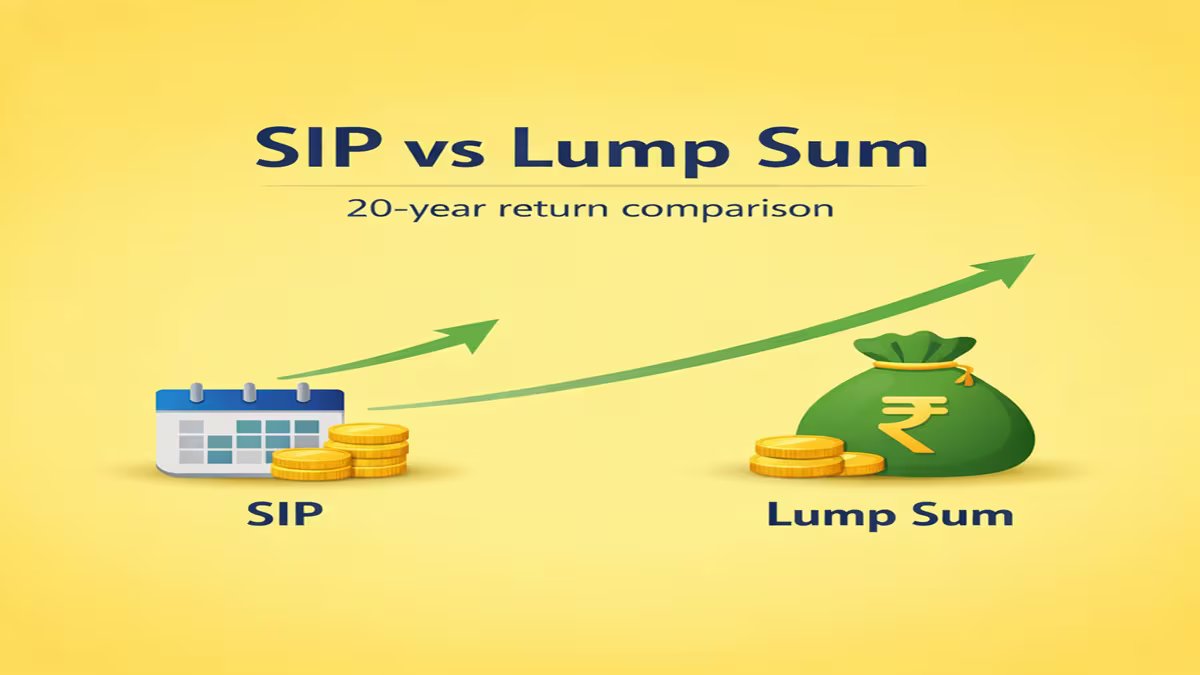
    When it comes to long-term wealth creation, mutual fund investors often face one key question: SIP (Systematic Investment Plan) or lump sum — what works better? To answer this, let’s compare a modest Rs 1,000 monthly SIP with a Rs 1 lakh lump sum investment over a long 20-year period, assuming a reasonable 15% annualised return for both.

    Why assume 15% CAGR for 20 years?

    The assumption of 15% CAGR over 20 years is not aggressive, especially for long-term equity investors. An analysis of around 300 active equity mutual funds from 15 of India’s largest fund houses shows that over a dozen funds have delivered more than 15% CAGR (up to 18%) in lump sum investments over 20 years and more than two dozen funds have generated over 15% CAGR via SIP routes in the same period

    These top-performing funds belong mainly to midcap, flexicap, multicap, value, and sectoral/thematic categories. So this clearly indicates that with proper research and fund selection, 15% long-term returns are achievable, making it a fair benchmark for this comparison.

    How SIP and lump sum investing work

    SIP allows investors to invest a fixed amount at regular intervals—usually monthly. It is popular among salaried and first-time investors as it helps build discipline, averages market volatility, and does not require a large upfront amount.

    Lump sum investing, on the other hand, involves investing a large amount at one go. It works best when investors have surplus funds and a long investment horizon, allowing compounding to do the heavy lifting over time.

    Rs 1,000 monthly SIP for 20 years at 15% CAGR

    Monthly investment: Rs 1,000

    Total period: 20 years (240 months)

    Total invested amount: Rs 2,40,000

    Estimated returns at 15% CAGR: Rs 10,87,073

    Total value after 20 years: Rs 13,27,073

    This shows how even a small monthly amount, invested consistently, can grow into a sizeable corpus over time thanks to compounding.

    Rs 1 lakh lump sum investment for 20 years at 15% CAGR

    One-time investment: Rs 1,00,000

    Investment period: 20 years

    Estimated returns at 15% CAGR: Rs 15,36,654

    Total value after 20 years: Rs 16,36,654

    Here, Rs 1 lakh grows over 16 times in 20 years, highlighting the power of long-term compounding when a lump sum is invested early.

    SIP vs lump sum: Which has the edge?

    From a pure return perspective, there isn’t a huge difference in CAGR — top equity funds have delivered around 18% CAGR in both SIP and lump sum modes. However, SIP investing does have a practical edge:

    Lower entry barrier: Rs 1,000 per month is far more manageable than arranging Rs 1 lakh upfront

    Market volatility advantage: SIPs average out market ups and downs over long periods, even during bear phases

    Better suitability for small investors: Many retail investors find SIPs easier to sustain

    More funds with 15%+ SIP returns: Historically, a higher number of funds have crossed the 15% mark through SIP investing compared to lump sum

    That said, investors with surplus funds and a long horizon may still benefit from lump sum investing—especially during market corrections.

    Summing up…

    Both SIP and lump sum investing can create substantial wealth over 20 years. A Rs 1,000 SIP can grow into over Rs 13 lakh, while a Rs 1 lakh lump sum can cross Rs 16 lakh at 15% CAGR. The right choice ultimately depends on cash flow, risk comfort, and investment discipline. For most small and first-time investors, SIP remains the more practical and stress-free route.

    Disclaimer: The above content is for informational purposes only. Mutual Fund investments are subject to market risks. Please consult your financial advisor before investing.


    Source link

    Share. Facebook Twitter Pinterest LinkedIn Tumblr Telegram Email

    Related Posts

    SIP vs PPF in 2026: Why flexible investing beats the 70:30 rule for balanced wealth creation

    April 29, 2026

    Rs 6,000 SIP: Can It Make You A Crorepati Before 50?

    April 28, 2026

    SIP vs PPF: Why the real decision lies in allocation, not choice

    April 27, 2026
    Leave A Reply Cancel Reply

    Top Posts

    The Shifting Landscape of Art Investment and the Rise of Accessibility: The London Art Exchange

    September 11, 2023

    Charlie Cobham: The Art Broker Extraordinaire Maximizing Returns for High Net Worth Clients

    February 12, 2024

    JPMorgan says 3 trends are quietly reshaping the $19.5 trillion ETF market. If you hold index funds or ETFs, here’s what’s coming

    May 1, 2026

    The Unyielding Resilience of the Art Market: A Historical and Contemporary Perspective

    November 19, 2023
    Don't Miss
    Mutual Funds

    Kotak MF temporarily suspends 4 international funds – Business News

    May 1, 2026

    Kotak Mutual Fund (MF) has temporarily suspended the subscription of its four international funds with…

    How equity funds are positioned in a broader mutual fund investment journey

    May 1, 2026

    JPMorgan says 3 trends are quietly reshaping the $19.5 trillion ETF market. If you hold index funds or ETFs, here’s what’s coming

    May 1, 2026

    Who won money in Norfolk in the May 2026 Premium Bonds?

    May 1, 2026
    Stay In Touch
    • Facebook
    • Twitter
    • Pinterest
    • Instagram
    • YouTube
    • Vimeo
    EDITOR'S PICK

    Trump freezes $2.1 billion in funds for Chicago in shutdown standoff

    October 3, 2025

    Michigan State Pension Fund Adds $6.6M in Bitcoin ETFs

    July 26, 2024

    SPY breadth and underperforming bonds

    August 11, 2024
    Our Picks

    Kotak MF temporarily suspends 4 international funds – Business News

    May 1, 2026

    How equity funds are positioned in a broader mutual fund investment journey

    May 1, 2026

    JPMorgan says 3 trends are quietly reshaping the $19.5 trillion ETF market. If you hold index funds or ETFs, here’s what’s coming

    May 1, 2026
    Most Popular

    🔥Juve target Chukwuemeka, Inter raise funds, Elmas bid in play 🤑

    August 20, 2025

    💵 Libra responds after Flamengo takes legal action and ‘freezes’ funds

    September 26, 2025

    ₹50 lakh retirement corpus: How to invest in SCSS, mutual funds, equities and other assets — CA offers tips

    April 16, 2026
    © 2026 Fund Focus News
    • Get In Touch
    • Privacy Policy
    • Terms and Conditions

    Type above and press Enter to search. Press Esc to cancel.