

What is ethical investing?
Ethical investing is an umbrella term for all approaches to investing that consider ethical values as well as financial returns.
The term also covers issues including, but not limited to, climate change, workers’ rights, gender equality, arms, tobacco and gambling, when selecting companies and other assets.
Traditionally, ethical investing meant not investing in certain companies that contravened your beliefs.
More recently, however, it’s expanded to include focusing on companies that make a positive real-world impact, or investing in firms in order to help them reduce their negative impacts.
Here we explain the various approaches and how to avoid ‘greenwashing’.
Please note: the content contained in this article is for information purposes only and does not constitute financial or investment advice.
What makes an investment ethical?
The Financial Conduct Authority (FCA) ‘anti-greenwashing’ rule has banned funds from using language like ‘sustainable’, ‘green’, or ‘responsible’ without the means to justify it.
Here we’ve detailed the main approaches, which can be combined:
Exclusionary
Where you don’t invest in companies or assets that clash with your goals. For example, your fund may decide not to invest in companies that extract fossil fuels.
Similar to the FCA’s Sustainability Focus fund label (see below).
- Pros: You know that your money won’t be going into certain industries.
- Cons: You’ve got fewer companies to choose from, and those remaining may have a neutral rather than positive impact.
Impact
Where you invest in companies to produce a measurable real-world impact. For example, your fund may invest in companies that make wind turbines to increase the percentage of power generated by them.
Similar to the FCA’s Sustainability Impact fund label.
- Pros: Your money should have a real-world impact.
- Cons: You’ve got fewer companies to choose from, and the real-world impact might not be achieved.
Stewardship
Where you invest in companies to make them more positive, such as via votes at annual general meetings. For example, your fund may invest in fossil fuel producers to encourage them to spend more on renewable solutions and reduce their fossil fuel operations.
Similar to the FCA’s Sustainability Improvers fund label.
- Pros: You can invest in a wider variety of companies.
- Cons: Your money could be going into activities you’re not comfortable with and, if in a fund, you’re dependent on the fund manager to vote and put pressure on companies.
What does ESG mean?
ESG (environmental, social and governance) was once a catch-all term for ethical investing.
But investors should view it with suspicion.
At its minimum, an ESG investment fund could simply consider the effects of, say, climate change on the companies it holds, without doing anything to stop climate change.
Or it could mean assessing companies on ESG factors while ignoring their overall negative impact.
For example, we found an ESG-branded fund that invests in the top 25 precious metal mining companies when ranked on ESG criteria. Yet these companies are still causing substantial damage, just doing better than other mining companies.
How can you invest ethically?
If you’ve got limited time or investment experience, you could ask an independent financial adviser (IFA) to choose investments for you, at a cost. Use an IFA that’s part of the UK Sustainable investment and Finance Association.
A cheaper alternative is to use a robo-adviser platform that offers a portfolio of funds based on your attitude to risk.
If you’re happy to make your own investment decisions, you’ve got several options:
Picking shares
You could buy shares in individual companies with which you agree, but building a balanced portfolio this way is very labour intensive.
Bear in mind that investment platforms tend to charge transaction costs each time you buy or sell a share, so frequent tinkering can damage returns.
Investment funds and trusts
Investment funds or investment trusts enable you to invest in hundreds or potentially thousands of companies at once.
Soon, UK funds will be able to use regulator-backed labels (see below) stating what sort of ethical approach they take.
Actively managed funds, where a fund manager or team picks the investments, charge higher fees.
Passively managed funds tend to charge lower fees but rely on indices and/or data to decide what to invest in.
- Find out more: Are fund charges eating into your returns?
Bonds, gilts and cash
There are a number of fixed-income investments, such as bonds, available for more risk-averse investors, and these include green and ethical bonds.
The UK government now issues green gilts, where proceeds are directed towards a range of environmental projects.
If part of your portfolio is in cash, choose a savings account with a more sustainable provider, using our rankings.
- Find out more: Britain’s greenest banks
New FCA sustainable fund labels
Fund managers can use labels that identify their fund as one of the following:
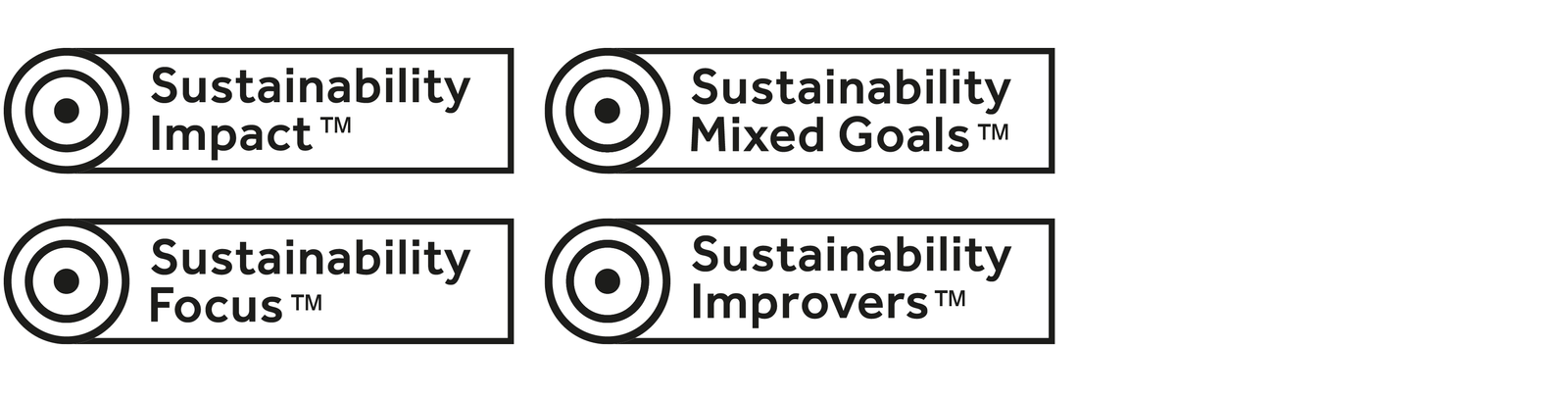
- Sustainability impact – funds that invest in assets directly making a positive impact.
- Sustainability focus – funds that invest in assets meeting a robust, evidence-based standard of sustainability.
- Sustainability improvers – funds that invest in assets that have the potential to meet a robust, evidence-based standard of sustainability.
- Sustainability mixed goals – funds with this label invest in a mix of the above styles.
At least 70% of the assets held in a fund must be invested according to the sustainability objective set out by the fund’s manager, which must fall into one of the above four categories.
The remaining 30% of assets can’t be in conflict with the objective, although they don’t have to meet it exactly. For example, a fund might need cash or other assets for liquidity.
Fund managers support the companies they’re invested in to meet whichever sustainability objective they’ve set out.
For passively managed funds tracking an index, the index must itself align with the criteria of the label.
Will ethical investments make you money?
There are no guarantees in investing, so you should only put in money you can afford to lose.
Investing in line with your morals won’t necessarily make you worse off than investing in a standard fund, and trying to compare the performance of ethical and non-ethical investments is increasingly irrelevant – due to the huge variety of ethical investments and approaches.
Instead, look at the individual company, fund or investment trust you’re considering investing in and compare with the sector it’s in – for instance, UK equities funds.
Do make sure that your portfolio is sufficiently balanced to shield you from market downturns. Also check you’re not paying over the odds in fund fees.
What are the best investment platforms for ethical investors?
Not all investment platforms give investors the same amount of resources to choose investments that line up with their morals.
Some tools available to help you see what’s going on inside of funds are filters that narrow down available investments to those making ESG claims or showing the top 10 holdings of funds so you can see the types of company they invest in.
A couple of platforms have additional features that aren’t found elsewhere. Interactive Investor is the only platform to provide a specialist list of recommended sustainable funds – the ACE40. This chooses the best-performing ethical funds and classifies them into whether they ‘avoid’ certain industries like mining or tobacco, ‘consider’ ESG factors, or ‘embrace’ companies focused on delivering positive social or environmental impact.
Aviva also has the Investment Preference Tool ,which presents you with several issues – for example, high-impact fossil fuels or unfair employment practices – and allows you to choose which types of company to exclude from the funds.
You can take a look at our individual brand reviews of investment platforms to see what tools are on offer with each provider – although we haven’t reviewed the impact of the platforms themselves this time. You can find detailed research in this area by Ethical Consumer.
- Find out more: Best investment platforms in the UK 2026
How can you find out if a fund meets your ethical standards?
- Read the factsheet – Every fund and investment trust will have a factsheet, which tells you some basics like how risky an investment is and, where relevant, what the fund’s ethical policy is. Some investment platforms will also spell out this ethical policy in their description of the fund.
- Read third-party analysis – You can search for funds or trusts through your investment platform, through Morningstar or through Fund EcoMarket, a search engine for ethical funds. Also check how the fund manager has voted at company annual general meetings. Share Action often reports on this, and many fund managers publish their voting decisions.
- Check the labels – The Financial Conduct Authority has introduced four labels to standardise the language used in this area, so you don’t get stuck investing in things you don’t agree with against your knowledge.
- Ask a financial adviser – If you don’t want to pick investments yourself, an independent financial adviser can help. Look for one who is part of the UK Sustainable Investment and Finance Association.