
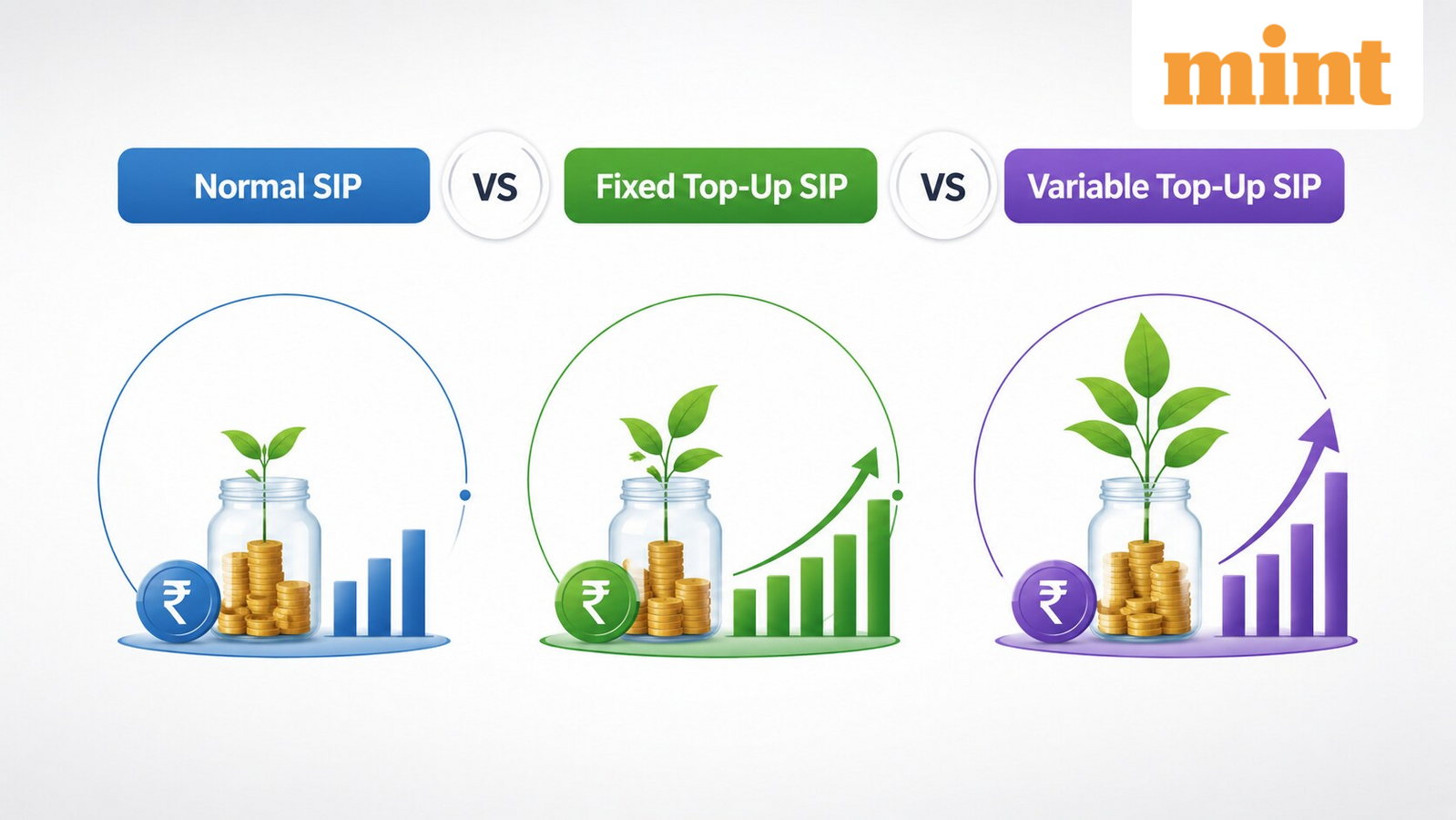
Starting a SIP is just a first step towards long-term wealth creation. However, as incomes grow over time, investors who gradually increase their SIP contributions can potentially build a much larger corpus than those who continue investing the same amount.
An analysis by WhiteOak Capital Asset Management comparing normal SIP, fixed top-up SIP, and variable top-up SIP strategies in the BSE Sensex TRI highlights just how powerful this approach can be.
While a regular ₹10,000 monthly SIP generated substantial wealth over the past 25 years, investors who increased their contributions annually accumulated significantly larger corpuses.
What do these 3 SIP strategies mean?
1. Normal SIP
A normal SIP means investing a fixed amount every month throughout the investment period. In this case, the investor contributes ₹10,000 every month without any increase.
2. Fixed top-up SIP
In a fixed-top-up SIP, the monthly SIP amount increases by a fixed amount each year. In the analysis, the SIP starts at ₹10,000 per month and increases by ₹1,000 every year.
3. Variable top-up SIP
A variable top-up SIP increases the SIP amount by a fixed percentage every year. In this study, the SIP rises by 10% annually.
For example, under a 10% annual top-up SIP, the monthly investment starts at ₹10,000 in the first year and increases to ₹11,000 in the second year. In the third year, it rises to ₹12,100 per month, and in the fourth year, it increases further to ₹13,310 per month.
The wealth creation difference becomes visible over time
The data shows that the gap between the three strategies remains relatively small over shorter periods but widens drastically as the investment horizon increases.
5-year period: Limited difference
Over the last five years, a normal SIP investor contributing ₹10,000 every month would have invested ₹6 lakh. As of May 2026, the investment would have grown to ₹6.95 lakh.
A fixed top-up SIP investor, who increased the monthly SIP by ₹1,000 every year, would have invested ₹7.20 lakh over the same period. The investment would have grown to ₹8.18 lakh.
Meanwhile, a variable top-up SIP investor, who increased the SIP amount by 10% annually, would have invested ₹7.33 lakh and accumulated a corpus of ₹8.30 lakh as of May 2026.
Although the top-up strategies created higher wealth, the difference was not substantial because there was limited time for the higher contributions to compound.
10-year period: Top-up advantage starts emerging
The picture changes over a 10-year horizon. A regular SIP investor contributed ₹12 lakh and accumulated ₹21.26 lakh by the end of May 2026. The fixed top-up SIP generated a corpus of ₹28.52 lakh from investments of ₹17.4 lakh.
Meanwhile, the variable top-up SIP recorded a gain of ₹30.49 lakh, with investments of ₹19.12 lakh.
The difference of nearly ₹9 lakh between the normal SIP and variable top-up SIP highlights how increasing contributions can accelerate wealth creation over longer periods.
15-year period: Compounding magic works
The wealth gap becomes much more visible after 15 years.
- Normal SIP corpus: ₹46.35 lakh
- Fixed top-up SIP corpus: ₹68.59 lakh
- Variable top-up SIP corpus: ₹78.96 lakh
While the normal SIP investor contributed ₹18 lakh, the variable top-up investor contributed ₹38.13 lakh, which is more than double the investment amount. The result was a portfolio that was almost ₹33 lakh larger than the regular SIP corpus.
20-year period: Variable top-up pulls ahead
At the 20-year mark, the normal SIP strategy created a corpus of ₹85.70 lakh from investments of ₹24 lakh.
The fixed top-up SIP accumulated ₹138.29 lakh, while the variable top-up SIP reached ₹174.40 lakh.
The variable top-up strategy delivered more than double the corpus of the normal SIP. But the return differential was minimal. XIRRs across all three strategies remained around 11%.
This suggests that the larger corpus was driven primarily by higher investments and compounding.
25-year period: The difference becomes massive
The most striking difference appears over a 25-year period. A regular ₹10,000 monthly SIP required a total investment of ₹30 lakh and grew to ₹227.28 lakh, delivering an XIRR of 13.73%.
In comparison, a fixed top-up SIP, where the monthly contribution increased by ₹1,000 every year, involved a total investment of ₹66 lakh and accumulated ₹344.28 lakh, with an XIRR of 13.25%.
The variable top-up SIP, which increased the contribution by 10% annually, generated the largest corpus of ₹445.86 lakh from total investments of ₹118.02 lakh, despite a slightly lower XIRR of 12.94%.
The biggest winner was the 10% variable top-up strategy, which accumulated nearly ₹4.46 crore and almost doubled the wealth generated by a regular SIP.
Why top-up SIPs work so well?
As income grows, investors can allocate more money to their mutual fund investments rather than maintaining the same contribution for decades. Each annual increase gets invested for many years, allowing the additional contributions to participate in market growth and compounding.
The analysis shows that while a regular SIP can create significant wealth over the long term, investors who increase their SIP contributions periodically are much more likely to build a larger corpus.
For investors whose salaries typically rise each year, a variable top-up SIP may be the most practical approach, as it aligns investments with income growth. Hence, wealth creation is not just about staying invested for longer periods; it is also about increasing investments as earning capacity grows.
Disclaimer: This is purely for educational/ informational purposes and should not be taken as any sort of investment advice. Always consult a SEBI-registered advisor before making any investment decisions.