

Oil ETFs offer investors a way to participate in the crude oil market without directly trading futures contracts or physically storing oil. These exchange-traded funds provide a relatively liquid and accessible avenue to express views on the price of oil, whether you’re betting on rising prices amid geopolitical tensions or hedging against inflation. The energy sector is constantly influenced by factors like global demand, production levels, and geopolitical events.
These factors, coupled with evolving energy policies, create a dynamic landscape for oil investments. This article will explore some of the most relevant oil ETFs to watch in 2026, highlighting their unique strategies, top holdings, and potential investment opportunities in the ever-changing oil market. We’ll examine ETFs that are gaining attention due to their unique approaches, exposure to different oil benchmarks, and cost-effectiveness, providing you with the insights needed to make informed decisions.

Below, we’ll examine a selection of popular and well-regarded Oil ETFs, highlighting their key characteristics to help you make informed investment decisions. We will consider factors such as expense ratios, top holdings, and reasons to consider each ETF.
1. United States Oil Fund (USO)
- Expense Ratio: 0.79%
- Top Holdings: Primarily near-month West Texas Intermediate (WTI) crude oil futures contracts.
- Why Consider It? USO is the most well-known and actively traded oil ETF, offering direct exposure to WTI crude oil prices. It’s a popular choice for short-term trading and expressing immediate views on oil.
2. United States Brent Oil Fund (BNO)
- Expense Ratio: 0.88%
- Top Holdings: Primarily near-month Brent crude oil futures contracts.
- Why Consider It? BNO provides exposure to Brent crude oil, the international benchmark, which often trades at a premium or discount to WTI. This ETF allows investors to diversify their oil exposure geographically.
3. United States 12 Month Oil Fund (USL)
- Expense Ratio: 0.82%
- Top Holdings: WTI crude oil futures contracts spread across the next 12 months.
- Why Consider It? USL mitigates the impact of contango (when future prices are higher than spot prices) compared to USO and BNO, by spreading its holdings across a longer period. This makes it suitable for investors with a longer-term outlook.
4. ProShares K-1 Free Crude Oil Strategy ETF (OILK)
- Expense Ratio: 0.65%
- Top Holdings: Collateralized swap agreements on WTI Crude Oil.
- Why Consider It? OILK offers exposure to the price of crude oil by investing in swap agreements rather than futures contracts. This structure is intended to avoid the issuance of a K-1 tax form, simplifying tax reporting for investors.
5. Invesco DB Oil Fund (DBO)
- Expense Ratio: 0.78%
- Top Holdings: Light Sweet Crude Oil (WTI) futures
- Why Consider It? DBO seeks to track changes, whether positive or negative, in the level of the DBIQ Optimum Yield Crude Oil Index Excess Return(TM) (the “Index”). The Index is intended to reflect the change in market value of the crude oil sector. The single futures contract in the Index is the light sweet crude oil (WTI) futures contract traded on the New York Mercantile Exchange (NYMEX). DBO is a potentially tax-efficient vehicle.
Discover the capabilities of InvestingPro for evaluating Oil ETFs. Access in-depth analysis of Oil ETFs, easily compare expense ratios, 1-year, and 5-year returns: InvestingPro provides real-time data, historical performance charts, and advanced analytical tools to help you make smarter investment choices. With InvestingPro, you can screen ETFs based on various factors, including expense ratios, trading volume, and holdings diversification, empowering you to identify the funds that best align with your investment goals.
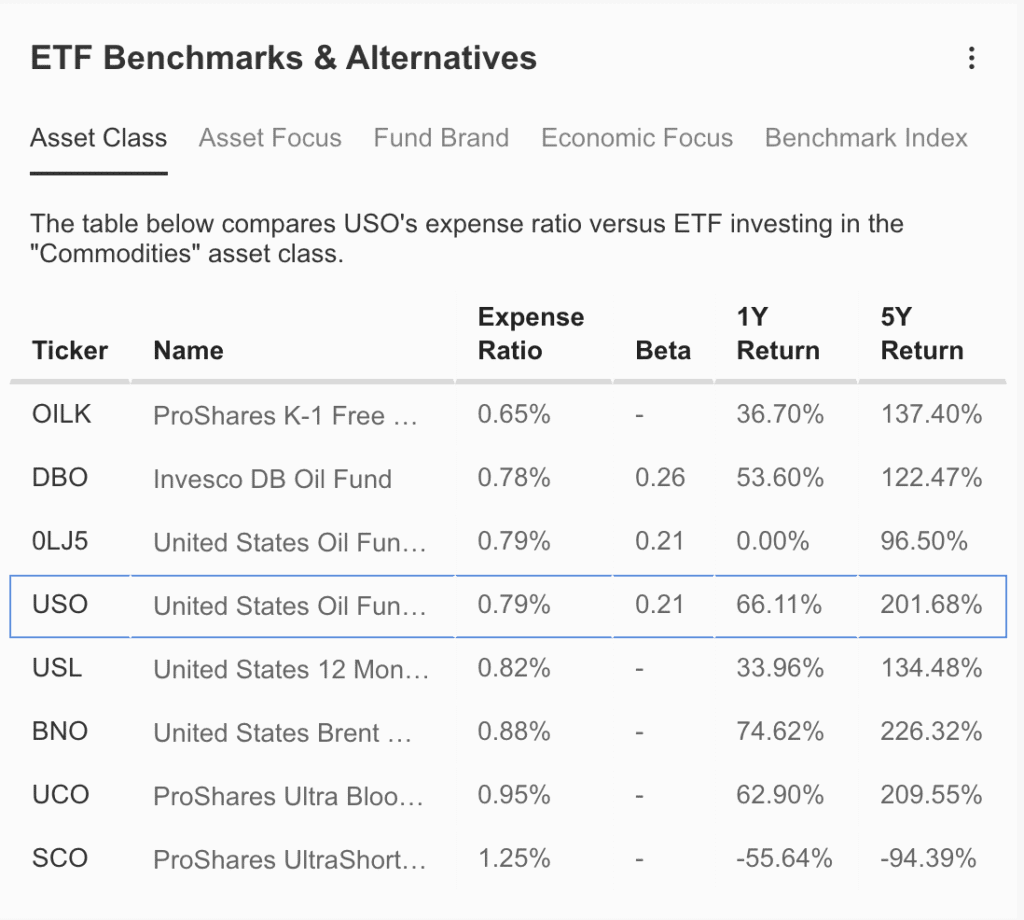
Investing in Oil ETFs is generally considered a sound strategy for investors seeking broad market exposure, diversification, and relatively low risk. However, it’s crucial to assess your financial goals, risk tolerance, and time horizon before investing.
Potential Benefits
- Inflation Hedge: Oil ETFs can serve as a hedge against inflation, as oil prices often rise during inflationary periods.
- Geopolitical Events: They can be used to capitalize on geopolitical events that impact oil supply and demand.
- Diversification (Within Energy): Provides exposure to oil, a key energy commodity.
- Liquidity: Oil ETFs offer relatively high liquidity, making it easy to buy and sell shares.
- Short-Term vs. Long-Term: Can be used for both short-term trading and longer-term strategic investments, depending on the ETF and your outlook.
Potential Risks
- Volatility: Oil prices are notoriously volatile, leading to significant price swings in Oil ETFs.
- Contango: Contango, where futures prices are higher than spot prices, can erode returns in some oil ETFs (especially those heavily reliant on near-month futures).
- Geopolitical Risk: Geopolitical events can have unpredictable and drastic impacts on oil prices.
Choosing the right Oil ETF requires careful analysis and consideration of several factors. Here are some essential steps to help you find the top Oil ETFs for your investment needs:
1. Analyze Holdings
Understand the underlying assets of the ETF. Is it focused on WTI or Brent crude? Does it use futures contracts or other derivatives? Is it spread along multiple months to alleviate contango issues? Knowing the composition is crucial for understanding the ETF’s price behavior.
2. Check Expense Ratios
Lower expense ratios mean more of your investment return is retained. Compare expense ratios across different oil ETFs, but also consider the ETF’s tracking performance and trading volume.. Use InvestingPro to assess and compare expense ratios.
3. Review Performance and Liquidity
Historical performance provides insights into how the ETF responds to market conditions. Ensure sufficient trading volume for easy buying and selling. Compare the performance against oil price benchmarks, but consider the tracking error. Within InvestingPro you can find and compare the performance across ETF benchmarks.
4. Understand the Theme
Does the ETF focus on short-term oil price movements, or does it use a strategy to mitigate contango for longer-term exposure? Align the ETF’s strategy with your investment goals and time horizon.
What’s the difference between WTI and Brent crude oil?
WTI is a US-based benchmark, while Brent is an international benchmark. Their prices can differ due to supply, demand, and logistical factors.
What is Contango, and how does it affect oil ETFs?
Contango is when futures prices are higher than spot prices. This can erode returns in ETFs that roll over near-month futures contracts, as they are forced to repeatedly buy higher-priced contracts.
Are oil ETFs suitable for long-term investing?
Some oil ETFs, like USL, are designed to mitigate contango, making them potentially more suitable for longer-term investing. However, oil prices are inherently volatile, so consider your risk tolerance.
Can I lose money investing in oil ETFs?
Yes, you can lose money investing in oil ETFs. Oil prices are subject to market risk and can decline significantly.
What are the tax implications of investing in oil ETFs?
Taxation of oil ETFs can be complex and may depend on the structure of the ETF. Some ETFs may issue a K-1 form. Always consult a tax professional.