
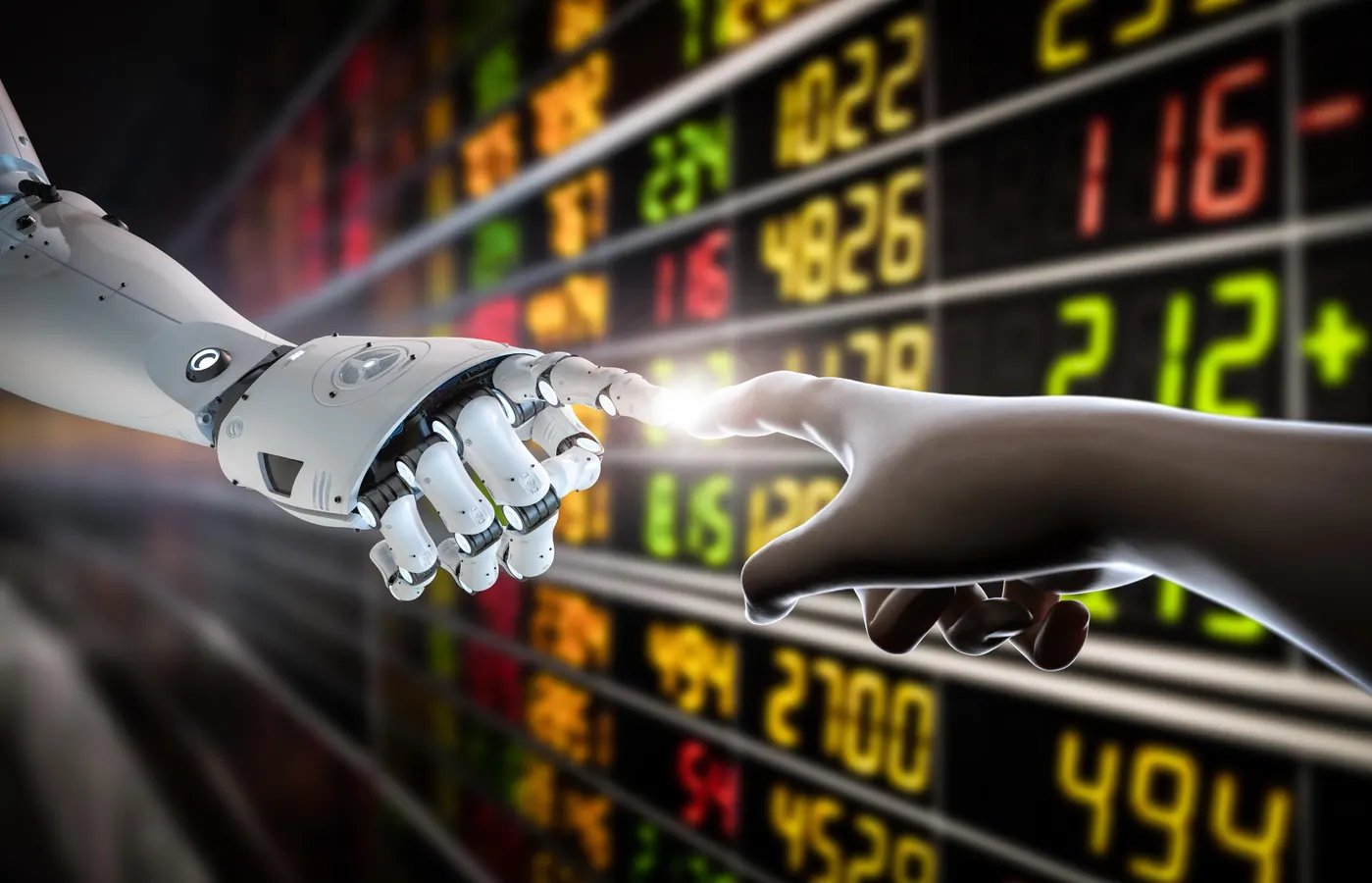
A new wave of ETFs is handing every investment decision to AI. The promise is bold, but the track record is still being written.
getty
In 2017, an ETF called AIEQ launched with a bold premise: Let artificial intelligence, powered by IBM’s Watson, pick stocks. It was among the first funds to hand the core of its investment process to a machine. Eight years later, AIEQ has provided a real-world stress test for the concept and the results have been humbling. The fund has trailed the S&P 500 for much of its existence, delivering roughly half the cumulative return of a simple index fund over comparable periods.
Now, a new entrant is making an even more ambitious claim.
Finq, an AI-focused fintech firm backed by Palo Alto Networks founder and billionaire Nir Zuk, has launched two actively managed ETFs — AIUP and AINT — that it describes as “the first SEC-registered funds managed entirely by AI.” Unlike earlier AI-powered funds where human portfolio managers retained the ability to override the machine’s recommendations, Finq says its AI framework handles all stock selection, weighting, and rebalancing. Humans oversee the system’s governance and regulatory compliance, but they do not interfere with individual investment decisions.
“AI in the investment world has the capacity to outperform humans,” said Eldad Tamir, Finq’s founder and CEO, in the company’s press release. “Finq is built on a data-only system that makes investment decisions without the disadvantages aligned with human fear, greed, urgency to act and other disabling human attributes.”
It’s a confident thesis. But if history is any guide, confidence alone hasn’t been enough.
A Meaningful Distinction
Finq’s structural argument, though, is worth examining on its terms. Most funds that describe themselves as “AI-powered” use machine learning as a research tool — scanning sentiment data, processing earnings reports and flagging patterns.
The final call still rests with a human portfolio manager. AIEQ’s prospectus, for instance, notes that its managers may exercise discretion alongside AI’s recommendations.
Finq draws a sharper line. Its proprietary model produces a daily relative ranking of every stock in the S&P 500. AIUP takes long positions in the highest-ranked names. AINT pairs long positions in top-ranked stocks with short positions in the lowest-ranked, maintaining a dollar-neutral posture designed to profit from relative performance rather than overall market direction. The long/short structure, in particular, brings a hedge fund-like strategy into a retail-accessible ETF wrapper — something that is genuinely uncommon at this price point.
The involvement of Zuk also adds a different dimension. Zuk, whose cybersecurity company Palo Alto Networks commands a market capitalization north of $125 billion, has been a longtime backer of Finq, injecting $6 million into the company in 2023.
He built that fortune on a core bet that automated systems could identify network threats faster and more reliably than human analysts. Finq is making the same bet about financial markets — that pattern recognition at machine speed, stripped of human emotion, can find value that traditional managers miss.
The Performance Question
Whether that bet pays off remains an open question— and not just for Finq.
A report from the European Securities and Markets Authority (ESMA), the EU’s financial markets regulator, found that funds using AI in their investment process showed no significant performance advantage over non-AI funds since 2022, whether measured by average returns or risk-adjusted returns. The finding held even when researchers controlled for fund size, age, and geographic focus.
Another study examining AI-driven investment funds in the U.S. painted an even starker picture: All 11 funds fully reliant on artificial intelligence — with no human intervention — underperformed the S&P 500. Six of them posted outright losses during what was otherwise a bullish market. The average annual return across those fully autonomous funds was negative 1.8%.
However, it’s worth noting that this performance gap isn’t unique to AI. The S&P Indices Versus Active (SPIVA) Mid-Year 2025 Scorecard found that only about 14% of actively managed U.S. large-cap funds beat the S&P 500 over a ten-year window.
Bryan Armour, director of ETF and passive strategies research at Morningstar, noted that just 33% of active strategies outperformed their index counterparts in the twelve months through June 2025 — a period marked by tariff disputes, elections and geopolitical swings. “Conventional wisdom says active managers should better manage those complexities,” Armour said, “but performance says otherwise.”
If human managers struggle to beat the index, the question becomes whether removing humans entirely solves the problem or compounds it.
The Behavioral Case
There is one argument in Finq’s favor that the data supports convincingly. Dalbar’s 2025 Quantitative Analysis of Investor Behavior report found that the average equity fund investor earned 8.5 percentage points less than the S&P 500 in 2024. The culprit, according to Dalbar, wasn’t poor stock selection — it was psychology. Loss aversion, herd behavior and panic selling consistently erode returns.
An AI doesn’t panic. It doesn’t chase headlines or sell at the bottom. That behavioral advantage is real, even if it hasn’t yet translated into consistent outperformance.
The CFA Institute’s 2025 publication AI in Asset Management: Tools, Applications, and Frontiers frames the current moment carefully: AI should “supplement professional judgment,” not replace it. A companion piece in the Financial Analysts Journal described portfolio managers evolving from decision-makers into “stewards of machine-driven models” — a role that sounds closer to oversight than obsolescence.
What Investors Should Watch
Finq’s ETFs carry the risks you’d expect from a new, untested strategy. The prospectus flags high portfolio turnover, model and data risk, concentration in a limited number of holdings and — for AINT specifically — the theoretically unlimited losses that come with short selling. There is no performance history to evaluate. These funds are, for now, a thesis in search of a track record.
The broader question is whether fully autonomous AI-managed investing represents a genuine structural shift or simply the latest iteration of a promise the industry has been making, and failing to deliver on, for nearly a decade. The answer, as always in investing, will come from returns. And for now, the clock is just starting.