

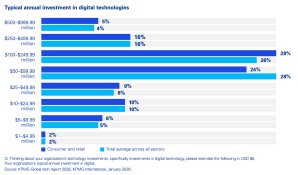
Consumer and retail businesses are aggressively funding digital transformation, with over half of the companies polled saying they are investing $50 million or more annually in digital technologies, according to the 2026 KPMG Global Tech Report.
This heavy spending is yielding massive dividends, as 45 percent of retailers and brands polled report financial returns of $250 million or more from their digital investments. Sector confidence is remarkably high, with 93 percent of leaders believing advanced systems will drive their future competitive advantage and 86 percent saying these tech investments frequently improve overall business value.
“There is no single objective for this investment but rather the pursuit of wide-ranging, value-enhancing use cases right across the business, from foundational efficiencies to transformative innovation,” the report’s authors said. “This may take shape in a host of ways: to boost productivity, achieve sharper demand forecasting, hone dynamic pricing, improve inventory management, streamline the supply chain—or to elevate brand storytelling at the front end and deliver hyper-personalized experiences to the consumer.”
Either way, the researchers said that however the investments are used will create new value for companies.
Meanwhile, the report’s authors said artificial intelligence has rapidly moved from experimental pilots to core operations, with 90 percent of retailers and brands already integrating AI agents into their daily workflows. Looking ahead, 74 percent of retail executives expect to deploy AI at scale within the next 12 months, which places the sector among the fastest across all industries to fully adopt the technology.
This shift is also rewriting job descriptions. Ninety-four percent of those polled said they agree that managing an AI agent will become a necessary workforce skill in the next five years, while 87 percent said they are actively adding AI-native roles to their hiring strategies.
“The real opportunity for AI in retail is not replacing people but augmenting their capabilities and changing the economics of growth,” said James Wilson, partner, technology consulting, advisory, and head of consumer and retail at KPMG in Singapore. “As AI becomes embedded across planning, forecasting, marketing and supply‑chain decisions, retailers can scale revenue far faster than costs, allowing existing teams to manage significantly greater complexity without proportional increases in headcount.”
Wilson said this will enable operating costs (particularly in non‑customer‑facing functions) to grow sub‑linearly as the business scales. “While physical store labor and operational complexity still add cost, AI materially improves productivity and margin leverage by shifting employees from transactional tasks to higher‑value advisory roles, Wilson said, adding that when deployed responsibly, “this can drive sustainable performance, stronger teams and greater customer trust.”
Other findings in the report include that retailers are prioritizing backend foundations, with 52 percent planning major budget increases for cybersecurity and 49 percent boosting data investments. However, the report highlights a critical gap in execution. Only 48 percent of retail firms polled said they currently measure tech performance against actual business plans, which compares to a 65 percent average across other industries.
To overcome this, industry experts at KPMG urge businesses to simplify their “cluttered application stacks.” The report’s authors said this can free up an estimated 15 percent of operational capacity and establish the clean data foundations required for secure, long-term AI success.