

Close Menu
Fund Focus News
    Facebook X (Twitter) Instagram
    Trending
    • Skip the Bank: Host Says Short-Term Bond Funds Offer Superior Yields Without the Savings Account Risk
    • Flexi-cap funds stay cautious on mid-, small-caps  – Market News
    • 5 Mutual Funds with the Best Risk-Adjusted Returns – Money Insights News
    • Women investors hold over ₹11 trillion AUM in mutual funds in FY26, account for 35% of inflows: CAMS
    • NS&I Premium Bonds update as expert warns savers ‘potentially missing out’
    • ICICI Prudential launches two new iSIF Long Short funds: What makes these strategies stand out?
    • Mutual fund investing basics: Understanding compounding with calculators
    • Bitcoin ETFs See Heavy Outflows as Macro Pressure Hits Risk Appetite
    Facebook X (Twitter) Instagram
    Fund Focus News
    • Home
    • Bonds
    • ETFs
    • Funds
    • Investments
    • Mutual Funds
    • Property Investments
    • SIP
    Fund Focus News
    Home»Mutual Funds»The hidden ratios that reveal a fund’s true potential
    Mutual Funds

    The hidden ratios that reveal a fund’s true potential

    October 22, 2025


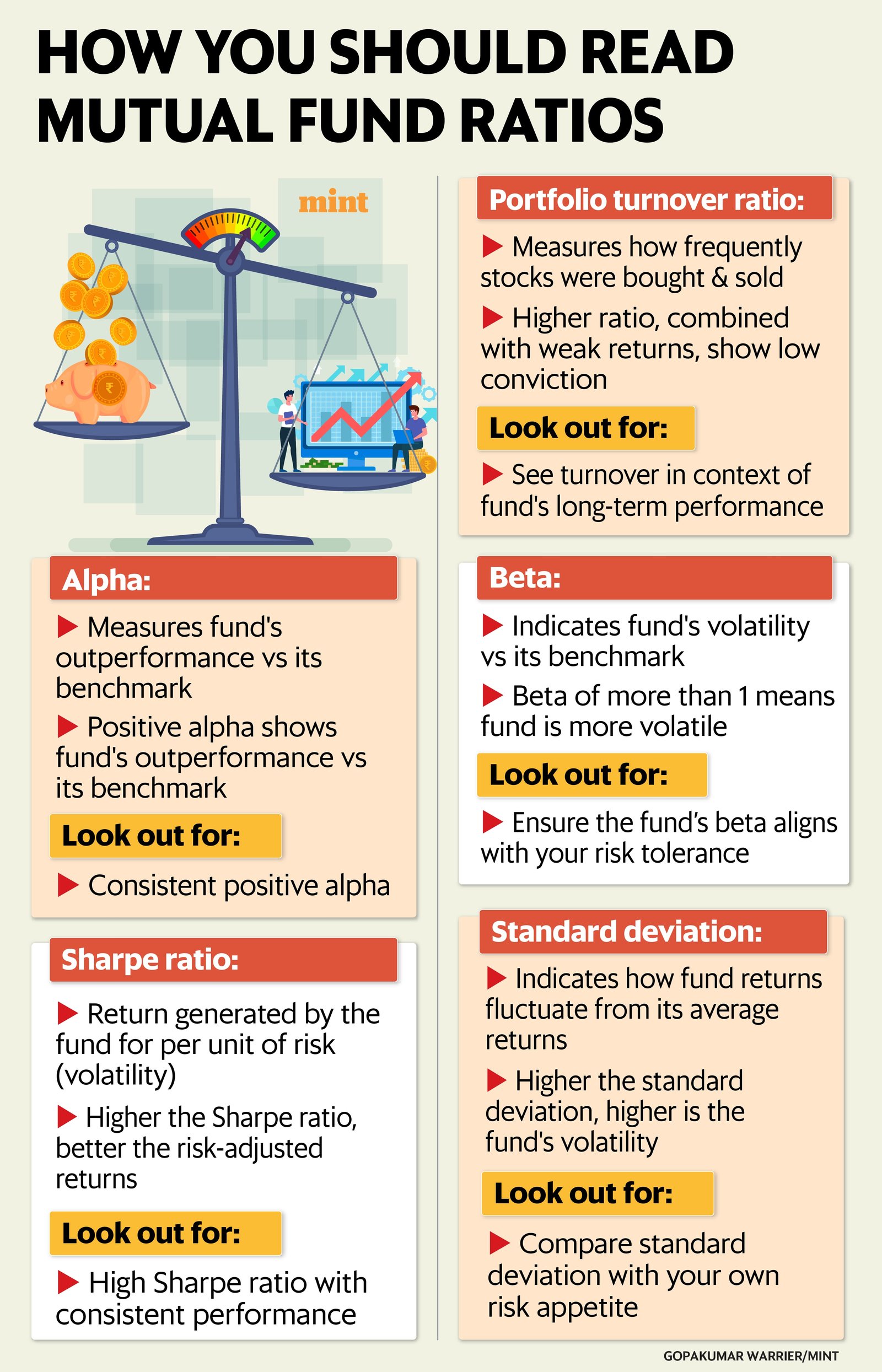
    When it comes to mutual funds, picking schemes purely based on past returns may not be the smartest move. Returns tell only part of the story. Especially if you’re a do-it-yourself investor, your research should go one step further—to the ratios hidden in fund factsheets. These metrics reveal how well a fund performs relative to risk, cost, and conviction.

    Alpha

    Returns in isolation don’t say much—you need to see how the fund fares against its benchmark. Alpha measures a fund manager’s skill in generating extra returns over what’s expected for a given risk level.

    A positive alpha means the manager has beaten the benchmark, while a negative one signals underperformance. Consistent alpha generation reflects the active manager’s ability to deliver long-term outperformance.

    This is an important measurement, especially in an actively-managed fund. If the fund is not generating alpha, it can’t justify the higher asset management fee it charges to the investor. In such cases, investor is better-off with a passively-managed fund that simply tracks the benchmark index.
    Gopalkumar Warrier/Mint

    View Full Image

    Gopalkumar Warrier/Mint

    Sharpe ratio

    The Sharpe ratio helps investors understand how well a fund has performed relative to the risk taken. It measures the additional returns a fund generates over a risk-free return—typically from short-dated government Treasury bill—for every unit of volatility. Simply put, a higher Sharpe ratio means better risk-adjusted performance.

    “As and when valuations of mid and small-cap stocks run up, the Sharpe ratio rises. In growth cycles, this would mean efficient risk-taking,” says Ravi Kumar TV, co-founder of Gaining Ground Investment Services.

    Mid- and small-cap funds often show high Sharpe ratios during bull markets because stocks in these segments get re-rated faster. But don’t rely on this number alone—a temporarily high ratio may simply reflect short-term aggressive bets paying off.

    Portfolio turnover ratio

    Fund managers in active schemes frequently buy and sell securities to generate returns. The portfolio turnover ratio captures how often this happens—essentially, how much of the portfolio changes over a year.

    A low turnover ratio reflects a buy-and-hold approach driven by conviction. A high ratio isn’t necessarily bad—it could mean the manager is agile and locking in profits. However, excessive churning increases transaction costs and may erode long-term gains.

    It could also point to low conviction if frequent trading fails to deliver better returns.

    Beta

    If you just wish to know how much more risky your fund is versus its benchmark index, look at the beta.

    A beta of 1 means the fund moves in line with the index. A beta greater than 1 implies higher volatility, while less than 1 means a more defensive stance.

    All passively managed funds like index funds and ETFs have a beta of 1 because they are designed to mirror the index. But if an actively managed fund’s beta is also close to 1, it may indicate that the fund’s portfolio largely overlaps with the benchmark— meaning it’s behaving just like an index fund, while charging active management fees.

    Standard deviation

    The standard deviation measures how much a fund’s returns fluctuate. A higher number means more volatility; a lower one indicates steadier performance.

    Investors seeking stability should prefer funds with lower standard deviations. However, this ratio doesn’t differentiate between good and bad volatility—it counts both gains and losses as deviations from the average.

    For instance, if your fund’s returns surge well above average, standard deviation still treats that as volatility—just as it does when returns drop below average.

    Bottomline

    These ratios — alpha, sharpe, turnover, beta, and standard deviation — form the guiding blocks of risk-aware investing. They don’t replace performance numbers but complete the picture, helping you choose funds that generate smarter, steadier returns.


    Source link

    Share. Facebook Twitter Pinterest LinkedIn Tumblr Telegram Email

    Related Posts

    Flexi-cap funds stay cautious on mid-, small-caps  – Market News

    May 19, 2026

    5 Mutual Funds with the Best Risk-Adjusted Returns – Money Insights News

    May 19, 2026

    Women investors hold over ₹11 trillion AUM in mutual funds in FY26, account for 35% of inflows: CAMS

    May 19, 2026
    Leave A Reply Cancel Reply

    Top Posts

    The Shifting Landscape of Art Investment and the Rise of Accessibility: The London Art Exchange

    September 11, 2023

    Charlie Cobham: The Art Broker Extraordinaire Maximizing Returns for High Net Worth Clients

    February 12, 2024

    Skip the Bank: Host Says Short-Term Bond Funds Offer Superior Yields Without the Savings Account Risk

    May 19, 2026

    The Unyielding Resilience of the Art Market: A Historical and Contemporary Perspective

    November 19, 2023
    Don't Miss
    Funds

    Skip the Bank: Host Says Short-Term Bond Funds Offer Superior Yields Without the Savings Account Risk

    May 19, 2026

    © Tessa Chung from capturenow and PashaIgnatov from Getty Images The math on parking cash…

    Flexi-cap funds stay cautious on mid-, small-caps  – Market News

    May 19, 2026

    5 Mutual Funds with the Best Risk-Adjusted Returns – Money Insights News

    May 19, 2026

    Women investors hold over ₹11 trillion AUM in mutual funds in FY26, account for 35% of inflows: CAMS

    May 19, 2026
    Stay In Touch
    • Facebook
    • Twitter
    • Pinterest
    • Instagram
    • YouTube
    • Vimeo
    EDITOR'S PICK

    Motilal Oswal Mutual Fund launches Contra Fund with contrarian investment strategy

    May 16, 2026

    Mutual funds boost holding in Delhivery to all-time high in September quarter

    October 16, 2024

    Best Mutual funds: These 10 flexi cap schemes gave over 23% annualised return in the past five years. Check list

    April 22, 2025
    Our Picks

    Skip the Bank: Host Says Short-Term Bond Funds Offer Superior Yields Without the Savings Account Risk

    May 19, 2026

    Flexi-cap funds stay cautious on mid-, small-caps  – Market News

    May 19, 2026

    5 Mutual Funds with the Best Risk-Adjusted Returns – Money Insights News

    May 19, 2026
    Most Popular

    🔥Juve target Chukwuemeka, Inter raise funds, Elmas bid in play 🤑

    August 20, 2025

    💵 Libra responds after Flamengo takes legal action and ‘freezes’ funds

    September 26, 2025

    ₹9000 monthly SIP can help you retire at 45 with ₹2 lakh monthly pension

    May 5, 2026
    © 2026 Fund Focus News
    • Get In Touch
    • Privacy Policy
    • Terms and Conditions

    Type above and press Enter to search. Press Esc to cancel.