
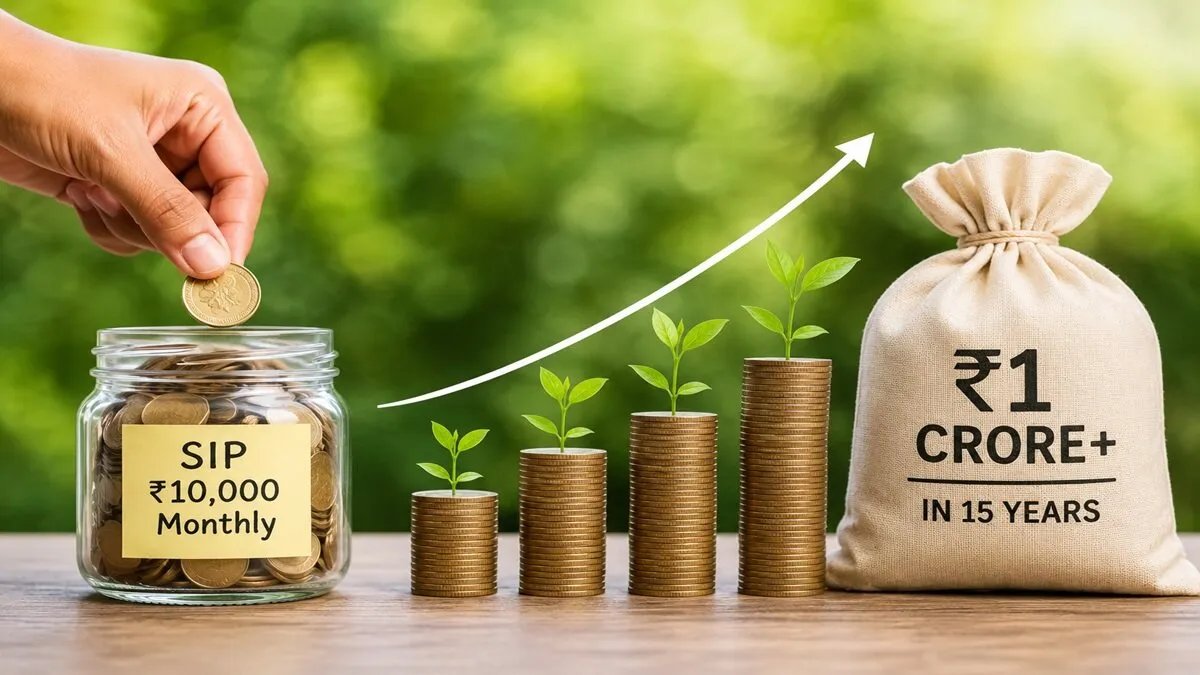
Can a single mutual fund turn a modest monthly SIP into a crore? Over the past 15 years, only one active equity mutual fund has managed to cross that milestone.
An analysis of more than 1,200 active equity mutual fund regular plans listed on Value Research shows that Nippon India Small Cap Fund is the only scheme that converted a Rs 10,000 monthly SIP into more than Rs 1 crore over the last 15 years. The analysis covers active equity schemes across categories, including diversified, thematic/sectoral and international funds.
We have considered regular plans because most direct plans are not old enough to have a complete 15-year performance history.
It is worth noting that Nippon India Mutual Fund has several schemes that have consistently outperformed their respective category averages as well as their benchmarks over different time periods.
However, among all the fund house’s 127 schemes, it is Nippon India Small Cap Fund that stands out for delivering the strongest long-term SIP performance. Even when compared with over 1,200 active equity funds, it remains the only scheme to deliver more than 20% annualised returns in both SIP and lump sum investments over 15 years, according to data available on Value Research.
The only fund to cross the Rs 1 crore SIP mark
Launched on September 16, 2010, Nippon India Small Cap Fund is benchmarked against the NIFTY Smallcap 250 TRI and primarily invests in small-cap companies.
Its biggest achievement is its long-term SIP performance.
A monthly SIP of Rs 10,000 for 15 years (total investment of Rs 18 lakh) would have grown to around Rs 1.21 crore, thanks to an XIRR of 22.68%.
The fund has also delivered an impressive 21.52% CAGR on lump sum investments over the same period.
15-year SIP performance
| Investment type | Return | Investment | Value after 15 years |
| Monthly SIP | 22.68% XIRR | Rs 10,000 per month | Around Rs 1.21 crore |
SIP performance across different time periods
| Period | XIRR |
| 3 years | 11.01% |
| 5 years | 17.46% |
| 10 years | 21.50% |
| 15 years | 22.68% |
Lump sum returns
| Period | CAGR |
| 3 years | 18.26% |
| 5 years | 20.20% |
| 10 years | 20.69% |
| 15 years | 21.52% |
Nippon India Small Cap Fund – more details
Nippon India Small Cap Fund currently manages Rs 74,604 crore in assets (as on May 31, 2026), making it one of the largest small-cap funds in the country.
The fund has a base expense ratio of 1.13% (as on June 30, 2026) and has delivered an annualised return of 20.09% since launch.
| Particulars | Details |
| Launch date | September 16, 2010 |
| Category | Small Cap Fund |
| Benchmark | NIFTY Smallcap 250 TRI |
| Riskometer | Very High |
| Assets under management | Rs 74,604 crore |
| Base expense ratio | 1.13% |
| Return since launch | 20.09% annualised |
Risk profile: High returns have come with high volatility
Like all small-cap funds, Nippon India Small Cap Fund comes with a Very High Risk rating. Small-cap stocks can deliver superior returns over long periods, but they also tend to witness sharper corrections during market downturns.
Some of the fund’s key risk-adjusted metrics are shown below.
| Metric | Value | What it means |
| Mean Return | 18.72% | Average annual return over the period analysed |
| Standard Deviation | 19.38% | Indicates volatility in returns |
| Sharpe Ratio | 0.67 | Measures return generated for each unit of total risk |
| Sortino Ratio | 0.97 | Measures returns after considering downside risk |
| Beta | 0.87 | Slightly less volatile than the benchmark |
| Alpha | 1.66 | Indicates excess returns generated over expected returns based on risk |
(Source: Value Research)
Overall, the numbers suggest that while the fund has experienced meaningful volatility, it has also rewarded investors with superior risk-adjusted returns over the long term.
Where does the fund invest?
Sector allocation
| Sector | Allocation |
| Industrials | 24.86% |
| Financials | 15.10% |
| Consumer Discretionary | 14.29% |
| Materials | 13.46% |
| Healthcare | 9.49% |
Stock Weight
| Stock | Weight |
| BHEL | 1.93% |
| HDFC Bank | 1.77% |
| TD Power Systems | 1.71% |
| MCX | 1.57% |
| APAR Industries | 1.55% |
| SBI | 1.55% |
| NLC India | 1.29% |
| Karur Vysya Bank | 1.23% |
| Zydus Wellness | 1.17% |
| Tube Investments of India | 1.05% |
Don’t invest based on past returns alone
While the fund’s long-term track record looks exceptional, investors should remember that past performance does not guarantee future returns.
In fact, despite its stellar 15-year record, the fund has delivered only around 4% return over the last one year, highlighting how mutual fund performance can vary significantly over shorter periods. Market cycles, economic conditions, interest rates, earnings growth, valuations and investor sentiment all influence how a fund performs in any given year.
A fund that tops the charts over one period may underperform in another.
What should investors check before choosing a mutual fund?
Instead of selecting a fund solely because it delivered the highest historical return, investors should evaluate multiple factors, including:
-Whether the fund suits their financial goal and investment horizon.
-Their own risk appetite, especially in the case of small-cap funds.
-Consistency of performance across market cycles rather than one exceptional period.
-Risk-adjusted measures such as Sharpe Ratio, Sortino Ratio and Alpha.
-Portfolio quality, sector diversification and concentration.
-Fund manager’s investment approach and track record.
-Expense ratio and investment process.
-Asset allocation within their overall portfolio.
For investors who can stay invested for the long term and withstand periods of volatility, small-cap funds can create substantial wealth. However, they should form only a part of a well-diversified portfolio rather than the entire investment strategy.
Disclaimer: This article is for informational and educational purposes only and should not be construed as investment advice or a recommendation to buy, sell or hold any mutual fund scheme. Mutual fund investments are subject to market risks, and past performance is not indicative of future results. The returns and performance figures mentioned are based on historical data and may not be repeated in the future.
Small-cap funds are inherently volatile and may witness sharp fluctuations in the short term. Investors should not choose a mutual fund solely based on past returns or rankings. Before investing, consider your financial goals, investment horizon, risk appetite, asset allocation, fund strategy, expense ratio and portfolio suitability. Read all scheme-related documents carefully and, if required, consult a qualified financial advisor before making any investment decision.
Every financial journey has a turning point. What’s yours?
Financial Express is launching a new series highlighting real experiences with money, investments, and the taxman. Did a sudden tax rule catch you off guard? Did a piece of financial advice change your life? Your story could provide invaluable, practical lessons for thousands of fellow taxpayers. Share your experience with us. We respect your privacy: no stories will be featured without a direct conversation and your full consent. Thank you.