

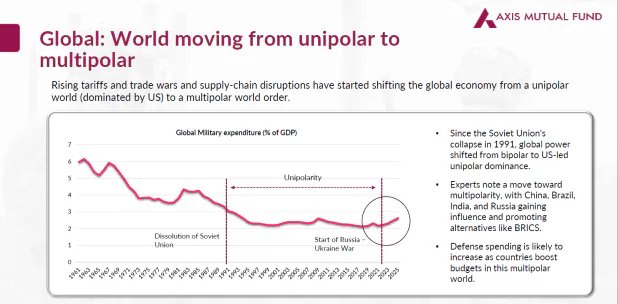
The world is transitioning from a US-dominated unipolar world to a multipolar world order, in which nations such as India, China, Brazil, and Russia are gaining influence.
This shift, combined with rising supply-chain disruptions, trade wars, and regional conflicts, has forced countries to significantly increase their security investments.
Source: Axis Nifty India Defence Index Fund Presentation
To address potential multi-front security challenges and modernise its armed forces, the Indian government has prioritised defence spending. India’s defence budget has grown consistently at a CAGR of 9%, expanding 2.7 times from Rs 2.53 trillion (tn) in FY14 to Rs 6.81 tn in FY26.
The fund cites a core reason for investing in this theme: the massive policy shift toward Atmanirbhar Bharat. The government has introduced a clear policy intent to build, innovate, and export from India.
Consequently, India’s defence production has nearly doubled from Rs 800 billion (bn) in FY20 to Rs 1,500 bn in FY25. The government aims to double this again to Rs 3,000 bn by 2029.
As a result, historically one of the world’s largest defence importers, India is becoming a major exporter of military equipment, shipping to over 85 nations, including the US and France. India’s defence exports have surged from less than Rs 10 bn in 2014 to a record Rs 384.2 bn in FY26.
The government aims to export defence products worth Rs 500 bn by 2029, including major platforms such as BrahMos missiles, artillery guns, helicopters, and naval vessels.
Axis Nifty India Defence Index Fund provides exposure to the defence sector. It provides a low-cost way to gain exposure to a concentrated basket of defence stocks.
Let’s dig deeper into what exactly this fund offers, and where it fits in a portfolio.
About Axis Nifty India Defence Index Fund
The fund is an open-ended index mutual fund tracking the Nifty India Defence Total Return Index (TRI).
- New Fund Offering Period: The New Fund Offering opens on 10 April 2026 and closes on 24 April 2026.
- Investment Objective: To provide returns, before expenses, that correspond to the performance of the Nifty India Defence TRI, subject to tracking error.
- Minimum Investment: Rs 100 and in multiples of Re 1 thereafter.
- Expense Ratio: The base expense ratio is 0.9% (maximum limit).
- Exit Load: 0.25% if units are redeemed or switched out within 15 days from the date of allotment; nil thereafter.
- Plans: Regular and Direct Plans are available, both offering only the Growth option.
Given the fund tracks the Nifty India Defence TRI index, it’s important to examine it more closely.
Understanding the Nifty India Defence TRI
The fund strategy is purely passive, aiming to mimic the Nifty India Defence Total Return Index (TRI).
The Nifty India Defence TRI is a thematic benchmark that tracks the performance of portfolio stocks that broadly represent the defence theme in India. It serves as the primary underlying benchmark for the Axis Nifty India Defence Index Fund.
The index follows a stringent, rule-based method to accurately capture the defence sector’s growth.
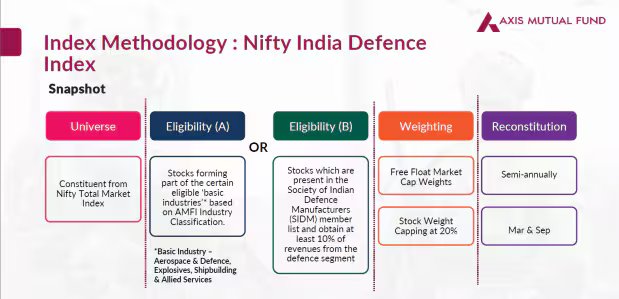
- Universe: To be eligible, a stock must first be a constituent of the Nifty Total Market Index.
- Industry Classification: The stock must belong to one of the specific ‘basic industries’ under the AMFI Industry Classification: Aerospace & Defence, Explosives, or Shipbuilding & Allied Services.
- Revenue and Association: Companies must be listed as members of the Society of Indian Defence Manufacturers and must derive at least 10% of their revenue directly from the defence segment.
- Liquidity and Trading: Individual constituents must have a trading frequency of at least 80% and an average impact cost of 1% or less over the previous six months to ensure sufficient liquidity.
- Weighting and Caps: This index is free float, with a minimum of 10 stocks. To prevent excessive concentration, the weight of a single stock cannot exceed a 25%, and the cumulative weight of the top three stocks is also restricted at 65% at any given time.
Source: Axis Nifty India Defence Index Fund Presentation
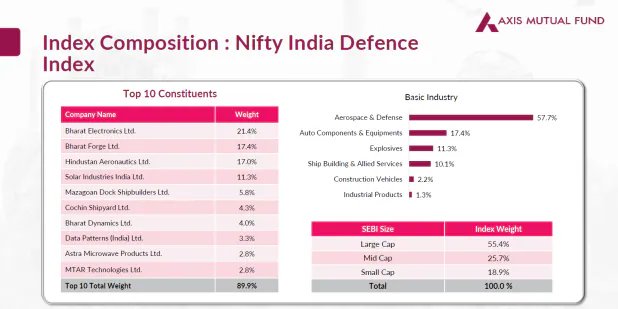
As of February 2026, the index exhibits a well-defined structure across market capitalisations and specialised sub-sectors.
Portfolio Constituents
The index is heavily weighted toward Large-cap stocks (55.4%), followed by Mid-cap stocks (25.7%) and Small-cap stocks (18.9%). In industry allocation, Aerospace & Defence is the dominant industry, making up 57.7% of the index.
This is followed by Auto Components & Equipment (17.4%), Explosives (11.3%), Ship Building & Allied Services (10.1%), Construction Vehicles (2.2%), and Industrial Products (1.3%).
The top 10 constituents account for 89.9% of the index’s total weight, making it highly concentrated. The heaviest individual holdings are Bharat Electronics (21.4%), Bharat Forge (17.4%), Hindustan Aeronautics (17%), and Solar Industries (11.3%).
Other notable stocks are Mazagon Dock Shipbuilders (5.8%), Cochin Shipyard (4.3%), Bharat Dynamics (4%), Data Patterns (3.3%), Astra Microwave Products (2.8%), and MTAR Technologies (2.8%).
Source: Axis Nifty India Defence Index Fund Presentation
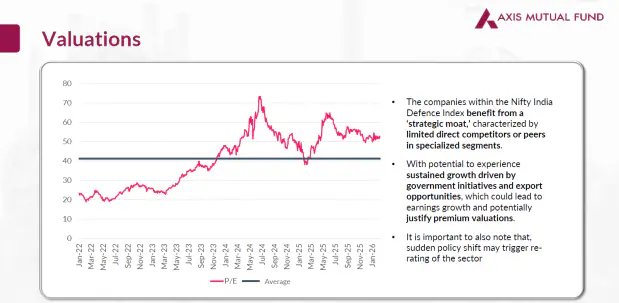
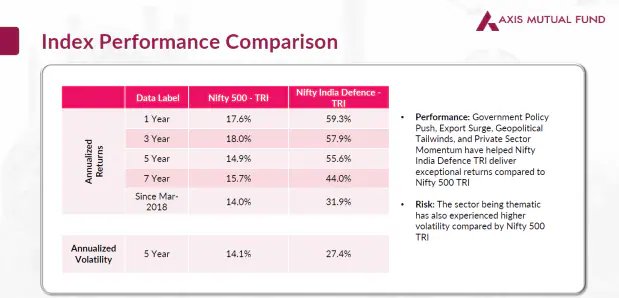
As the index is thematic and concentrated, it has higher volatility compared to diversified indices. The 5-year annualised volatility for the Nifty India Defence TRI stands at 27.4%, which is higher than the Nifty 500’s 14.1%. The valuation is also at a significant premium.
The fund house states that the companies in the index have ‘strategic moat,’ meaning they have very few direct competitors or peers in their specialized segments.
This lack of competition, combined with sustained growth driven by government localisation initiatives (Atmanirbhar Bharat) and growing export opportunities, helps fuel earnings growth. This can potentially justify the premium valuation multiples these stocks currently trade at.
Source: Axis Nifty India Defence Index Fund Presentation
Asset Allocation of the Axis Nifty India Defence Index Fund
The fund employs a passive investment strategy, meaning the fund managers do not actively pick stocks based on market timing but instead aim to track the benchmark index. The scheme’s fundamental strategy is to mirror the benchmark index as closely as possible.
It achieves this replication by investing in all constituent stocks in the same weightage and proportions they represent in the underlying index. This ensures the fund provides pure, unbiased thematic exposure to the defence sector without active fund manager intervention.
A snapshot of asset allocation:
- Equities: The scheme allocates 95-100% of its assets to stocks in the Nifty India Defence Index.
- Liquidity and Debt: The remaining 0-5% are allocated to money market instruments, short-term deposits, and units of debt and liquid mutual fund schemes. This portion is strictly maintained to meet liquidity needs and operational expenses.
- Derivatives: The fund may take exposure to equity derivatives of the index constituents up to 15% of its net assets. These derivatives will not be used for speculative trading. Instead, they are strictly utilised for short-term and defensive considerations.
The fund will use derivatives only when an underlying index security is temporarily unavailable for purchase, when it is not available in sufficient quantities in the cash market, or to facilitate smooth portfolio rebalancing during corporate actions.
- The fund prohibits short selling and will not invest in overseas securities, ADRs/GDRs, securitized debt, InvITs, or complex/bespoke debt products.
To potentially generate additional income for the portfolio, the scheme may engage in Stock Lending (maximum of 20% of the scheme’s net assets), subject to strict risk management limits.
To mitigate counterparty concentration risk, no more than 5% of net assets may be deployed in stock lending to any single counterparty or intermediary.
Portfolio Rebalancing and Tracking Error
Tracking error is a key metric in evaluating an index fund’s efficiency. It’s the standard deviation of the difference between an investment portfolio’s returns and its benchmark index’s returns over time.
It indicates how closely a passive fund (like Axis Defence Index Fund) tracks its target index (Nifty India Defence TRI). A low tracking error shows high replication. A high tracking error shows significant deviation.
As a standard practice, the lower the tracking error, the better.
Factors such as illiquid constituent stocks, index providers changing stock constituents during periodic reviews, or lags in receiving large dividends can increase this fund’s tracking error.
To mitigate this, the fund manager aims to rebalance the scheme within 7 calendar days of the deviation, provided the deviation is due to exogenous factors or periodic index reviews.
Still, the fund’s objective is to maintain an annualised tracking error (based on past one-year rolling data) of no more than 2%.
The target tracking difference is just 50 basis points higher than the actual total expense ratio incurred. Tracking difference is the gap between the fund’s return and the index’s return over a period.
Suppose that if the index delivers 15% in a year, but the fund delivers 14.2%, the tracking difference is -0.8%. This gap is usually negative because costs drag returns down. The fund aims to maintain this difference to just 50 bps.
The greater the tracking difference, the larger the gap between fund returns and index returns, typically reflecting underperformance due to costs. Therefore, generally, lower tracking error and tracking difference are considered optimal.
Historical Return
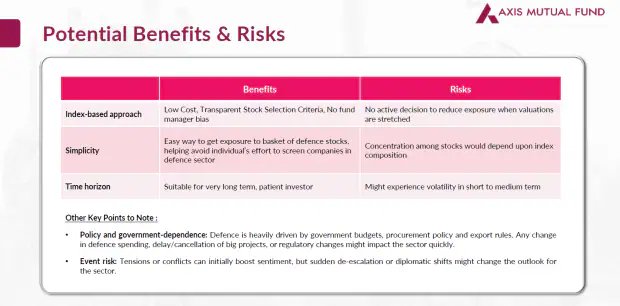
Although the fund could enable investors to participate in the defence theme, such thematic funds are highly risky. The risk of a slowdown in order inflows remains, which could compress earnings.
In this case, the passive nature of the fund means there is no active fund manager intervention to reduce exposure if warranted.
Source: Axis Nifty India Defence Index Fund Presentation
This is why the fund carries a very high risk-o-meter rating, given its thematic concentration and reliance on government policies.
Source: Axis Nifty India Defence Index Fund Presentation
That said, the index has delivered strong historical returns, significantly outperforming the broader Nifty 500 TRI. This is driven by strong government policy pushes, surging exports, and geopolitical tailwinds.
As of February 2026, the index has delivered an annualised return of 59.3% over 1 year, 57.9% over 3 years, 55.6% over 5 years, and 31.9% since its inception on 31 March 2018.
Fund Managers
The scheme is co-managed by Nandik Malik (15 years’ experience) and Rohit Gautam (18 years’ experience). As this is a passively managed index fund, the fund managers will not actively pick stocks or time the market.
Instead, they aim to replicate the underlying Nifty India Defence TRI, manage liquidity needs, and minimise tracking error.
Bottomline
Axis Nifty India Defence Index Fund sits at the intersection of geopolitics, policy intent, and industrial transformation.
As the world shifts toward a multipolar order and countries raise defence spending, India’s push for self-reliance and exports is reshaping the sector’s trajectory.
The fund offers a clean, rules-based way to participate in this shift.
However, its concentrated exposure and inherent volatility mean outcomes will remain linked to execution, order flows, and policy continuity.
Investors need to balance the structural opportunity with valuations and cyclicality, viewing this as a play on a long-term theme rather than a linear growth story.
Happy investing.
Disclaimer: This article is for information purposes only. It is not a stock recommendation and should not be treated as such. Learn more about our recommendation services here…
The website managers, its employee(s), and contributors/writers/authors of articles have or may have an outstanding buy or sell position or holding in the securities, options on securities or other related investments of issuers and/or companies discussed therein. The content of the articles and the interpretation of data are solely the personal views of the contributors/ writers/authors. Investors must make their own investment decisions based on their specific objectives, resources and only after consulting such independent advisors as may be necessary